The Best Submersible Pond Pump
By The Pond Review · Updated August 2026
Independent editorial guide. We never accept payment for coverage, though we may earn a commission if you purchase through our links.
Quick Take
For most backyard koi and goldfish ponds we'd buy the Pondmaster Pond-Mag, a magnetic-drive pump that sips watts and keeps running for years, sized so its flow at your actual head lands near half your pond's volume per hour through the filter. The number stamped on the box is measured with no lift and no hose, so it isn't the flow your pond gets. Read the curve, not the headline.
The pump you buy runs every hour of every day, so two things decide the real cost: how reliably it keeps running, and how many watts it burns doing it. Peak GPH decides neither. If your waterfall sits high or you need to pass fish solids, step up to an asynchronous pump like the OASE AquaMax or the Aquascape AquaForce. If it's a simple low fall on a tight budget, a cheap high-GPH pump will do, as long as you know what you're giving up.
Below, we match six pumps to pond size, head height, and how hard the pump has to work, from the mag-drive we default to up to the efficiency benchmark. See our picks ↓

Every pump listing leads with one number, gallons per hour, and it's the easiest spec to compare and the least useful one to buy on. That figure is measured on a bench with the pump pushing against nothing, and your pond isn't a bench. Lift the water toward a waterfall, run it through a hose, and the real output drops, often by half.
So we shop pond pumps on the numbers that decide what one costs you over a season: the flow you get at your own head height, the watts the pump draws around the clock, and whether it'll still be running in five years. Here's how to size one honestly, and the six pumps we'd put on ponds from a small water garden to a stocked koi pond.
Why the box GPH is the wrong number to shop on
Walk the pump aisle and every listing shouts gallons per hour, because it's the one spec that's trivial to compare. It's also measured with the pump sitting in open water, lifting nothing and pushing through no pipe. The moment you raise the water toward a waterfall lip and send it down a length of hose, the real output falls, often by half or more. Two pumps wearing the same number on the box can deliver wildly different flow once they're doing your job instead of the lab's.
There's a second problem with peak GPH, and it compounds over time. A pond pump is the one appliance in your yard that never switches off. It runs every hour of every day, all season, often all year. The numbers that decide what it costs you aren't the flow at full tilt but how reliably it keeps running and how many watts it draws to do it. A pump that quits in an August heat wave can cost you a pond full of fish, and one that pulls an extra hundred watts costs you real money every month it runs. The headline GPH tells you nothing about either.
Head height, and the flow you end up with
Head is the vertical distance the pump has to lift water, measured from the pond surface to the top of the falls, plus the drag of the pipe in between. Every foot of rise and every foot of hose eats into the flow. A pump rated for a few thousand GPH at zero head might deliver little more than half of that once it's lifting water five or six feet to a waterfall lip through twenty feet of tubing.
This is why manufacturers publish a flow curve, a small graph that shows output dropping as head climbs, and why the honest listings print the maximum lift right on the box. Read the curve, not the headline. Find your head on the bottom axis, trace up to the line, and read across to the flow you'll see. If a listing gives you only the big zero-head number and no curve, treat that as a reason to be suspicious, not a reason to trust it.
How to size a pump for flow at your head
The arithmetic takes about a minute, and it's the part the box hopes you skip. First, measure your head: the vertical rise from the pond surface to the top of your waterfall, then add roughly a foot of equivalent head for every ten feet of hose to cover friction. A four-foot fall fed by twenty feet of tubing works out to about five or six feet of total head.
Second, decide the flow you want. A common rule is to turn the whole pond over about once an hour, but what matters for the pump is the flow through your filter, and for most gravity and box filters you aim to move roughly half the pond's volume per hour through the media rather than force the entire volume through and overwhelm it. For a 1,500 gallon pond that's around 750 GPH, at your head.
Now put the two together. You aren't shopping for 750 GPH on the box; you're shopping for 750 GPH at five or six feet of head, which means a pump whose zero-head rating is meaningfully higher. That's exactly why a pump like the Pond-Mag, stamped 1,800 GPH, is close to right for a pond that size: at real head it settles into the flow you want. Chase the biggest number instead and you buy a 5,000 GPH pump that forces far too much water through a gravity filter, blows solids straight past the media, and burns twice the watts to do it. Too big is a genuine mistake here, not a safe margin.
Flow per watt is the number that adds up over a year
Because the pump never stops, wattage quietly decides the cost of owning it. The math is blunt. A pump drawing 100 watts more than another, running around the clock, burns about 876 kilowatt-hours more a year. At average U.S. electricity rates that's somewhere near 130 dollars a year, every year, for as long as you run it. That gap is usually larger than the price difference between a cheap pump and a good one, which flips the value question: the efficient pump that looks expensive is often the cheaper pump by its second season.
This is where asynchronous and magnetic-drive pumps earn their place. They move more water per watt than the cheap direct-drive units that pad their GPH numbers, and over a season that efficiency shows up on the electric bill instead of the price tag. The OASE AquaMax Eco Premium is the benchmark we point to here: it moves a lot of water on comparatively few watts, and if you run a pump hard all year, that's the one to price out on running cost, not sticker.
Mag-drive reliability, and what it trades away
Magnetic-drive pumps like the Pond-Mag are built around a simple idea: the motor spins a magnet, and that magnet drags an impeller around with no physical shaft connecting them. One moving part, and no seal between motor and water to wear out and leak. That's why owners run them for years, and why we default to one for a typical backyard pond. Fewer parts that can fail is worth more, over a decade of continuous running, than a bigger number on the box.
The trade is honest and worth knowing. Mag-drive pumps top out at modest head, so a tall waterfall can outrun them, and they don't like solids: fish waste and debris can jam the impeller, so they want a pre-filter or a clean skimmer feed. When you need real lift, or you're pumping dirty water straight from the pond, an asynchronous solids-handling pump is the better tool. The Aquascape AquaForce is built for exactly that job, passing waste that would clog a mag-drive and backed by a long warranty, which is why owners keep naming Aquascape when the talk turns to pumps that last.
Matching a pump to your pond and your filter
For a stocked koi or goldfish pond in the 1,000 to 1,500 gallon range with a modest waterfall, the Pond-Mag is the default: cheap to run, reliable, and sized about right at real head. If your waterfall sits high or your run of hose is long, the Alpine PAL3100 gives you more lift on a still-reasonable 276 watts. If you're feeding a skimmer or a pressure filter and need to pass solids without clogging, the AquaForce is the pick, and the AquaMax is the one to buy if you run hard year-round and want the lowest running cost.
The two budget pumps, the VIVOSUN 5300 and the TotalPond 3600, are for a simple low waterfall or a fountain, where reliability and watts matter less than upfront price. Read their big GPH ratings as zero-head figures that fall off fast, expect to draw more power for the same real flow, and don't put one on a heavily stocked pond you care about. They're honest budget tools for the right job, not the pump we'd trust to run a koi pond all summer.
What we'd put on our own pond
Strip away the marketing numbers and pump buying comes down to three things: the flow you get at your head, the watts you pay for around the clock, and whether the thing keeps running. For most backyard ponds we'd buy the Pond-Mag, size it by reading its curve at our real head rather than the box, and aim for about half the pond's volume per hour through the filter. If we ran the pump hard all year we'd price out the AquaMax on watts and probably pay more up front to save on the bill. And if we needed to lift water high or pass solids, we'd reach for the Alpine or the AquaForce and skip the cheap high-GPH pumps.
One thing worth saying plainly: the advice to just buy the highest GPH you can afford is wrong for almost everyone. A pump that's too big for your pond and filter wastes electricity every hour, drives too much flow through a gravity filter, and buys you nothing your fish can use. Buy the right flow at your head, on the fewest watts, from a pump that'll still be running in five years.
The picks
Products we recommend for this guide.
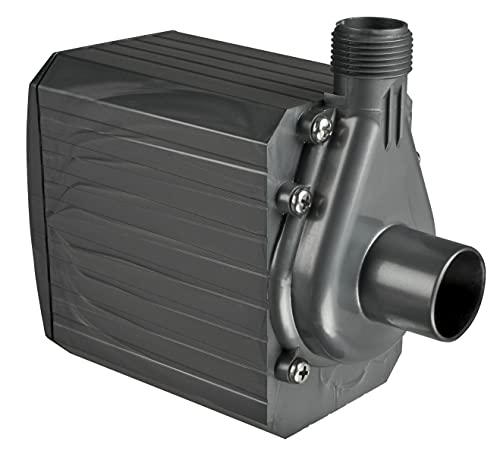
Pondmaster Pond-Mag 1800 Magnetic Drive Pump
A magnetic-drive pump with one moving part and no shaft seal to leak, so it runs for years on modest watts. Read its 1,800 GPH as a zero-head number that lands near what a 1,000 to 1,500 gallon pond wants once you subtract head and hose friction.
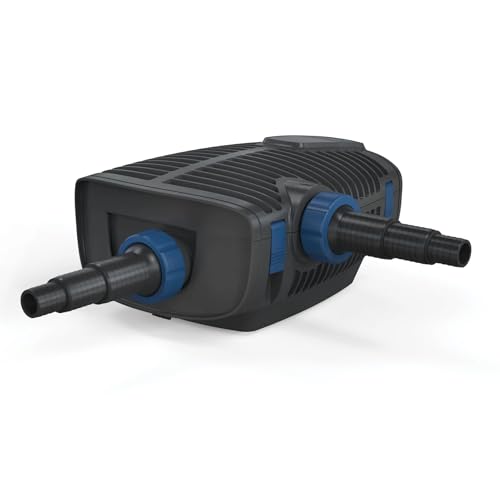
OASE AquaMax Eco Premium Pump
Our flow-per-watt benchmark. OASE's asynchronous motor moves a lot of water on few watts, so it wins over a season on the electric bill rather than the sticker, and it passes solids for a skimmer or waterfall feed. See our full review for the draw.
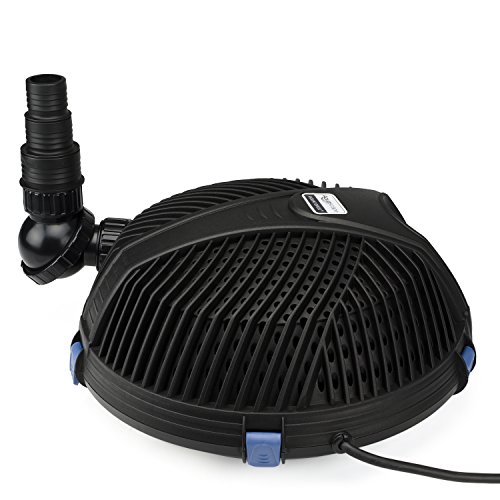
Aquascape AquaForce 1000 Solids-Handling Pump
A solids-handling asynchronous pump built to pass fish waste without jamming, so it feeds a waterfall or pressure filter cleanly. Aquascape backs it with a long warranty, and owners keep naming the brand for pumps that last, not fail mid-summer.

Alpine Corporation PAL3100 Submersible Pump
Rated 3,100 GPH on a 276-watt motor with a tall 21.5-foot maximum lift and a 33-foot cord, so it reaches a raised waterfall on reasonable power. The mid-tier pick when your rise is too high for a mag-drive but you still want sane running watts.

VIVOSUN 5300 GPH Submersible Pond Pump
A high-nominal-GPH pump for a simple waterfall or fountain on a tight budget. Read the 5,300 rating as a zero-head figure that drops fast with lift, and expect to give up the long-run reliability and low draw of a mag-drive or asynchronous pump.

TotalPond 3600 GPH Waterfall Pump
A basic 3,600 GPH pump for a lightly stocked garden pond where simple beats efficient. Fine over a low fall, but the flow falls off quickly with head and it draws more power than a mag-drive, so it costs more to run every month it stays on.
What owners say
Real owner reports from the threads and editorial sources we drew on for this guide.
“Should be a good one , but it's designed for high head applications. 922 watts is a big energy draw. Do you know the head pressure you're working with in the rest of the system? Elevation rise (pond water level to bog water level), size and length of existing plumbing that you're tying into?”
“I'd spend the extra few dollars and go Aquascape - we've had great luck with their pumps.”
“Agreed as with most things you get what you pay for....jebao are usually cheap knock offs of nicer pumps at least in the aquarium hobby. Stuff is junk will never buy a jebao anything.”
“Tetra debris handling pumps are the best. I have 2 - had to replace one but it was 5+ years old. Most dependable of the brands I have tried.”
“I like Laguna brand for all my pumps. Lower power consumption and works forever!”
“I know I see many liking laguna for smaller pumps. I use an Aquascape 2000 that works great with 10 of vertical lift”