Pondmaster Pond-Mag 1800 Review + Verdict for Ponds
By The Pond Review · Updated August 2026
Independent editorial review. We never accept payment for coverage, though we may earn a commission if you purchase through our links.
Verdict
The Pond-Mag 1800 has too few long-run reports on the exact model to judge alone, so we read it as part of the Pondmaster magnetic-drive line, which carries one of the strongest reliability reputations on the pond forums. The pattern is remarkably consistent. Owners describe running various Pondmaster sizes for the better part of a decade or longer without trouble: a keeper with a 2400 Supreme "running for 14 yrs straight 24/7," another who has leaned on a ProLine for eight years of filthy pump-out work where "it's pumped all sorts of crap and never even burps," a third who simply reports "excellent reliability." The counterweight is a single, preventable failure mode. Run one without a pre-filter and grit gets in: as one owner explains, the pumps that die early "have been operated at some point without a pre-filter," the sand "scoring the magnet and impeller surfaces," and even the keeper who got more than twelve years out of a Pondmaster 1200 traced its end to exactly that, noting "if i had used a better filter that pump would still be working." Our read matches the forum's. This is a buy-it-once pump whose only real enemy is the sediment you can screen out, and whose oil-free, controller-free simplicity is what lets it run for years. Keep grit off the impeller and it will likely outlast the pond around it.
Read full take ↓Similar pond pumps
The Danner Pondmaster Pond-Mag 1800 is the pump you buy to stop thinking about pumps. Our verdict is simple: this is the reliability pick. It is an oil-free magnetic-drive return pump, and its whole argument is that it runs, and runs, and keeps running, the pond forums are full of Pondmaster owners a decade in on the same unit, and Danner backs it with a 5-year warranty. Buy it as the pump behind your filter or feeding a modest waterfall on a small-to-mid pond, and it will likely outlast the liner.
Two honest caveats decide the fit. First, the "1,800 GPH" is a zero-head number; Danner's own max lift is 16 feet 6 inches at shut-off, so at a real four-to-six-foot waterfall with tubing and elbows you keep roughly half of the badge. Second, it is a magnetic-drive pump built to move clean water, not a solids-handler, so it wants a pre-filter or a skimmer, or grit will score the impeller. It also draws a published 145 watts around the clock, which is the number budget pumps hide and the one that lets you budget the roughly $200 a year it costs to run. Size it by flow-at-head, keep the grit out, and it will outlast three cheap submersibles.
The short version
What works:
- An oil-free magnetic drive with a 5-year warranty. Owners of the Pondmaster line report 8, 12, even 14 years of 24/7 running on a single pump.
- Danner publishes the specs that matter, 145 watts and a 16.5-foot max head, so you can size real flow and budget the running cost before you buy, instead of guessing.
- Dead simple and serviceable: no external controller to fail, no oil to lose, and the impeller is a cheap replaceable wear part.
What to watch:
- The 1,800 GPH is a zero-head figure. At a real lift with fittings you keep roughly half, so size for your head, not the box.
- It is a clean-water mag-drive, not a solids-handler. Run it behind a pre-filter, a skimmer, or a screened intake or grit will kill it.
- At 145 watts running 24/7 it costs more to run than a DC pump. If the yearly electricity bill matters most to you, price that out first.
Which ponds and setups it fits
Buy the Pond-Mag 1800 as the return pump behind a pressurized or gravity filter, or to feed a modest waterfall or stream, on a pond up to roughly 1,000 gallons at once-an-hour turnover, about 500 gallons of koi once you double the rate for their load. It is happiest sitting in a skimmer box or on a screened intake where it pumps already-clean water, because that is the exact job a magnetic drive is built for and the reason these units last a decade.
Look elsewhere in three cases. If you need to move debris-laden water off a bottom drain, that is a solids-handling pump's job, like the Aquascape AquaForce, not a mag-drive's. If minimizing the running cost matters more than anything, a DC pump such as the Jebao DCP-4000 draws a fraction of the watts. And if you have to push a tall or wide waterfall well past six feet of head, size up to the Alpine PAL3100 or a larger Pond-Mag, because this one runs out of lift where a big fall begins.
The numbers that matter
Start with flow. The "1,800 GPH" is measured at zero head, with the outlet wide open and nothing to lift, and you will never see it. Danner's published max head is 16 feet 6 inches, that is the shut-off height where flow falls to zero, so useful output sits well below both figures. At a four-to-six-foot lift through tubing and a couple of elbows, plan on somewhere in the neighborhood of 900 to 1,200 GPH. Size so that flow-at-head still turns your pond over about once an hour, twice for koi, and the 1,800 reveals itself as a small-to-mid-pond and filter-return pump, not the 3,000-gallon pond the headline hints at.
Then price the watts. 145 watts is the number cheap submersibles leave off the box, and Danner prints it. Run the pump 24 hours a day and that is about 1,270 kilowatt-hours a year, which lands near $200 at 16 cents per kilowatt-hour. That is the honest cost of an AC magnetic drive, and it is exactly why the efficiency-minded reach for a DC pump. The trade is that a DC pump leans on an external controller, its most common failure point, while the Pond-Mag is a sealed unit with almost nothing to break.
Why it lasts
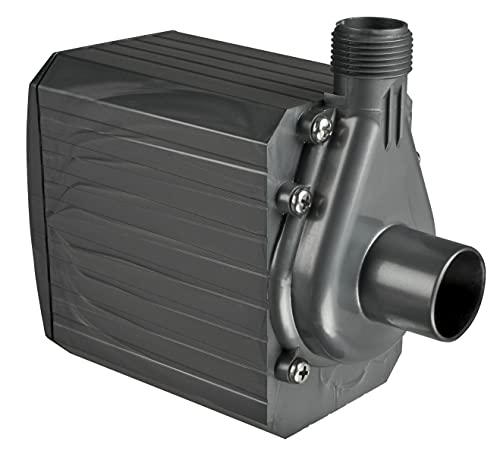
The Pond-Mag's entire case is longevity, and the design is why. It is an oil-free magnetic-drive pump: the motor is epoxy-sealed and spins the impeller through a magnetic coupling, so there is no shaft seal to weep and no oil reservoir to lose. There is no circuit board, no external controller, and no electronics sitting pondside waiting to fail. Danner covers it with a 5-year limited warranty, raised from the three years these carried a few seasons ago. A manufacturer lengthening a warranty is quietly telling you what its return rate looks like.
Owners bear that out across the line. On the pond forums, Pondmaster keepers describe the kind of lifespan that makes the up-front price look cheap: one running a 2400 Supreme "for 14 yrs straight 24/7," another leaning on a ProLine for eight years of filthy pump-out duty where "it's pumped all sorts of crap and never even burps," a third who simply says "I use Pond Masters too and have had excellent reliability." These are owners of various Pondmaster magnetic-drive sizes rather than the 1800 specifically, but they speak to a line with a real, earned reputation for running and running.
The one way to kill it
There is a single failure mode, and it is preventable. A magnetic drive holds tight tolerances between the impeller and its housing, so sand or a stray shard of filter media scores those surfaces and eventually weakens or seizes the pump. Long-time keepers name the cause plainly, pumps that fail early "have been operated at some point without a pre-filter," and the grit "scoring the magnet and impeller surfaces" is what does them in. Even the owner who got twelve years out of a Pondmaster 1200 traced its eventual death to the same thing, noting that with "a better filter that pump would still be working."
The fix costs nothing but a little planning. Run the pump behind a pre-filter, a skimmer, or at minimum a screened intake, and sit it an inch or two off the pond floor on a flat stone or platform so it never inhales the muck that settles at the bottom. Keep grit off the impeller and the impeller, a cheap, replaceable part, is the only component that ever really wears.
How it compares
- Versus the Alpine PAL3100: the size-up. Where the Pond-Mag tops out near 16.5 feet of head, the Alpine publishes a 21.5-foot lift on a 276-watt motor, so a tall or wide waterfall that starves the Pond-Mag has the head it needs, at a higher running cost. Buy the Alpine when the fall, not the reliability, is the constraint.
- Versus the Jebao DCP-4000: the efficiency play. A DC sine-wave pump draws a fraction of the watts and lets you dial the flow, so it wins the yearly electricity bill by a wide margin. The trade is its external controller, which is one more thing that can fail; the Pond-Mag has none, which is the whole point of buying one.
- Versus the VIVOSUN 5300: the budget contrast. The VIVOSUN's headline flow is far higher and its price far lower, but it hides its watts and wears at the impeller like any cheap submersible. The Pond-Mag costs more up front and buys a decade where the VIVOSUN buys a season or two, a different purchase entirely.
Setting it up
Work out the flow you need at your head before anything else: measure the lift from the water surface to the top of your waterfall or filter return, add for tubing and every elbow, and check that the pump's flow-at-head still turns the pond over about once an hour, twice for koi. Sit it in a skimmer or on a screened intake, raised an inch or two off the floor, so it pumps clean water and stays clear of bottom muck. Plug it into a GFCI outlet, a submersible pump in a pond is a shock hazard before it is a flow problem, and if it feeds a waterfall above the water line, add a check valve so the basin does not drain back when it shuts off. Then let a new pond and filter cycle for a few weeks before you judge the water.
Where we land
The Pondmaster Pond-Mag 1800 is the pump you buy once. It is not the cheapest, the highest-flow, or the most efficient, and on a big waterfall or a debris-heavy bottom drain it is the wrong tool. Reach for a bigger pump or a solids-handler there. But as the clean-water return pump behind a filter or feeding a modest fall on a small-to-mid pond, its oil-free magnetic drive, published specs, and 5-year warranty add up to the most reliable pump we cover, and owner reports of decade-plus lifespans back that up.
Give it a pre-filter so grit never reaches the impeller, size it by flow-at-head rather than the zero-head badge, budget the roughly $200 a year it draws, and put it on a GFCI. Do that and it will quietly outlast almost everything else on your equipment pad.
Our Ratings
Overall score
The highest reliability score we have given a pump, and the reason to buy it. An oil-free magnetic drive with no shaft seal and no external controller, a 5-year warranty Danner recently extended from three, and owner reports across the line of 8 to 14 years of 24/7 running. Its one weakness, grit scoring the impeller, is fully preventable with a pre-filter, and the impeller itself is a cheap replaceable part.
It moves solid, predictable flow for a small-to-mid pond or a filter return, and Danner's published 16.5-foot max head lets you size it honestly instead of guessing. The score sits below the top of the scale because it is a clean-water magnetic drive, not a solids-handler, and its lift tops out right where a big waterfall begins, buy it for the job it is built for, not to push a tall fall.
The up-front price is mid-pack and the cost-per-year is excellent once you spread it over a decade of service. It loses a little ground on running cost: at 145 watts around the clock it burns roughly $200 a year, where a DC pump of similar flow costs a fraction of that. You pay more to run it than to buy it, but you buy it once.
Pondmaster Pond-Mag 1800 on Amazon.
The Evidence Behind Our Verdict
The Pond-Mag 1800 has too few long-run reports on the exact model to judge alone, so we read it as part of the Pondmaster magnetic-drive line, which carries one of the strongest reliability reputations on the pond forums. The pattern is remarkably consistent. " The counterweight is a single, preventable failure mode.
" Our read matches the forum's. This is a buy-it-once pump whose only real enemy is the sediment you can screen out, and whose oil-free, controller-free simplicity is what lets it run for years. Keep grit off the impeller and it will likely outlast the pond around it.
Our rating above is our own editorial call. What follows is the field evidence we weighed to reach it: first-hand reports from pond owners on dedicated pond and koi forums, which we lean on more than manufacturer-influenced published reviews because unsponsored owners tend to be the more candid signal.
What Pond Forums Say
“I've a pondmaster 2400 supreme that had been running for 14 yrs straight 24/7.”Source →
“I've used a PondMaster ProLine for the past 8 years (hooked up to a fire hose) for pond pump outs (I'm pretty sure that it's a 5000gph). It's pumped all sorts of crap and never even burps. Super high flow, reliable and sturdy.”Source →
“Sounds like these pumps have been operated at some point without a pre-filter. Sand or some other object has infiltrated the pump thus scoring the magnet and impeller surfaces.”Source →
“I have used a Pondmaster 1200 for more than 12 years in a small pond without the best of filters. The shaft the impeller sits in is not smooth. If i had used a better filter that pump would still be working.”Source →
Frequently asked questions
Is the Pondmaster Pond-Mag 1800 worth it?
The up-front price is mid-pack and the cost-per-year is excellent once you spread it over a decade of service. It loses a little ground on running cost: at 145 watts around the clock it burns roughly $200 a year, where a DC pump of similar flow costs a fraction of that. You pay more to run it than to buy it, but you buy it once.
How reliable is the Pondmaster Pond-Mag 1800?
The highest reliability score we have given a pump, and the reason to buy it. An oil-free magnetic drive with no shaft seal and no external controller, a 5-year warranty Danner recently extended from three, and owner reports across the line of 8 to 14 years of 24/7 running. Its one weakness, grit scoring the impeller, is fully preventable with a pre-filter, and the impeller itself is a cheap replaceable part.
How well does the Pondmaster Pond-Mag 1800 perform?
5-foot max head lets you size it honestly instead of guessing. The score sits below the top of the scale because it is a clean-water magnetic drive, not a solids-handler, and its lift tops out right where a big waterfall begins, buy it for the job it is built for, not to push a tall fall.
What do real owners say about the Pondmaster Pond-Mag 1800?
The Pond-Mag 1800 has too few long-run reports on the exact model to judge alone, so we read it as part of the Pondmaster magnetic-drive line, which carries one of the strongest reliability reputations on the pond forums. The pattern is remarkably consistent. " The counterweight is a single, preventable failure mode.
Options Worth Checking Out

Alpine Corporation PAL3100 Submersible Pump
The size-up when a tall or wide waterfall needs more lift than the Pond-Mag has. Alpine publishes a 21.5-ft max head on a 276-watt motor, so you can push a real fall and still size flow and watts honestly. More head, and a bigger power bill to match.

Jebao DCP-4000 DC Sine-Wave Pump
The efficiency pick. A controllable DC pump draws a fraction of the Pond-Mag's watts and lets you dial flow, so it wins the yearly power bill by a wide margin. The trade is an external controller, one more part to fail where the mag-drive has none.

VIVOSUN 5300 GPH Submersible Pond Pump
The cheap high-flow option for a short waterfall or a backup pump. Far more headline GPH for far less money, but it hides its watts and wears at the impeller like a budget submersible. Buy it to save up front and expect a season or two, not a decade.