Jebao DCP-4000 Pond Pump Review
By The Pond Review · Updated August 2026
Independent editorial review. We never accept payment for coverage, though we may earn a commission if you purchase through our links.

Verdict
Sentiment on DC return pumps as a class is split on the pond forums, and the split tracks almost exactly with what a pump like the DCP-4000 is asked to do and whether its controller holds up. The keepers running a DC return pump on a low-head line are content: one describes an energy-efficient install where the controller lets him slow the flow at feeding time and the pump loafs at under half capacity most of the day, and another is eyeing a switch purely because the cost to run is so much lower than his big AC external pump. The skeptics are just as vocal and, on their own terms, right. One flatly calls everything he has seen in the category junk. Another found that a DC-to-AC inverter feeding an efficient AC pump beat the DC pumps outright, so he went back. The sharpest technical caution comes from a keeper who notes the printed wattage is the pump end alone, and that the transformer and controller draw power nobody bothers to publish, so the true wall figure is unknown. Our own read lines up with the content owners on the arithmetic and with the skeptics on the risk: as one puts it, delivered flow on these open-impeller pumps is efficient only under about 10 feet of head and drops off sharply above it, and the external controller is the part that fails. Buy it as an efficient low-head return pump, protect the controller, and it's a strong pump; ask more of it, and the doubters have a point.
Read full take ↓Similar pond pumps
A DC sine-wave pump like the Jebao DCP-4000 is the efficiency buy for the one job that never stops: moving your pond's water twenty-four hours a day, every day of the year. It sips watts per gallon, runs cool and close to silent, and its controller lets you dial the flow up or down and set a slower feed-time speed so the fish aren't fighting the current at dinner. Run it against an AC mag-drive pump of the same useful output and the DC pump's lower draw adds up to real money over a year of continuous running. That's the case for it, and on a return line it's a strong one.
The catch is the part that made all of this possible. The efficiency and the flow control live in an external controller and transformer sitting outside the pond, and that box is the thing most likely to fail. It's why a stubborn contingent of experienced keepers still trust a dumb AC pump they can replace at any hardware store. Buy the DCP-4000 for what it's, an efficient clean-water return pump, wire the controller where it stays dry, and it earns its keep. It disappoints only when you ask it to run a waterfall high overhead or pull sludge off the bottom, neither of which it was built for.
The short version
What works:
- Very low power draw for the flow it delivers, which is what matters on a pump that runs every hour of every day.
- The controller adjusts flow on the fly, including a feed-time slowdown, with no valves to throttle or pumps to swap.
- The sine-wave motor runs cool and near-silent, a real step up from a buzzing AC pump next to a patio.
- 24V low voltage is safer around water than a 120V pump, and cheaper to run to boot.
What to watch:
- Delivered flow falls off hard above about 10 feet of head, and the "4000" on the box is a litres-per-hour rating, not gallons: it works out to about 1,056 GPH at zero head, so the real delivery is modest.
- The external controller and transformer are the failure point, and their own power draw is rarely published.
- The open impeller clogs on leaves and sludge. This is a clean-water return pump, not a bottom-drain solids handler.
- If the proprietary controller dies, the pump is dead until you source a replacement, which you can't buy locally.
Who it's for, and who should skip it
Buy the DCP-4000 if you run a pump around the clock on a return line, pushing filtered or bog-cleaned water back to the pond, you want the lowest running cost and the quietest option you can get, and your total head is modest, under roughly 10 feet. On a clean-water return with low lift, this is the pump we'd reach for first.
Skip it if your pump has to lift water high to a waterfall, where the DC flow falloff eats the very output you paid for, or if it sits where it'll suck in debris and clog, which is a job for a solids-handling pump. Skip it too if you want a pump you can replace anywhere the day it quits. If a single point of failure you can't source at a local store is a dealbreaker for you, a plain AC mag-drive is the safer call, and the skeptics who say so aren't wrong.
The number that matters: flow per watt, not peak GPH
The listing leads with the "4000" model number, and it reads like a big flow figure until you notice it's litres per hour, not gallons: about 1,056 GPH at zero head, which is modest. On a pump that runs 24/7, the figure that decides your electric bill is flow per watt at the head you run, not the headline number. Run the arithmetic the box hopes you skip: take the watts the pump draws, multiply by 8,760 hours in a year, divide by 1,000 for kilowatt-hours, and multiply by your power rate. That's the yearly cost to keep it running, and it's the number to compare between two pumps, because a lower-flow pump that draws a third of the watts can be the cheaper way to move the water you need.
There's an honest complication the forums flag. The wattage printed on a DC pump is the pump end alone; to get that flow it has to run through the transformer and controller, and those draw their own power that almost no seller lists. As one keeper points out, the transformer's consumption is the figure nobody publishes, so measure at the wall if you can rather than trusting the pump's rating. Even accounting for that, a DC sine-wave pump's total draw is a fraction of an AC mag-drive's for the same useful flow, which is the reason to run one at all.
Where the delivered flow goes
The open impeller that makes these pumps so efficient has a hard limit, and one of the sharper forum voices calls it exactly right. This design moves water very efficiently when total dynamic head stays under about 10 feet, and above that the delivered flow drops off significantly. So that 1,056 GPH (the 4000 litres-per-hour rating) is a best-case, zero-head figure. Route the water through a filter, up some lift, and through a few fittings, and real delivery is a good deal lower, then past roughly 10 feet of head it falls off a cliff.
Before you trust any pump's headline number, add up your total dynamic head: the static lift from pond surface to outlet, plus friction losses from pipe, elbows, and the filter it feeds. If your waterfall sits high above the water, this whole class of pump is the wrong tool, and a pump engineered to hold flow against head will serve you better up top. Keep the lift low and the DCP-4000 delivers close to what you expect while barely touching your power bill.
The controller is the weak spot
The wet end of the pump is simple and rarely the thing that fails. The failure point is the external controller and transformer, and that's the reason reliability opinion on these pumps is split down the middle. Happy owners run theirs for years and love the efficiency and control. Skeptics have watched the electronics quit and write off the entire category as junk. Both are describing the same pump; the difference is whether the controller held up.
Because the controller is proprietary, a dead one isn't something you grab on the way home from work. When it goes, the pump is out of service until a replacement ships, which is precisely why some seasoned keepers refuse DC pumps and stick with an AC mag-drive they can swap in ten minutes. Our read is that the risk is real but manageable: treat the controller as the consumable part, keep it bone dry and out of the sun, and favor a pump line whose replacement controllers you can order. Buy it knowing the brain is the part to baby.
A return pump, not a solids handler
The same open impeller that earns the efficiency is what makes this pump clog. It's built to move clean water on a return line, from a filter or a bog back into the pond, not to sit on the bottom pulling leaves, string algae, and settled sludge. Feed it debris and the impeller jams, and you're back at the pond fishing it out. Put mechanical filtration or a leaf-excluding intake ahead of it and let a proper solids-handling pump or a gravity-fed bottom drain do the dirty work. Behind filtration it stays clean and quiet; used as a bottom drain it becomes a weekly headache.
Wiring it safely
The 24V low-voltage design is safer around water than a 120V pump, since a low-voltage fault carries far less danger to fish or people. That doesn't retire the basics, because the transformer and controller still plug into household current. Put them on a GFCI-protected outlet, which the National Electrical Code requires for outdoor and near-water circuits, and mount the controller box well above any standing water where it can't be splashed or submerged. Give the cord a drip loop so water runs off and drips away rather than tracking down into the connection. Low voltage at the pump doesn't mean no voltage at the wall.
How it compares
If the DCP-4000 is more pump than your line needs, or not quite enough, our other pond pump reviews cover the alternatives. Here's how the closest ones stack up.
- Versus a POPOSOAP or hygger 24V DC pump: the same idea, a low-voltage DC return pump with its own speed controller, at a similar price. The DCP-4000 moves a modest 1,056 GPH, so if your return line needs more, the POPOSOAP (1,600 GPH) or the aquarium-grade hygger (2,650 GPH) step up on flow; all three carry the same DC efficiency, the same controller strength, and the same controller risk.
- Versus the Jebao DCP-10000: the bigger model in the same family, not a different pump. If your pond or your head demands more flow than the 4000 can deliver in its efficient range, size up to the 10000 rather than running the smaller pump flat out all day. It's a size-up, not a swap, with the same tradeoffs scaled up.
- Versus a plain AC mag-drive: the pump the skeptics keep. It draws more power and gives you no flow control, but there's no external controller to fail and you can replace it at any store. The tradeoff we'd take on a low-head return line is the DC pump's efficiency and quiet, as long as we can source a spare controller.
Our verdict
On the job it was built for, an efficient, quiet, adjustable return pump on a line under about 10 feet of head, the DCP-4000 is a strong buy and the running-cost math sits firmly on its side. Size it to the flow you need at your real head, run it behind filtration, and it sips power while a comparable AC pump drinks it, month after month, with a controller that lets you back the flow off at feeding time.
What keeps it from a clean recommendation is the one part you can't buy at the hardware store. The external controller is the pump's brain and its weak point, and if reliability with a locally replaceable part outranks efficiency for you, the skeptics have a case and an AC mag-drive is the calmer choice. Treat the controller as the thing to protect and to keep a spare for, wire it where it stays dry, and the DCP-4000 pays you back every month it runs.
Our Ratings
Overall score
This is the weak spot, and the score reflects a genuine split. The wet end is simple, but the efficiency lives in an external controller and transformer, which is the part owners lose and cannot replace locally. Content owners run theirs for years; skeptics have watched the electronics fail and call the class junk. Keep the controller dry and sourceable and the risk is manageable, but it is real.
As an efficient, quiet, adjustable return pump on a low-head line it performs well, and the flow-per-watt is its strong suit. It loses real points for the head falloff above about 10 feet, where delivered flow drops off a cliff, and because the open impeller limits it to clean-water duty rather than pulling solids off the bottom.
The running-cost case is strong: over a year at 24/7 a DC pump's draw is a fraction of a comparable AC mag-drive's, and the arithmetic favors it clearly on a low-head return. Docked because the hidden transformer draw muddies the on-paper efficiency and because a controller failure can turn a cheap pump into a total loss.
Jebao DCP-4000 Pond Pump on Amazon.
The Evidence Behind Our Verdict
Sentiment on DC return pumps as a class is split on the pond forums, and the split tracks almost exactly with what a pump like the DCP-4000 is asked to do and whether its controller holds up. The keepers running a DC return pump on a low-head line are content: one describes an energy-efficient install where the controller lets him slow the flow at feeding time and the pump loafs at under half capacity most of the day, and another is eyeing a switch purely because the cost to run is so much lower than his big AC external pump. The skeptics are just as vocal and, on their own terms, right.
One flatly calls everything he has seen in the category junk. Another found that a DC-to-AC inverter feeding an efficient AC pump beat the DC pumps outright, so he went back. The sharpest technical caution comes from a keeper who notes the printed wattage is the pump end alone, and that the transformer and controller draw power nobody bothers to publish, so the true wall figure is unknown.
Our own read lines up with the content owners on the arithmetic and with the skeptics on the risk: as one puts it, delivered flow on these open-impeller pumps is efficient only under about 10 feet of head and drops off sharply above it, and the external controller is the part that fails. Buy it as an efficient low-head return pump, protect the controller, and it's a strong pump; ask more of it, and the doubters have a point.
Our rating above is our own editorial call. What follows is the field evidence we weighed to reach it: first-hand reports from pond owners on dedicated pond and koi forums, which we lean on more than manufacturer-influenced published reviews because unsponsored owners tend to be the more candid signal.
What Pond Forums Say
“It's energy efficient and I also like the fact I can control the flow during feeding or slow the flow of water through the bog I designed. Most of the time it's only running less than half it's capacity.”Source →
“I have looked into them, not pulled the trigger yet, but do want to look into it I think as the cost to run is much lower compared to my 3/4HP LifeGard Seahorse external pump.”Source →
“These dc pumps have an open impeller design that makes them very efficient at moving water when total dynamic head is <10 feet or so. Once your TDH climbs above that, they drop off significantly.”Source →
“I do like the idea of the DC or low voltage pumps for a pond, unfortunately everything I’ve seen appears to be junk.”Source →
“when i was doing the solar thing i found out buying a dc to ac inverter then buying a efficient ac pump worked better than dc pumps. go figure”Source →
“to get the pumps reported power it has to go into a transformer and a controller. So we should forget the pumps power usage and see what the transformer is using.”Source →
Frequently asked questions
Is the Jebao DCP-4000 Pond Pump worth it?
The running-cost case is strong: over a year at 24/7 a DC pump's draw is a fraction of a comparable AC mag-drive's, and the arithmetic favors it clearly on a low-head return. Docked because the hidden transformer draw muddies the on-paper efficiency and because a controller failure can turn a cheap pump into a total loss.
How reliable is the Jebao DCP-4000 Pond Pump?
This is the weak spot, and the score reflects a genuine split. The wet end is simple, but the efficiency lives in an external controller and transformer, which is the part owners lose and cannot replace locally. Content owners run theirs for years; skeptics have watched the electronics fail and call the class junk.
How well does the Jebao DCP-4000 Pond Pump perform?
As an efficient, quiet, adjustable return pump on a low-head line it performs well, and the flow-per-watt is its strong suit. It loses real points for the head falloff above about 10 feet, where delivered flow drops off a cliff, and because the open impeller limits it to clean-water duty rather than pulling solids off the bottom.
What do real owners say about the Jebao DCP-4000 Pond Pump?
Sentiment on DC return pumps as a class is split on the pond forums, and the split tracks almost exactly with what a pump like the DCP-4000 is asked to do and whether its controller holds up. The keepers running a DC return pump on a low-head line are content: one describes an energy-efficient install where the controller lets him slow the flow at feeding time and the pump loafs at under half capacity most of the day, and another is eyeing a switch purely because the cost to run is so much lower than his big AC external pump. The skeptics are just as vocal and, on their own terms, right.
Options Worth Checking Out

POPOSOAP 1600 GPH 24V DC Pond Pump
A 24V DC return pump with the same efficiency and speed controller, rated 1,600 GPH, a step up in flow from the Jebao DCP-4000 (about 1,056 GPH). Reach for it when your return line needs more water on low voltage.

hygger 24V DC 2650 GPH Return Pump
A 24V DC pump built for aquarium sumps that moves serious water, rated 2650 GPH, with its own speed controller. Step up to this when you want more flow than the DCP-4000, and keep its transformer dry on a GFCI outlet like any DC pump.
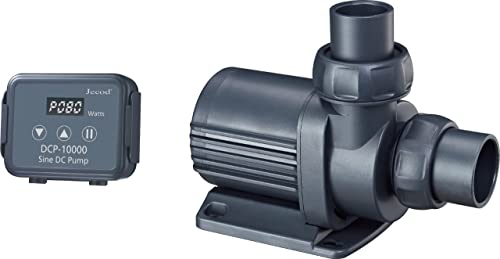
Jebao DCP-10000 Sine Wave Return Pump
The bigger model in the same Jebao line, not a different pump. When your pond or your head needs more than the 4000 delivers, size up to the 80W 10000 rather than running the smaller pump flat out. Same strengths, the same controller to keep dry.


