The Best Solar Pond Pump (and When to Skip Solar)
By The Pond Review · Updated August 2026
Independent editorial guide. We never accept payment for coverage, though we may earn a commission if you purchase through our links.
Quick Take
Buy a solar pond pump for a fountain, a bird bath, or a small decorative feature you can't run a cord to, and nothing more. Our top pick is the cheap AISITIN DIY kit, which turns a sunny bird bath or urn into a bubbling water feature for the price of a takeout lunch. Solar is a placement tool, not a power plant: it stops the moment the sun goes behind a cloud and it's dead all night, so it can't run a filter or keep a fish pond alive.
If there are fish in the water, don't run bare solar. A pump that quits at sundown is the opposite of what fish need, because a pond's oxygen bottoms out overnight, and life support has to run every hour of every day. Use mains power, or a solar pump with a real battery backup so it carries through the dark and the clouds. And don't buy solar to save money on a small pump: the panel-and-battery rig usually costs more than twenty years of grid electricity would.
Below, four solar pumps matched to the job, from the daytime fountain kit we default to up to a battery-backed unit that runs after dark. See our picks ↓

Solar pond pumps are sold on a promise that doesn't survive contact with a real pond: free power, no wiring, drop it in and forget it. Two of those are true. The wiring does disappear, and for a fountain in the middle of a lawn that's exactly what you want. The "free power" part is where the marketing quietly skips the arithmetic, and "forget it" is exactly the wrong instinct if anything is living in the water.
We shop solar the opposite way the listings want us to. A solar pump isn't a cheaper pond pump; it's a pump that only works when the sun is out, bought to reach a spot no cord can. Get that straight and it's a useful tool. Miss it and you end up with dead fish or a dead battery. Here's what solar can and can't do, the money math the listing hopes you skip, and the four pumps we'd buy for the jobs solar is good at.
When solar is the right call, and when it isn't
Solar earns its place on exactly one criterion: you can't get a cord to where the water is. A fountain in the center of a lawn, a bird bath by the back fence, a half-barrel water feature on a patio with no outlet nearby, a decorative urn bubbling in a bed of gravel. For those, a small solar pump is the elegant answer. No trench, no conduit, no GFCI outlet to add, no cable snaking across the grass. You set the panel in the sun, drop the pump in the water, and it runs on daylight. That freedom is the entire reason to buy solar, and it's a real one.
The moment the water holds fish, or needs to stay clear and oxygenated around the clock, the calculus flips. A bare solar pump is the wrong tool, not a cheaper version of the right one. It can't run filtration you can rely on, it can't aerate a pond overnight, and it goes dark on the first cloudy afternoon. The popular framing that solar is the modern, money-saving upgrade to a mains pump has it backwards. Solar is a niche tool for cordless placement, and a poor substitute for a plug when the pond depends on the pump.
What solar can't do: run at night or push through a cloud
A solar pump with no battery runs on the current the panel is making right now. That means full flow in bright midday sun, a weak dribble under a passing cloud, and nothing at all after sunset. This isn't a defect in any particular pump; it's what direct solar is. Owners who run these happily are the first to say so, describing a pump that operates only with enough sunlight and stops the rest of the time. For a fountain that's fine, because a fountain that pauses when a cloud rolls over and sleeps at night bothers nobody.
For filtration it's a problem you can't design around. A biological filter is a colony of bacteria that needs a steady flow of oxygenated water to stay alive and keep processing fish waste. Cut the flow every night and on every gray day and the colony starves and dies back, so the filter is never fully working when you need it. A filter that runs banker's hours isn't a filter. It's a fountain that occasionally moves water through some foam. If your pond needs real filtration, solar without storage can't provide it, and no amount of a bigger panel changes the fact that the sun sets.
The money math almost nobody runs
The pitch for solar is saving money, so run the numbers the listing leaves out. A small decorative or fountain pump draws very little, call it around ten watts. Running around the clock that's about ninety kilowatt-hours a year, which at average US electricity rates is roughly fifteen dollars a year. Over twenty years of continuous running, that pump costs something like three hundred dollars in grid power. Even a thirstier thirty-watt pump lands near forty-five dollars a year, under a thousand dollars across two decades.
Now price the solar path that matches a mains pump, meaning one that runs at night. You need a panel plus a battery big enough to carry the pump through the dark and the overcast. Even our little ten-watt pump wants on the order of a hundred to two hundred watt-hours of storage to get through the small hours, and a thirstier fish-pond pump pushes that far higher; owners sizing a larger pump out talk about a lithium power station in the fifteen-hundred to two-thousand watt-hour range to cover a night. Either way it's real money up front, from the better part of a hundred dollars for a small battery to several hundred for a power station, and the battery is a consumable that fades and gets replaced every few years. Add a replacement or two over twenty years and the solar-plus-storage rig costs more than the grid power it was meant to save. The arithmetic is blunt: for a small pump, solar to save money doesn't pencil. What your money buys is placement freedom, the ability to put water where no cord reaches, and that's worth paying for only when you need it.
Fish change everything: oxygen is a twenty-four-hour job
This is the line we won't soften, and it comes from the biology, not from the forums. A pond full of fish is a life-support system, and life support runs twenty-four hours a day. The reason is oxygen. During daylight, plants and algae photosynthesize and add oxygen to the water. After dark they stop, and everything in the pond, including those same plants, keeps consuming oxygen all night. Dissolved oxygen falls through the small hours and hits its low just before dawn, and it's lowest of all on warm summer nights, because warm water holds less oxygen to begin with. Nighttime and pre-dawn is when ponds lose fish to suffocation.
A pump or aerator exists partly to keep that from happening, by moving the surface and letting the water breathe. A bare solar pump does the exact opposite of what the pond needs: it runs hardest at midday, when oxygen is already high, and it shuts off at night, when oxygen is crashing. It withdraws aeration at the precise hours the fish depend on it. So the rule isn't a preference, it's a safety line. If fish live in the water, their pump can't be allowed to stop when the sun does. Run it on mains power, or run a solar pump with a battery backup sized to carry it through the night and the clouds. Bare daytime-only solar on a fish pond is a fish kill waiting for a hot, still night.
Battery backup, and what it costs you
A solar pump with a battery gets closer to round-the-clock running, and it's the only version of solar we'd consider near fish. The panel charges the battery through the day, and the battery keeps the pump going after sunset and through cloudy spells. The better small units build this in, with a battery pack and dry-run protection so the pump doesn't burn itself out when the reserve empties. But be honest about how far a small built-in battery reaches. The POPOSOAP unit below, for instance, runs only about two to four hours past sunset on its charge, which bridges dusk and a passing cloud but dies hours before the pre-dawn low, when oxygen bottoms out. That's fine for a decorative feature. It isn't overnight life support for a stocked pond.
Be clear-eyed about the tradeoff. A battery is a consumable, and a small built-in one carries the pump for a few hours after dark, not all the way to dawn, let alone through a run of dark December days. Size the system so the pump draws less than the panel can replace, or the battery drains faster than it charges and dies early, which owners who tried DIY battery rigs ran into again and again. The more you engineer solar to behave like a plug, the more it costs and the more there's to fail. Past a certain point you're building a small off-grid power station to avoid running one cord, and for most fish ponds the cord is cheaper, simpler, and safer. Battery-backed solar is the right answer only when mains isn't an option.
Matching a solar pump to the job
For a fountain, a bird bath, or a decorative urn in full sun with no fish depending on it, the cheap AISITIN DIY kit is all you need. It floats a small pump under a spray head, runs on daylight, and turns a still basin into moving water for a few dollars, and if it stops during a cloud, nothing is harmed. That's solar used exactly right, and it's our top pick because it nails the one job solar is good at.
Step up only for what each job requires. A bird bath you want bubbling on a budget is the AISITIN 3.5W, a hair more capable than the bare kit. A small planted feature that you'd like to keep gently filtered and moving is where the POPOSOAP 8W filter-and-pump unit fits, pairing a little filtration with the pump. And a small feature where you want the water to keep moving into the evening is the one case for the POPOSOAP battery-backup pump, whose panel-charged battery and dry-run protection let it run a few hours past sunset. Treat it as a dusk-and-cloud bridge, not overnight aeration: on its two-to-four-hour battery it quits well before the pre-dawn oxygen low, so any pond whose fish depend on the pump still needs mains power or a dedicated aerator through the night. None of these is a substitute for a mains pump on a real koi pond. They're tools for small, cordless, sunlit water, which is the only place solar belongs.
The rule we'd give a neighbor
Strip out the marketing and solar pond pumps come down to one decision. Is there anything alive in the water that depends on the pump? If no, and you just want moving water somewhere a cord can't reach, buy a cheap solar fountain pump, enjoy the freedom from wiring, and don't expect it to save you money, because on a small pump it won't. If yes, don't run bare solar. Use mains power, or if a cord can't reach, a battery-backed solar pump sized to run through the night, and understand you're paying for placement, not for cheap electricity.
The real pitch is smaller than the ads, and better for it. Solar is a fine way to bubble a bird bath or feed a fountain off in the yard. It's a bad way to run a filter and a dangerous way to oxygenate fish, because it quits exactly when a fish pond needs the pump most. Buy it for what it does, cordless daytime water, and use a plug for everything that has to keep running. When your pond needs real flow at real head all day and night, our submersible pond pump picks are the place to start instead.
The picks
Products we recommend for this guide.
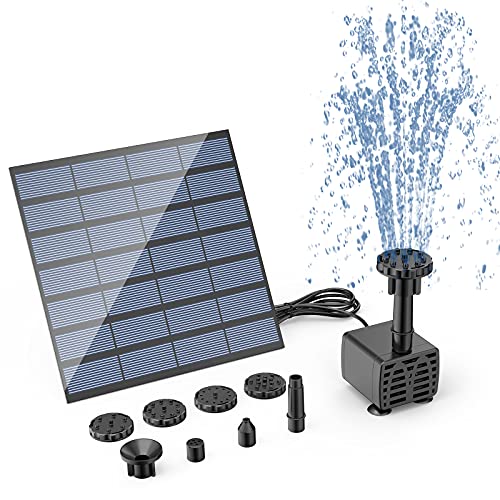
AISITIN DIY Solar Water Pump Kit for Water Features
The best-value way to bubble a fountain, bird bath, or urn where no cord reaches. A tiny panel-fed pump with six nozzles that runs on daylight alone. It stops in cloud and at night, which for a decorative feature with no fish is a non-issue.

POPOSOAP Solar Fountain Pump with 3600mAh Battery Backup
A dusk-and-cloud bridge, not overnight fish support. The 3600mAh battery runs the pump only about 2-4 hours past sunset (per POPOSOAP), dying before the pre-dawn oxygen low. For a decorative feature, not to aerate a fish pond overnight.

POPOSOAP 8W Solar Pond Filter with Battery Backup
Pairs a small pump with light filtration and a battery backup, for a modest planted feature you want gently filtered and moving. Treat its filtration as polishing, not life support for a stocked pond, and keep the load light and placement sunny.

AISITIN 3.5W Solar Fountain Pump for Bird Bath
A separated-design solar fountain pump with eight nozzles for a bird bath or small basin on a budget. A step up in spray from the bare DIY kit, still daylight-only with no battery, so buy it for looks and movement, never to filter or aerate fish.
What owners say
Real owner reports from the threads and editorial sources we drew on for this guide.
“Nothing fancy in our pond. We have a small 37-watt solar panel dedicated to powering a submerged 12-volt 1100gph bilge pump (Amazon) with vinyl tubing attached to the outlet. The pump and tubing produce a "bubbling" effect at the pond surface. No battery backup so the pump only operates with sufficient sunlight, which is most days here in California. Depending upon the pump output plus size and length of tubing, you should be able to achieve 63cm of head above the pond. Each pump has lasted about a year but at around $20.00 USD, that's cheap efficiency.”
“i tried going solar with my pond . the size of my pond / too shady will make solar way too expensive. i am going to make a small water pond near my house next year in full sun and i think solar will work for a few goldfish / rosey reds but not much more.”
“I don't know of any members here who are totally solar. Most members have some type of fish and having a loss of power can cause issues.”
“general rule would be you need 1,000L-2,000L per hour pump many of those are about 120Watt, so I'd also recommend a battery for night and overcast days, Lithium power station in the 1,500Wh to 2,000Wh to cover up to 12 hours of night/overcast use.”
“For me, I think it would be a fun engineering problem to play with, it wouldn't be for cost savings or green... I don't think it'll have payback for years”
“yes, this is where i gave up on it. i don’t need to run it at night, so maybe just a panel and pump, with no battery is a simple solution that will work for me.”