AISITIN Solar Fountain Pump Review + Verdict
By The Pond Review · Updated August 2026
Independent editorial review. We never accept payment for coverage, though we may earn a commission if you purchase through our links.
Verdict
Owners who have chased solar for a pond keep landing where we do, and the pattern across the threads is consistent rather than split. For a purely decorative, daylight-only jet on a fishless feature, the cheap bare pumps are treated as good enough, and at least one owner runs a no-battery solar pump happily on the understanding that it only runs when the sun is shining. The disagreement is entirely about asking one to do more. Keepers who tried to power a whole pond report the bare units are weak, with one who abandoned them for a battery build because the solar pump combos he saw were weak as hell. The most experienced voices flag the real risk, that most pond owners keep fish and a loss of power causes problems, which is exactly the night-and-cloud gap a battery-free pump can't close. On cost, the people who built solar setups don't sell them as savings; one flatly doubted it would have payback for years. There's one fair nuance worth keeping: in a small pond, surface gas exchange usually covers oxygen and filtration is the tighter constraint. Our read stands on the safety point regardless. A bare solar pump is a decoration you can enjoy on a fishless feature, and the wrong tool the moment a fish depends on the water moving.
Read full take ↓Similar fountain and waterfall kits
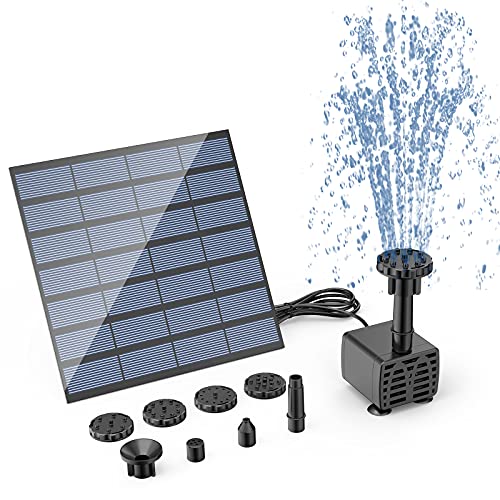
The AISITIN DIY Solar Water Pump Kit is a ten-dollar panel, a small pump and six nozzles, and for what it's, a fair-weather decorative fountain, it does the job. Float it in a bird bath, a fishless bowl or a lightly planted water feature, set the panel in full sun, and it'll throw a tidy jet for the price of a couple of coffees. The catch is that the whole solar-pump category is sold on a bigger promise than that, and this is where we part ways with it.
A bare solar pump has one defining limit that no marketing copy changes: it runs only while the sun is on the panel. A cloud drifts over and the jet stutters. The sun goes down and it stops. That's fine for decoration and a hard no for anything keeping a fish alive, because fish life support has to run every hour of the day, not just the sunny ones. If there are fish in your water, this is the wrong tool, and the fix is a battery-backup solar unit or a mains pump. We size those calls below.
The short version
What works:
- Very cheap, and cheap in a useful way: for a decorative jet in a bird bath or fishless feature it costs less than a bag of gravel.
- No cord, no outlet, no electrician. Drop it in, aim the panel at the sun, and it runs.
- Six nozzles let you tune the spray to a small feature, and full sun gives a surprisingly lively jet for the wattage.
- Nothing to plumb and nothing to winterize beyond lifting it out. There's very little on it to go wrong.
What to watch:
- It stops at night and in heavy cloud. There's no battery, so there's no running it after dark.
- It can't run filtration and it can't keep a fish pond oxygenated, because both of those jobs have to be continuous.
- Output is weak and lift height is small. This is a fountain, not a pond pump.
- The panel needs regular sun and a wipe now and then; shade or grime and the jet falls off fast.
Who it's for, and who should skip it
Buy this if you want a solar splash on a fishless feature: a bird bath, a patio bowl, a small decorative pond with plants and no livestock, somewhere you can't or won't run a cord. For that job it's a fair, cheap little pump, and running only in daylight is no loss because nothing depends on it overnight.
Skip it the moment fish enter the picture. A pump that dies every night can't carry a fish pond, and no amount of full-sun performance during the day makes up for the hours it's off. Skip it too if you want water cleaned rather than just moved, since a bare pump does no filtration. And skip it if you need any real lift for a waterfall, because a panel this size won't push water uphill.
The limit the listing skips: it stops at night
Read a bare solar pump's rating and it quotes a flow figure under bright, direct sun with the panel clean and square to the light. That's the best case and it's also the only case. There's no battery banking the day's energy, so the moment the light drops, so does the pump. One owner setting up a small pond put the same limit in plain terms after buying one: his solar pump runs only when the sun is shining. That isn't a defect. It's the whole design.
For decoration that's fine. A fountain that quits at dusk and restarts in the morning bothers no one, and the plants in a water garden don't care. The trouble starts only when you ask this pump to do a job that has to run around the clock, and the listing photos of lush ponds full of fish quietly invite exactly that mistake.
Why a fish pond needs more than sun
Here's the part the category glosses over, and it's a safety line, not a preference. A pond's dissolved oxygen doesn't hold steady through the day. It sags lowest in the hours before dawn, after a whole night of fish and plants both breathing it down with no sunlight driving photosynthesis to put any back. Aquaculture and extension guidance is consistent on this: aeration and circulation on a stocked pond are sized to run continuously, precisely because the danger window is the night.
A bare solar pump is off during that exact window. It stops right when the oxygen is lowest and the fish need water moving most. It's worth being fair about the counterpoint: in a small pond the surface area is usually large enough relative to the water that passive gas exchange helps, and filtration, not oxygen, is often the first thing to run short. That doesn't rescue this pump for fish, though, because when it cuts out at night it stops circulating the surface too, at the worst possible time. Life support has to be continuous. If fish live in the water, run a battery-backup solar unit that banks the day's charge, or run mains, and treat this pump as decoration only.
The money math solar quietly loses
The other promise worth checking is the one where solar saves money. For a decorative ten-dollar puck the math is beside the point; it's cheap either way. But the reasoning breaks down the second you scale it to a real pond pump you want running all the time. Do the arithmetic the sales pitch hopes you skip.
A modest 24/7 pond pump draws on the order of 30 watts. That's roughly 0.7 kilowatt-hours a day, about 260 a year, or around 40 dollars a year of grid power at ordinary rates. Run that out and twenty years of electricity lands near 800 dollars. Now price the solar version that matches it: a panel big enough to both run the pump and charge, a deep-cycle battery, a charge controller with a low-voltage cutoff, and battery replacements every handful of years. Owners who have built this describe it as an expensive, fiddly project, and one summed up the economics bluntly, that he didn't think it would have payback for years. A full solar-plus-battery setup often costs more than the two decades of grid power it's meant to replace. Solar earns its place here when a cord is off the table for good, not as a way to save money.
Living with a bare solar pump
Day to day, the pump is about as simple as pond gear gets, and its faults are the faults of anything this cheap. Keep the panel in full sun and clean; a wipe of dust or a creeping tree shadow drops the jet noticeably. Expect to lift out and rinse the little intake and impeller when the flow weakens, since debris and algae are what usually choke these small pumps. There's nothing to winterize beyond pulling it out before a freeze.
Set expectations at the price. The output is small, the lift is small, and the reliability is what you'd guess from a sub-twenty-dollar assembly: fine for a season or two of decorative duty, not a heirloom. Bought as a cheap fair-weather fountain, it earns its keep. Bought as a pond pump, it disappoints on every axis that matters.
How it compares
- Versus a battery-backup solar unit like the POPOSOAP: this is the upgrade that closes the night gap. A built-in battery banks the day's sun so the fountain keeps running after dark and through passing cloud, and dry-run protection guards the pump if the water drops. It still isn't fish life support, but for a decorative feature you want lively into the evening, it's the pick over a bare panel.
- Versus a solar pump-plus-filter kit: if you want the water cleaned and not just splashed, a solar pump paired with a filter and battery moves and polishes water in a fishless or very lightly stocked feature. A bare pump like this one does no filtration at all, so on anything you want to keep clear it's the wrong starting point.
- Versus a mains pump: if a cord can reach at all, a small GFCI-protected mains pump runs every hour, costs little to operate, and is the only option that can keep fish. Solar wins only when there's no way to run power to the pond.
Where we land
As a cheap solar fountain for a bird bath or a fishless water feature, the AISITIN kit is a fair buy: no cord, a tidy jet in full sun, and little to go wrong. Judged against the promise the category makes for it, running filtration, keeping a pond, saving money, it fails, and it fails by design rather than by defect.
Match the tool to the job and you'll be happy. Use it to make water move where nothing lives in that water, and let the sun set it on its own schedule. Put a fish in the picture and you have outgrown it before you start; that's a battery-backup solar unit or a mains pump, and it isn't a close call.
Our Ratings
Overall score
A sub-twenty-dollar assembly of panel, small pump and nozzles, with the reliability you would expect from the price: fine for a season or two of decorative duty, with a small intake and impeller that clog on debris and algae and need regular rinsing. Nothing pressurized and nothing to winterize beyond lifting it out, but nothing built to last either.
In full sun on a small fishless feature it throws a fair jet for the money, and that is the entire performance envelope. It stops in cloud and at night, it does no filtration, and it will not lift water for a waterfall, so it scores as what it is: a fair-weather decorative pump, not a pond pump. Judged against the pond duty the listing implies, it underperforms badly, which is why this sits in the middle of the scale rather than higher.
For a decorative bird-bath or fishless jet it is honest value, cheaper than almost anything else that moves water without a cord. It loses points because value alone cannot carry it: buyers who take the pond-and-fish framing at face value pay a little for a pump that cannot do the job they had in mind, and that mismatch is a real cost.
AISITIN Solar Fountain Pump on Amazon.
The Evidence Behind Our Verdict
Owners who have chased solar for a pond keep landing where we do, and the pattern across the threads is consistent rather than split. For a purely decorative, daylight-only jet on a fishless feature, the cheap bare pumps are treated as good enough, and at least one owner runs a no-battery solar pump happily on the understanding that it only runs when the sun is shining. The disagreement is entirely about asking one to do more.
Keepers who tried to power a whole pond report the bare units are weak, with one who abandoned them for a battery build because the solar pump combos he saw were weak as hell. The most experienced voices flag the real risk, that most pond owners keep fish and a loss of power causes problems, which is exactly the night-and-cloud gap a battery-free pump can't close. On cost, the people who built solar setups don't sell them as savings; one flatly doubted it would have payback for years.
There's one fair nuance worth keeping: in a small pond, surface gas exchange usually covers oxygen and filtration is the tighter constraint. Our read stands on the safety point regardless. A bare solar pump is a decoration you can enjoy on a fishless feature, and the wrong tool the moment a fish depends on the water moving.
Our rating above is our own editorial call. What follows is the field evidence we weighed to reach it: first-hand reports from pond owners on dedicated pond and koi forums, which we lean on more than manufacturer-influenced published reviews because unsponsored owners tend to be the more candid signal.
What Pond Forums Say
“There are small cheap solar pumps that will do what you need. I HAVE A 1600 GPH SOLAR PUMP NO BATTERY ONLY RUNS WHEN THE SUN IS SHINNING.”Source →
“it will have a very light fish load, maybe 20 rosy red minnows, no goldfish, no koi electricity is totally out of the question, so its solar or nothing.”Source →
“Do note that oxygenation in small ponds usually isn’t an issue, it’s filtration.”Source →
“i went with the battery because all the solar pump combos i saw were weak as hell.”Source →
“I don't know of any members here who are totally solar. Most members have some type of fish and having a loss of power can cause issues.”Source →
“I don't think it'll have payback for years and the "green" part is arguable”Source →
Frequently asked questions
Is the AISITIN Solar Fountain Pump worth it?
For a decorative bird-bath or fishless jet it is honest value, cheaper than almost anything else that moves water without a cord. It loses points because value alone cannot carry it: buyers who take the pond-and-fish framing at face value pay a little for a pump that cannot do the job they had in mind, and that mismatch is a real cost.
How reliable is the AISITIN Solar Fountain Pump?
A sub-twenty-dollar assembly of panel, small pump and nozzles, with the reliability you would expect from the price: fine for a season or two of decorative duty, with a small intake and impeller that clog on debris and algae and need regular rinsing. Nothing pressurized and nothing to winterize beyond lifting it out, but nothing built to last either.
How well does the AISITIN Solar Fountain Pump perform?
In full sun on a small fishless feature it throws a fair jet for the money, and that is the entire performance envelope. It stops in cloud and at night, it does no filtration, and it will not lift water for a waterfall, so it scores as what it is: a fair-weather decorative pump, not a pond pump. Judged against the pond duty the listing implies, it underperforms badly, which is why this sits in the middle of the scale rather than higher.
What do real owners say about the AISITIN Solar Fountain Pump?
Owners who have chased solar for a pond keep landing where we do, and the pattern across the threads is consistent rather than split. For a purely decorative, daylight-only jet on a fishless feature, the cheap bare pumps are treated as good enough, and at least one owner runs a no-battery solar pump happily on the understanding that it only runs when the sun is shining. The disagreement is entirely about asking one to do more.
Options Worth Checking Out

POPOSOAP Solar Fountain Pump with 3600mAh Battery Backup
The fix for this pump biggest flaw. A 3600mAh battery banks daytime sun so the fountain keeps running after dark and through passing cloud, and dry-run protection saves the pump if the water drops. Not fish life support, but the closest solar gets.

Lewisia 5W Solar Fountain Pump
The cheapest step up we'd take. A separated panel-and-pump design lets you sink the pump and site the panel in better sun, and several nozzle heads tune the spray for a steadier daytime jet than an all-in-one puck. It still stops at night.

Biling 20W Solar Pond Pump (320 GPH)
The pick if you want real flow, not a trickle. A 20W panel pushes up to 320 GPH with dry-run protection that shuts the pump off if the water drops, so it can drive a small spillway on a fishless feature by day. It still goes dark at night.

