The Best Waterfall Pump for a Pond
By The Pond Review · Updated August 2026
Independent editorial guide. We never accept payment for coverage, though we may earn a commission if you purchase through our links.
Quick Take
For a backyard pond waterfall, the pump to buy is whichever one delivers the flow you want at your head height, not the one with the biggest GPH on the box. That box number is measured with the pump pushing water nowhere, and your falls asks it to lift water several feet and fight friction in the hose first. Once you size for that, our default is the OASE AquaMax Eco Premium Pulse 6, a quiet, low-draw pump that holds its flow at height and costs little to run around the clock.
The catch is that two pumps with the same headline rating can pour very different sheets over the same falls, because what really differs is how much flow each one keeps as the water climbs. So we size on head and on the width of your spillway, then read the pump's flow at that height rather than at zero. A big-numbered budget pump can still be the right buy for a short falls; on a tall or wide waterfall it'll trickle where an efficient pump built for head keeps pouring.
Below we size five pumps to real waterfalls, from the value TotalPond and VIVOSUN to a high-lift Alpine, and show the head-and-friction math that tells you which one reaches the top of your falls. See picks ↓

Most best waterfall pump lists rank pumps by the GPH printed on the box, and for a waterfall that number is close to useless. It's measured with the pump sitting in a bucket, pushing water nowhere. Your waterfall asks it to lift water several feet and shove it through a hose first, and the flow that survives that trip is a fraction of the headline figure.
So we size a waterfall pump on head height and the width of the spillway, then read the flow off the pump's own curve at that height. Match the pump to that head and a modest pump can pour a full sheet; misjudge it and a big-numbered pump barely wets the rocks.
Head height is what you're really buying
The spec that decides a waterfall pump is head, the vertical distance it has to lift water. Measure it from the surface of your pond, not from the pump sitting on the bottom, up to the top lip of the falls where the water spills out. That rise is your static head. A pump rated for 5,000 GPH at zero head might deliver half that at 6 feet, and a different 5,000 GPH pump might deliver a third, because what differs between them is the shape of their flow-against-head curve, not the single number on the carton. Ask for that curve, or the maker's flow at your height, and set the bucket rating aside.
This is where we split from the popular advice. On the pond forums and the retail pages alike, the default is to shop by the big GPH number and assume more is better. For a waterfall that's the wrong first move. A pump with a huge zero-head rating and a steep curve can lose more flow over a 6-foot climb than a smaller pump built to push against height. Buy the one that holds its flow at your head, and let the headline number come second.
Your real head includes the hose
Static head is only the vertical part. Water also loses push to friction as it travels through hose and fittings, and that loss counts as head the same way the climb does, so add the two together for your total head. Friction is where a lot of quiet flow disappears: a long run of narrow hose, a couple of tight elbows, and a check valve each cost you real gallons. The fix is cheap. Go up a hose size. Moving from 3/4 inch to 1 inch, or 1 inch to 1.5 inch, drops the friction loss sharply at the same flow, so a bigger hose often buys you more waterfall than a bigger pump. Keep the run short, keep the bends gentle, and match the hose to the pump's outlet instead of necking it down.
How much flow your waterfall wants
Once you know your head, decide how much water you want going over the falls, because that sets the flow you need at the top. The rule we use is width based: plan on roughly 100 to 150 GPH for every inch of spillway width for a full, even sheet. A 12-inch spillway wants somewhere around 1,200 to 1,800 GPH arriving at the top of the falls, and the phrase arriving at the top matters, because that's after head and friction have taken their cut, not at zero head. Want a thin veil trickling over the rocks? Aim lower. Want a solid curtain? Stay at the top of the range or above.
Cross-check that against turnover, the other half of pump sizing. As a circulation figure you want to move roughly the whole pond volume once an hour, and up toward twice an hour on a koi pond carrying a heavy fish load, since the pump is also doing the water's filtering laps. On most backyard ponds the spillway-width number is the larger of the two and ends up governing the buy. Size to the falls, confirm it also clears your turnover, and one pump covers both jobs.
It runs every hour, so watch the wattage
A waterfall pump doesn't switch off. It runs day and night, so its power draw is a bill you pay every month for years, which makes flow-per-watt as important as flow. This is where the pumps separate. A cheap high-GPH pump can pull 400 watts or more to move its water, while an efficient asynchronous or mag-drive pump moves a similar useful flow on a fraction of that. Over a season of round-the-clock running the difference is real money, and it's the strongest reason to spend more up front on an efficient pump than a sticker-price comparison suggests.
Noise rides along with efficiency. The same smooth, low-vibration motors that sip power tend to run quietly, and a pump you can hear from the patio is one you'll resent. Vibration isn't only an annoyance; it wears a pump out faster. When an owner tells you their pump has run nine or ten years without trouble, they're almost always describing a smooth, efficient motor, not the cheapest box on the shelf.
Submersible or external, and which suits your pond
Most backyard waterfalls run on a submersible pump that sits in the pond or a skimmer box, and for anything up to a mid-size falls that's the right call: cheaper, simpler, quieter for you at the edge, and nothing to prime. The trade is efficiency and serviceability at the top end. An external pump, mounted dry beside the pond, tends to be more energy efficient at high flow and easier to service without reaching into cold water, which is why big-waterfall and high-turnover koi keepers gravitate to them. For most readers here a good submersible is the pump to buy; step up to an external only when your flow needs climb past what a submersible does comfortably, or when the power bill on a big pump makes the plumbing worth it.
Where our five picks fit
Our top pick is the OASE AquaMax Eco Premium Pulse 6, the pump we'd put on a mid-size waterfall and stop thinking about. Its asynchronous Eco motor is built for flow-per-watt, so it runs quietly and cheaply around the clock and holds its flow at head better than the cheap high-GPH pumps it gets cross-shopped against. It costs more up front, and on a pump that runs for years we think that's the right place to spend.
For a wide or tall waterfall that needs raw water, the Alpine 6550 steps up: a 6550 GPH rating and 26 feet of lift, enough to feed a full sheet over a big spillway. It pulls 456 watts to do it, so it earns its place on a waterfall that needs the flow, not a small one where an efficient pump would cost less to run. The Aquascape AquaForce 1000 is our solids-handling middle option, an asynchronous pump that passes debris instead of clogging and needs its intake cleaned about once a season, well matched to a modest waterfall on a stocked pond.
The two budget picks are honest about what they're. The TotalPond 3600 and the VIVOSUN 5300 both carry high GPH numbers measured at zero head, and both give most of it back the moment you ask them to climb. Read them as low-head pumps for a short falls on a lightly stocked pond, where they move plenty of water for very little money. Feed a tall waterfall with one and you'll be let down; feed a two-foot spill and either is a fair buy.
What we'd put on our own pond
Buying today for a typical backyard waterfall, we'd measure the head first, add a size to the hose to claw back friction, and put the OASE AquaMax on it for the quiet and the low running cost. On a big falls we'd size up to the Alpine and accept the wattage as the price of the flow. And we wouldn't spend a dollar chasing a bigger box GPH number until we knew what it delivered at our own head, because that's the figure that actually pours over the rocks.
The picks
Products we recommend for this guide.
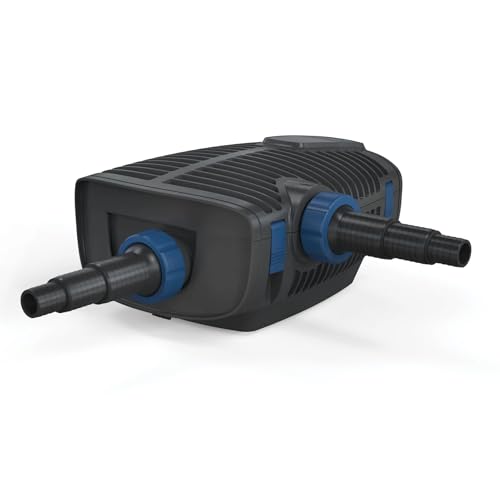
OASE AquaMax Eco Premium Pulse 6 Pond Pump
The quiet, low-draw pump we'd put on a mid-size waterfall. OASE's asynchronous Eco motor sips watts running around the clock and holds its flow at head far better than cheap high-GPH pumps, so you pay more up front and save it back every month.

Alpine Corporation 6550 GPH Submersible Pump
The step up in raw water for a wide or tall waterfall: a rated 6550 GPH and 26 feet of lift, enough to feed a full sheet over a big spillway. It pulls 456 watts to do it, so put it on a falls that needs the flow, not a small one.
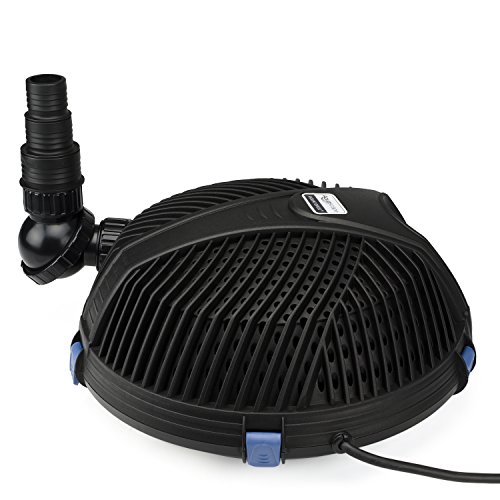
Aquascape AquaForce 1000 Solids-Handling Pump
Our solids-handling mid pick, an asynchronous pump that passes debris instead of clogging on a stocked pond. The pre-filter cage means you clean the intake about once a season, not every week, and it runs efficiently on a modest waterfall.

TotalPond 3600 GPH Waterfall Pump
The cheap way to run a small backyard waterfall. Its 3600 GPH is a zero-head rating, so plan on markedly less over a 3-4 foot rise, but for a short falls on a lightly stocked pond it moves enough water for the money.

VIVOSUN 5300 GPH Submersible Pond Pump
The lowest-cost high-GPH option for a short waterfall or a starter pond. The 5300 GPH is measured at zero head and falls off fast with lift, so read it as a low-head pump; feed a tall falls with something that holds flow better.
What owners say
Real owner reports from the threads and editorial sources we drew on for this guide.
“The Laguna Max-flo 4280 has a maximum of 2219gph at 9' of head, so doesn't meet your needs. Adding in the flow reduction of fittings, it probably won't work if you need 2300gph.”
“You need at least 1.5 times the volume of the pond being circulated per hour. This equates to a 2700 lph pump or more correctly a pump that will supply 2700 lph.”
“That Harbor freight submersible pump uses more watts (175 watts) to pump nearly half the water (2150). Energy efficiency, and smooth running (no vibration = long life) is what makes the Sequence pumps a more expensive.”
“if external I have sequence with more gph than what you are looking for and they are very energy efficient and quiet. Mine is going on 9 or 10 years and no problems what so ever, that is running 24 hrs/day for 9 months out of the year.”
“Save money and go low cost variable speed pump. The jaboa pumps are reliable and energy efficient, go for a larger capacity and then dial it down.”
“One feature that I fail to understand why is missing on 2-6K GPH pumps as standard is remote inlet connection, which I just could not do without. My Oase 2000 is connected to a skinner/ leaf basket down stream. You can pull water from the pump or remote or both. Very reliable pump - had it for 4 years , just awsome”