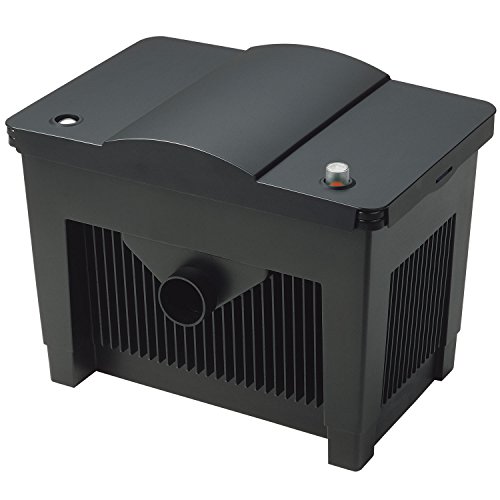
OASE FiltoClear Review: Pressure Filter Verdict for Ponds
By The Pond Review · Updated August 2026
Independent editorial review. We never accept payment for coverage, though we may earn a commission if you purchase through our links.

Verdict
Our verdict is that the FiltoClear is a competent pressure filter whose two real weaknesses are baked into the category, and the owner reports on the garden forums line up with that read rather than contradicting it. The people who bought it for placement, to hide the filter and feed a raised waterfall, describe exactly the frustrations we'd predict: a constant trickle from the backwash line even with the valve set to return to the pond and a pump inside the rated range, and a dirty return for the first thirty seconds after every clean that owners solve by running the first flush to waste. A long-time member's broader caution, that manufacturers sometimes overstate what these filters can do, is the same point our halve-the-rating math makes from the other direction. The dissent worth hearing is that on a large pond with room to build, a hidden bog filter beats a canister on both capacity and upkeep, and we wouldn't overrule that. But for a mid-sized pond where the filter has to disappear and a bog isn't practical, our call stands: buy it for placement, size it to your fish rather than the box number, and respect the backwash rhythm.
Read full take ↓Similar pond filters
A pressure filter like the OASE FiltoClear solves one problem better than any gravity box can, and that problem is placement. You can bury it, tuck it behind a shrub, or sink it below the water line and let the pump push water uphill into a raised waterfall, all while a UVC lamp built into the same canister works on green water. That freedom is the reason to buy one. For a planted water garden or a lightly stocked pond it's a tidy, hide-it-and-forget-it answer that a box filter sitting in plain sight at the pond edge can't match.
What you pay for that freedom is capacity and upkeep. Start with the number on the box and cut it in half. The gallon rating is a fishless, clear-water figure, so a filter badged for 4,000 gallons is closer to 2,000 gallons once there are fish in the pond, and closer to 1,000 once those fish are koi. A pressure filter is mechanical first, with far less room for biological media than a gravity box of similar price, so for a koi load you want to pair it with real bio media or run a gravity stage alongside it. Plan for backwashing more often than a box filter too, because the sealed canister packs its media tight.
The short version
What we like:
- Placement you can't get any other way. Bury it, hide it, or sit it below the water line and let it push uphill to a raised waterfall.
- A UVC clarifier built into the same housing, so mechanical filtration and green-water control share one canister and one set of plumbing.
- A backwash lever that rinses much of the media without opening the lid on a routine clean.
- OASE seals and fittings are better sorted than most of the budget pressure canisters we'd cross-shop it against.
What to watch:
- Less biological capacity than a gravity box at the same price. Undersize it for koi and the water won't hold.
- Backwash-line leaks are the recurring owner complaint, a constant trickle running to waste even with the valve set to return to the pond.
- The first half-minute of water after a cleaning cycle comes back dirty, and owners end up running it to waste before the return goes clear.
- More frequent backwashing than a gravity box, and because the canister is sealed you feel a clog as falling flow rather than seeing it.
Which ponds and setups it fits
Buy the FiltoClear when placement is the constraint. If you can't sit a gravity filter above the water line, if the filter has to be hidden, or if you're feeding a raised waterfall and want the pump to do the lifting, a pressure canister is the tool that fits. On a planted water garden or a lightly stocked goldfish pond sized inside its halved rating, the built-in UV and the buried install make it a clean single-box solution.
Look elsewhere in three cases. For a heavily stocked koi or show pond, you want the biological volume of a gravity box, a bog, or a vortex, because the FiltoClear will be backwashing constantly and still chasing clear water. If the price is the sticking point, a cheaper pressure filter gives you the same buried-and-hidden trick for less. And if you can place a box filter above the water line and don't need it out of sight, a gravity box is more filter per dollar, with no backwash line to leak and no sealed canister to over-pack.
The spec that decides it: halve the rating, then halve again for koi
Every pressure filter is sold on a gallon number, and that number is the most optimistic figure the category allows. It's measured with clear water and no fish, which is a mechanical throughput rating, not a bioload rating. Fish are the load a filter has to process. They eat, they excrete ammonia, and the biological media is what converts that ammonia to something harmless. So the working rule we'd apply to any FiltoClear is to halve the box number for a stocked pond, then halve it again for koi, who are large and heavy feeders. A canister badged for 4,000 gallons is a roughly 2,000 gallon filter with a light fish load and a roughly 1,000 gallon filter with koi.
This matters more on a pressure filter than on a gravity box, because a sealed canister has to fit its foams and bio media into a pressure vessel, and there's only so much room. A gravity box of the same price holds noticeably more biological media. That's the trade you're making when you choose placement over volume. If your pond is stocked with koi and you still want the buried, feed-the-waterfall install, plan to add real biological media or run a gravity stage in series, and size everything to the fish rather than the water. One more correction while we're on specs: the built-in UVC clears suspended, single-cell algae, the pea-soup green-water kind. It does nothing for the string algae you scrape off rocks and waterfalls. That's a different organism and no clarifier touches it.
What owners run into
Our read is that the FiltoClear does its job when it's sized honestly, and the owner reports we trust most aren't about whether it clears water but about two specific frustrations. The first is the backwash line. On the garden forums, a FiltoClear 8000 owner running a 3,000 gallon pond described the problem exactly as we'd flag it:
"I'm running a ~3000 gallon pond through an Oase FiltoClear 8000 pressure filter from a 3690 gph submersed pump. I'm getting a constant trickle of water flowing through the backwash line despite the filter being set to flow back to the pond."
His pump was inside the filter's rated range, so this is a seal-and-valve issue, not overpressure, and it's common enough that we treat it as a known quirk of the design rather than a defect on one unit. The second frustration is the dirty first flush. Another owner watched the return run cloudy right after every clean:
"I recently noticed that after the pumping cycle and the water was turned back on that for the first 30 seconds the water going back into the pond was dirty! My neighbour suggested that I should run the first few gallons of water to waste which I have done and it seems to have worked."
That workaround is the right one, and it's worth knowing before you buy: a pressure filter dumps its first post-clean flush back at the pond unless you send it to waste first. One long-time forum member put the broader caution about the whole category plainly, and it lines up with our halve-the-rating math:
"I understand your frustration, sometimes manufacturers over state what these filters can do."
None of this makes the FiltoClear a bad filter. It makes it a filter with a maintenance rhythm you have to respect, and a rating you shouldn't take at face value.
Build quality and living with it
As pressure canisters go, the OASE build is on the better end. The seals, the clamp, and the backwash mechanism are the parts that decide whether one of these lasts, and OASE has more of them right than the discount brands do. The UVC lamp is a consumable that you replace roughly once a season for it to keep doing anything useful, and the foams wear and get replaced over years. Those are the running costs to plan for, alongside the electricity for the pump you supply.
Living with it means backwashing on a schedule rather than waiting for the water to tell you. Because the canister is sealed and pressurized, a clog shows up as falling flow at the waterfall, not as an obvious pile of muck you can see, so you learn to work the backwash lever before the pond loses turnover. On a correctly sized pond that's a quick weekly job in summer. On an over-stocked one it becomes a near-daily chore, which is the same trap that catches gravity-box owners who buy the badge number instead of sizing to their fish.
How it compares
- Versus a gravity box like the OASE BioSmart 5000: the choice is almost entirely placement against capacity. The BioSmart holds more biological media per dollar and costs less to run, with no backwash line to leak, but it has to sit at the pond edge above the water line where you can see it. The FiltoClear you can bury, hide, or sink below water and feed a raised waterfall, and it includes the UV the BioSmart lacks. Pick the box when you can place it above water and don't need it hidden. Pick the pressure filter when placement is the whole problem.
- Versus a cheaper pressure filter like the Laguna PF4000: you get the same buried-and-hidden install and a built-in UV for less money. The Laguna gives up some of OASE's build refinement and the smoother backwash action, but if the FiltoClear's price is what's stopping you, the cheaper canister does the core job. On a koi pond, both need the same honest downsizing.
One forum member, rebuilding a koi pond and hitting the same placement wall, summed up why people land on a pressure filter at all:
"My problem is that the only type of filter that appear to allow me to ‘hide’ them and still feed via the waterfall, is a pressurised filter."
That's the argument for a pressure filter in one sentence. The counter-argument, also from the forums, is that on a bigger pond a hidden bog filter beats a canister on both capacity and upkeep:
"With a pressure filter you're not guaranteed to have clear water, but if you build and size the bog correctly, you'll have a natural filter and you won't be cleaning filter pads every week or so."
We wouldn't overrule that for a large koi pond with room to build. For a mid-sized pond where a bog isn't practical and the filter has to disappear, the FiltoClear is the answer, sized down and backwashed on schedule.
Setting it up
Match the pump to the filter's rated intake rather than reaching for the biggest pump you own, since overdriving a sealed canister is one way to force water out the backwash line. Aim to turn the pond over about once an hour, twice for a koi pond, and remember the pump's box GPH is measured at zero head, so a tall waterfall lift cuts real output. GFCI-protect everything electrical near the water. After each clean, send the first flush to waste before you return flow to the pond so the dirty first thirty seconds doesn't go back to your fish, then let the biology re-cycle for a few weeks before you judge the water. For a bigger or algae-prone pond where the built-in UVC runs short, our UV clarifier picks cover what to add inline.
Where we land on the FiltoClear
The FiltoClear earns its place when placement is the constraint and you buy it with clear eyes. It's a good pressure filter, hobbled only by the same two things every pressure filter is: an optimistic gallon rating and a maintenance rhythm you can't skip. Size it to your fish rather than your water, add bio media or a gravity stage for a koi load, run the first post-clean flush to waste, and keep an eye on that backwash line, and it delivers the one thing a box filter never will, which is a filter you can hide and a waterfall it can feed.
Buy it for placement, not for capacity. If you can put a gravity box above the water line and don't need it out of sight, you'll get more filter for the money there. If you can't, this is the tool, and it's a competent one once you stop trusting the number on the label.
Our Ratings
Overall score
The seals, clamp, and backwash mechanism are better sorted than the discount pressure canisters, and the pressure vessel itself is durable. It is docked for the recurring backwash-line leaks that appear even within the rated pump range, and for the UVC lamp and foams that are ongoing consumables rather than one-time costs.
Sized honestly and backwashed on schedule, it clears and holds a lightly stocked pond, and the built-in UVC handles green water in the same canister. It loses ground on results for two reasons: less biological capacity than a gravity box of the same price, and a dirty first flush that has to be sent to waste after every clean.
You are paying a premium for placement freedom and an integrated UV, not for capacity. Against a gravity box at a similar price it holds less biological media, and against a cheaper pressure filter it gives up some price to gain build refinement. Fair for what it does, but never a bargain on filtration per dollar.
OASE FiltoClear on Amazon.
The Evidence Behind Our Verdict
Our verdict is that the FiltoClear is a competent pressure filter whose two real weaknesses are baked into the category, and the owner reports on the garden forums line up with that read rather than contradicting it. The people who bought it for placement, to hide the filter and feed a raised waterfall, describe exactly the frustrations we'd predict: a constant trickle from the backwash line even with the valve set to return to the pond and a pump inside the rated range, and a dirty return for the first thirty seconds after every clean that owners solve by running the first flush to waste. A long-time member's broader caution, that manufacturers sometimes overstate what these filters can do, is the same point our halve-the-rating math makes from the other direction.
The dissent worth hearing is that on a large pond with room to build, a hidden bog filter beats a canister on both capacity and upkeep, and we wouldn't overrule that. But for a mid-sized pond where the filter has to disappear and a bog isn't practical, our call stands: buy it for placement, size it to your fish rather than the box number, and respect the backwash rhythm.
Our rating above is our own editorial call. What follows is the field evidence we weighed to reach it: first-hand reports from pond owners on dedicated pond and koi forums, which we lean on more than manufacturer-influenced published reviews because unsponsored owners tend to be the more candid signal.
What Pond Forums Say
“My problem is that the only type of filter that appear to allow me to ‘hide’ them and still feed via the waterfall, is a pressurised filter.”Source →
“I'm running a ~3000 gallon pond through an Oase FiltoClear 8000 pressure filter from a 3690 gph submersed pump. I'm getting a constant trickle of water flowing through the backwash line despite the filter being set to flow back to the pond. I assume this is not a result of excess pump flow/pressure as the manual lists the filter to take up to a 4200 gph pump.”Source →
“I recently noticed that after the pumping cycle and the water was turned back on that for the first 30 seconds the water going back into the pond was dirty! My neighbour suggested that I should run the first few gallons of water to waste which I have done and it seems to have worked.”Source →
“I understand your frustration, sometimes manufacturers over state what these filters can do.”Source →
“With a pressure filter you're not guaranteed to have clear water, but if you build and size the bog correctly, you will have a natural filter and you won't be cleaning filter pads every week or so.”Source →
Frequently asked questions
Is the OASE FiltoClear worth it?
You are paying a premium for placement freedom and an integrated UV, not for capacity. Against a gravity box at a similar price it holds less biological media, and against a cheaper pressure filter it gives up some price to gain build refinement. Fair for what it does, but never a bargain on filtration per dollar.
How reliable is the OASE FiltoClear?
The seals, clamp, and backwash mechanism are better sorted than the discount pressure canisters, and the pressure vessel itself is durable. It is docked for the recurring backwash-line leaks that appear even within the rated pump range, and for the UVC lamp and foams that are ongoing consumables rather than one-time costs.
How well does the OASE FiltoClear perform?
Sized honestly and backwashed on schedule, it clears and holds a lightly stocked pond, and the built-in UVC handles green water in the same canister. It loses ground on results for two reasons: less biological capacity than a gravity box of the same price, and a dirty first flush that has to be sent to waste after every clean.
What do real owners say about the OASE FiltoClear?
Our verdict is that the FiltoClear is a competent pressure filter whose two real weaknesses are baked into the category, and the owner reports on the garden forums line up with that read rather than contradicting it. The people who bought it for placement, to hide the filter and feed a raised waterfall, describe exactly the frustrations we'd predict: a constant trickle from the backwash line even with the valve set to return to the pond and a pump inside the rated range, and a dirty return for the first thirty seconds after every clean that owners solve by running the first flush to waste. A long-time member's broader caution, that manufacturers sometimes overstate what these filters can do,
Options Worth Checking Out
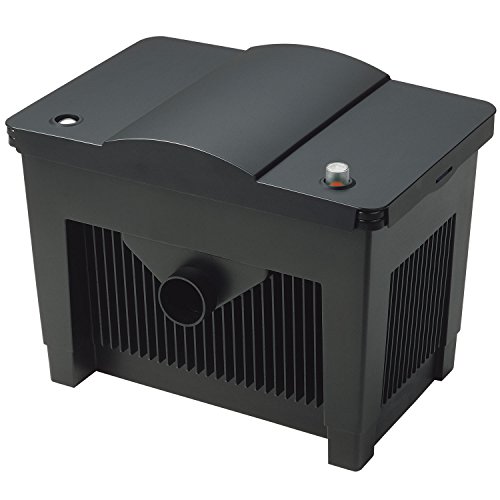
OASE BioSmart 5000 Pond Filter
The gravity-box counterpoint. More biological media per dollar and cheaper upkeep than any pressure canister, with no backwash line to leak. The catch is placement: it sits at the pond edge above the water line and can't be buried or hidden.

Laguna PF4000 Pressure-Flo Filter
The budget pressure option if the FiltoClear's price stings. Same buried, hidden, push-to-a-waterfall trick with a built-in 36W UV for less. You give up some build refinement and OASE's smoother backwash lever, but the placement freedom is identical.
You Might Also Need
Accessories worth grabbing alongside your purchase