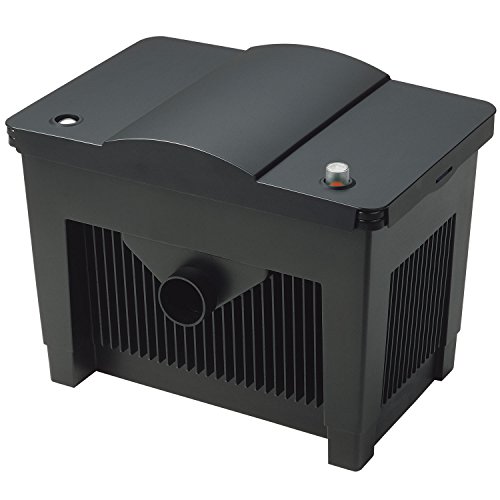
The Best Pressurized Pond Filter
By The Pond Review · Updated August 2026
Independent editorial guide. We never accept payment for coverage, though we may earn a commission if you purchase through our links.
Quick Take
Buy a pressurized pond filter for one structural reason and one only: it's a sealed canister, so you can bury it below grade out of sight and it'll pump its cleaned water uphill to feed a waterfall or a stream. A gravity box can't do either, because it has to sit open at the pond edge above the water line and drain back down. Most pressure canisters also carry a UV lamp, so the same unit clears green water. If hiding the filter or lifting the water is your problem, this is the tool for it.
The tradeoffs come with the seal. A closed canister clogs faster than an open box, so you backwash it often, and if you skip that the flow down your waterfall quietly falls off before you notice. The gallon ratings are optimistic too: halve the number on the box for a koi load and buy the next size up. And match it to a modest bioload, because a big messy koi pond is better served by a gravity box you can open and rinse than by any sealed can.
We've matched four pressurized filters to real ponds below, from the value canister we'd start with to the premium and budget options for different layouts and fish loads. See picks ↓

A pressurized pond filter is a sealed canister that water passes through under pressure, rather than an open box that drains back to the pond by gravity. That one difference, the seal, is the entire reason to buy one, and it's worth being clear-eyed about what it buys you and what it costs.
Our view is narrow on purpose. A pressure filter is the right answer when your layout forces it: when you can't hide a box at the water's edge, or you want to push filtered water uphill to a waterfall. It's the wrong answer when you're just chasing more biological capacity for a heavy koi load, because on that axis a gravity box beats it. Pick a pressure canister for where it goes, not for how much fish it can carry.
What a pressurized filter buys you
Strip away the marketing and a pressure filter is a sealed plastic drum packed with foam and biological media, with an inlet and an outlet that hold pressure. Water is pushed in by a pump, forced through the media, and leaves under enough pressure to travel somewhere. Many models fold a UV lamp into the same housing, so the water passes the bulb on its way out and green-water algae gets zapped in the same trip. It's a tidy piece of engineering, and for the right pond it solves a problem nothing else solves as cleanly.
The line we know best in this class is the OASE FiltoClear, which we cover in depth in our OASE FiltoClear review. It's the reasoning behind the premium pick below, and it's the unit we'd hand someone who wants a pressure filter to last rather than to be replaced in two seasons.
The one structural advantage: bury it and pump uphill
Here's the reason to reach for a pressure filter, and it has nothing to do with capacity. Because the canister is sealed, you can put it almost anywhere. Bury it up to its lid behind a shrub, sink it below the water line, tuck it in a filter pit, and it keeps working, because the water inside is under pressure and doesn't need gravity to get back to the pond. A gravity box can't do any of that. It has to sit at the pond edge, above the water line, in plain sight, so it can drain back down.
The same pressure that lets you hide the canister also lets you lift the water. A pressure filter will push its cleaned output uphill, so you can run it to the top of a waterfall or the head of a stream and let it fall back through the pond. That's the layout a pressure filter is built for: a hidden canister feeding a raised water feature. If that describes your pond, no gravity box will do the job, and the sealed canister stops being a compromise and becomes the only sensible tool.
The catch the box never mentions
The seal that makes the canister so placeable is also what makes it fussy. An open gravity box has room to spare and forgives a neglectful owner for weeks. A sealed canister doesn't. Solids pack into the media, back-pressure builds, and the flow through the whole system drops. Owners who run these know the pattern well: the water is clear and the waterfall is strong, then a few days later the flow down the falls has fallen off and it's time to backwash. One keeper who installed one described exactly that, the flow greatly reduced after a few days, and rigged a timer to shut the pump off nightly so the canister could shed its load.
So a pressure filter is a maintenance commitment, not a set-and-forget box. You backwash it, spin the valve or pull the lid and rinse, on a schedule measured in days to a couple of weeks through summer, not months. Some experienced keepers are blunt that the cheaper multifunction canisters don't hold up, that gaskets and hinges and small parts give out after a year, and that the media they ship with is mediocre. That's a real minority view worth respecting: buy for the seal and the placement, keep up with the backwash, and don't expect a bargain canister to be a lifetime purchase.
Halve the rating, then buy the next size up
The gallon number on a pressure filter is the most optimistic figure in pond gear. It's a fishless rating, the volume the canister can polish with no livestock adding waste. Put fish in, and especially put koi in, and the real capacity falls hard, because biological filtration is sized to the waste load, not to the water the waste sits in. A canister badged for 1,600 gallons isn't a 1,600 gallon koi filter. Read it as roughly half that once koi are producing ammonia, and less again if the pond is heavily stocked.
The rule we use is plain arithmetic done at the store instead of after the waterfall slows: halve the rated gallons for a koi load, then buy the next size up from whatever that leaves you needing. A canister runs closer to its limit than a gravity box because the sealed volume is small and it clogs as it loads, so headroom isn't luxury, it's what keeps the flow steady between backwashes. Undersize a pressure filter and you're backwashing every other day and still watching the falls run thin. Oversize it by a step and the same pond stays clear with far less fuss.
Where a gravity box still wins
None of this makes the pressure canister the default filter. For a big, heavily stocked koi pond, an open gravity box or a purpose-built koi system beats it, and it isn't close. A gravity box holds far more biological media per dollar, it clogs slower because it has room, and when it does load up you lift the lid and rinse the foams in a bucket in a few minutes rather than fighting a sealed valve. For the raw job of processing a heavy koi bioload and being easy to clean, the open box is the better machine.
So the choice comes down to your pond's layout and its fish load, not to which filter is "better" in the abstract. If you keep a serious koi load and can place an open box at the edge, size a gravity filter to the fish and skip the canister. Our koi pond filter guide walks through that sizing math and the box we'd start with. Reach for a pressure filter when placement or an uphill water feature is the thing forcing your hand.
Matching the filter to your pond
Work from the layout first. If you can't hide a box above the water line, or you want the filter to feed a raised waterfall or stream, a pressure canister is your filter and the only question left is which size. If you can place an open box and your pond is a lightly stocked water garden or a young-koi pond, a pressure canister is a fine choice for the clean look and the built-in UV. If you can place a box and you run a heavy adult koi load, buy the gravity box instead.
Then size to the fish, not the gallons. Do the halving math above, land on a rated capacity with real headroom over your koi load, and match a pump to it that delivers its flow at your actual head height, because a pump's box number is measured at zero lift and drops fast once the water has to climb. Feed the canister the flow it's rated for, not the biggest pump you own, and plan the backwash into your week from day one so the falls never gets the chance to run thin.
How we'd choose among the four
For most people who need a pressurized filter, the Grech CPF-2500 is where we'd start. It's the most filter per dollar here, a sealed canister with a built-in 13W UV and a pump included in the box, so one purchase hides out of sight and clears green water. Read its 1,600-gallon rating as roughly half that for koi and it fits a modest stocked pond well. If you want the canister that lasts and can pay for it, the OASE FiltoClear is the premium buy, the line we've reviewed and the one least likely to shed parts after a season.
For a larger but lightly stocked water garden, the SunSun CPF-250 carries the highest rating in this lineup, 2,600 gallons unstocked and around 1,300 with fish, a compact canister with an 11W UV that tucks below the water line and feeds a stream uphill. Halve that rating for koi and it still lands above the Grech, so read it as the higher-capacity pick, not a smaller one. And the Anbull 1060GPH is the cheapest way in, fine as a starter on a modest goldfish or young-koi pond, with the same caveat that rides on every budget canister: the seals and small parts are the first to go, and a growing koi load will outrun it. Match the canister to your layout and your fish, keep up with the backwash, and each of these has a pond it fits.
The picks
Products we recommend for this guide.
Grech CPF-2500 Pond Pressure Filter with UV
Our value pick and the most filter per dollar here: a sealed canister with a built-in 13W UV and a 720GPH pump in the box, so one unit buries out of sight and clears green water. Read the 1,600-gallon rating as roughly half that for a koi load.

OASE 3rd Gen FiltoClear Pressure Filter
The premium canister, and the OASE line we've reviewed in full. A sealed build with an integrated UV and a backwash lever, made to sit below grade and push cleaned water uphill to a waterfall. You pay for it, but it outlasts the cheap cans.

SunSun CPF-250 Pond Pressure Filter
The highest-rated canister here, for a larger, lightly stocked pond: a compact 11W-UV unit that hides below the water line and feeds a stream uphill. Halve its 2,600-gallon rating for koi and it still tops the Grech; stay ahead of the backwash.

Anbull 1060GPH Bio Pressure Pond Filter
The cheapest way into a pressurized setup: a small sealed canister with a 9W UV lamp for a modest goldfish or young-koi pond. Undersized for a stocked koi load, and the seals are the first thing to go, so buy it as a starter you may replace.
What owners say
Real owner reports from the threads and editorial sources we drew on for this guide.
“If what you are asking about is something such as this PondMax Pressurized filter with UV and Backwash , then I am adamantly not a fan. They do not last. There will eventually be gasket parts or hinges or some other part will be needed after a year of using it.”
“The water is AMAZINGLY clear with this new filter. I did encounter clogging issues, after a few days, the flow down my waterfall was greatly reduced.”
“As unpopular as they are on this forum, I use a pressurized filter with a UV light. I use my 1200 gph pump for it and it splashes back into my pond.”
“I just got one and just LOVE it!! Looks very well made and has a warranty too. Water now has no little floaty stuff and even more crystal clear so I am very happy so far.”