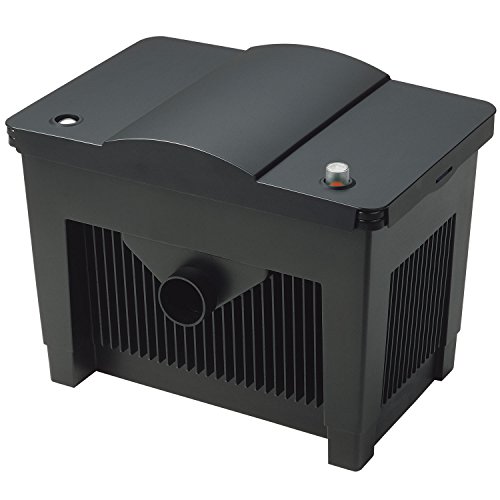
Grech CPF-2500 Pressure Filter Review
By The Pond Review · Updated September 2026
Independent editorial review. We never accept payment for coverage, though we may earn a commission if you purchase through our links.

Verdict
Owner sentiment on the pond forums runs skeptical, and we have let our verdict follow it honestly. The most experienced keepers are pointed: one is "adamantly not a fan," warning that "there will eventually be gasket parts or hinges or some other part will be needed after a year," and that the all-in-one concept "is not a good concept for filtration for the small size they are." The recurring theme is optimistic sizing, another keeper recalling a filter with "about a half dozen 2-inch bio-balls" advertised as good "for ponds up to 1000 gallons," and landing on the constructive rule that these work "on smaller ponds (500 gal or less) if they were designed to be used exclusively as mechanical filters." On stocking, the shorthand is blunt: "pressurized is fine for a small pond with no fish or hardly any fish," and you "will still be back flushing it a lot." But the picture is not all negative, and the pragmatists are worth hearing. One owner who runs one against the grain reports a realistic "may be once a week" clean that "take about 15 minutes," and a newer owner who hit clogging solved it with a nightly pump-off timer. The single advantage nobody disputes is placement, as one keeper flatly notes: "the only benefit to a pressure filter is you can put them anywhere you like and bury them if desired." Weigh it all under the verdict: a hideable clarifier and mechanical filter that earns its keep on a light fish load and sized for half its rating, and a poor bet as a koi pond's only filter.
Read full take ↓Similar pond filters
The Grech CPF-2500 is a budget all-in-one pressure filter: a sealed canister that takes pump-fed water, runs it through foam and bio media, passes it under a built-in 13-watt UV clarifier, and sends it back clear. Its two real virtues are convenience and concealment. Because the water is pushed through under pressure, the canister can sit above pond level or be buried up to its neck behind a shrub, out of sight, and it bundles mechanical filtration, some biological media, and a green-water-clearing UV into one cheap box. For a small or lightly stocked pond, or as a green-water clarifier and mechanical pre-filter on a bigger one, it does a genuine job for the money.
The honest catch is that it is oversold and cleaning-heavy, and the pond forums are blunt about it. The "up to 1,600 gallons" on the box is optimistic; for a pond with koi and their heavy waste, rate it for half that or less. The built-in bio capacity is small, the backwash handle rinses rather than fully cleans, so you will still open it up regularly, and the gaskets, clamps, and UV bulb are wear items on a cheap build. Buy it understanding what it is, a convenient, hideable clarifier and mechanical filter for a modest fish load, and it earns its keep. Ask it to be the sole biological filter on a stocked koi pond and it will disappoint, exactly as the experienced keepers warn.
The short version
What works:
- All-in-one and hideable: pressure-fed, so it can sit above the pond or bury up to its neck, out of sight, with mechanical media, bio media, and a UV in one box.
- The 13-watt UV clears green, single-celled algae well, turning pea-soup water clear in a few days when the flow is slowed enough.
- Cheap for what it bundles, and simple to set up: hose in, hose out, plug in the pump and the UV.
- A quick backwash between full cleanings buys you time, and it is a fine mechanical pre-filter ahead of a bigger biological filter.
What to watch:
- The gallon rating is optimistic. For koi, rate it for roughly half the box number or less, because their waste load is heavy.
- Small built-in bio capacity: it is not enough biological filtration on its own for a well-stocked koi pond.
- The backwash rinses rather than fully cleans; you will still open it and clean the foams regularly, often weekly.
- Gaskets, clamps, and the UV bulb are wear items on a budget build, and the canister will crack if left to freeze in winter.
Who it is for, and who should skip it
Buy the Grech CPF-2500 if you have a small to mid-size pond with a modest fish load, or a goldfish pond, and you want one hideable box that clears green water and handles mechanical filtration without a visible DIY barrel sitting by the water. Its single genuine advantage over a homemade filter is placement, and one keeper puts it exactly: "the only benefit to a pressure filter is you can put them anywhere you like and bury them if desired." If concealment and an all-in-one UV matter to you and your fish load is light, this is a reasonable buy.
Skip it as the only filter on a stocked koi pond. The experienced voices on the forums are consistent that the built-in biological capacity is too small for a heavy waste load, and that you will be cleaning it constantly. As one keeper sums the sizing up, "pressurized is fine for a small pond with no fish or hardly any fish," and you "will still be back flushing it a lot." If you keep koi and want it in the system anyway, use it as a green-water clarifier and mechanical pre-filter feeding a properly sized biological filter, not as the whole filtration plan.
Size it for half the box rating
The most important number on this filter is the one the box overstates. Pressure filters are rated for tidy-looking gallon figures that assume light stocking and clean conditions, and keepers who have owned them are wry about it. One recalls a filter with "about a half dozen 2-inch bio-balls in it, and that was suppose to be good for ponds up to 1000 gallons according to the advertising specs," which tells you how thin the biological media is relative to the rating. The rule of thumb the forums land on is to take the maker's gallon figure and cut it in half for goldfish, and to a third or less for koi, whose waste output is far higher.
Practically, treat the CPF-2500's "up to 1,600 gallons" as a headline for a lightly stocked ornamental pond, and match the real capacity to your fish. The same keeper's constructive take is the right frame: these back-flushing canisters "could be used successfully on smaller ponds (500 gal or less) if they were designed to be used exclusively as mechanical filters, and the ponds utilized some other form of practical biological filtration." Size it for the fish, not the sticker, and it performs; size it for the sticker and it falls behind.
What the UV does, and what it does not
The built-in UV is the feature that sells these filters, and it is worth being precise about what it does. A UV clarifier kills free-floating, single-celled algae as the water passes the bulb, which is what clears green, pea-soup water, and owners report it working fast, green tanks going clear in a couple of days. What it does not touch is string algae, the hair-like algae clinging to rocks and waterfalls, because that algae never flows past the bulb. If your problem is green water, the UV is the fix; if it is string algae, this filter will not help, and no clarifier will.
The catch with any UV, built-in or not, is flow rate. The water has to pass the bulb slowly enough for the dose to land, so a pump that pushes too much water through the canister blows past the UV too fast to clarify. As one keeper puts it, "in order for your UV to be effective, water needs to pass fairly slowly, by it." Match the pump to the filter rather than over-pumping it, and treat the UV bulb as a consumable that loses output over a season and needs replacing roughly once a year to keep working. We keep this to water clarity on purpose: a UV clears green water, it is not a fish-disease treatment, and it is no substitute for good husbandry.
The backwash is a rinse, not a cleaning
Every one of these filters advertises a backwash handle, and the near-universal owner verdict is that it helps but does not fully clean. You twist the handle to reverse-flush the foams between services, which buys time, but the gunk that matters still packs into the media, and you will open the canister and clean the foams by hand on a regular schedule, often about weekly in season. A pragmatic owner who runs one against the forum's skepticism reports the realistic cadence: "I clean my canister filter less often than before I added filtration to my skimmer, may be once a week. It take about 15 minutes." That is the honest maintenance picture: a quick weekly clean, not a set-and-forget box, and a backwash that is a stopgap rather than a substitute.
One clogging quirk is worth planning for. When the foams load up, flow drops and your waterfall thins to a trickle. A recent owner's fix is a good one: "I did encounter clogging issues, after a few days, the flow down my waterfall was greatly reduced," solved by putting the pump on a timer, "a smart outlet that shuts off the pump each night at 2AM for 5 minutes," after which the clogging stopped. A brief daily pump-off lets the media settle and shed, and it costs nothing.
Build, wiring, and winter
This is a budget filter, and the build shows it in the parts that wear. Experienced keepers warn that the failure points are the seals and fittings, one noting that with these canisters "there will eventually be gasket parts or hinges or some other part will be needed after a year of using it. Also, it is not a good concept for filtration for the small size they are." Keep an eye on the O-rings and the lid clamp, seat the gasket clean each time you close it up, and expect the UV bulb and the odd seal to be maintenance items rather than one-time buys.
On wiring, both the pump feeding it and the UV plug into household current, so put them on a GFCI-protected outlet, which the National Electrical Code requires for outdoor and near-water circuits, and give each cord a drip loop so water runs off rather than tracking into the connection. And plan for winter: a sealed canister full of water will crack when it freezes, so in cold climates drain it and bring it inside once the pond shuts down for the season, the same way owners say they "bring it inside in Nov., as it will crack and freeze in winter weather." Store it dry and it lasts; leave it out to freeze and it splits.
How it compares
If the Grech is not the right size or build for your pond, our best pressure pond filter guide and our take on pressurized versus gravity filters lay out the field. Here is how the closest options compare.
- Versus the SunSun CPF-250: the same CPF-series canister from the same OEM family, with a lower 11-watt UV. The model numbers and the sellers' gallon ratings are confusingly inconsistent, so ignore both and size to your fish; the tradeoffs, optimistic rating and cheap seals, are identical.
- Versus the Anbull bio pressure filter: a comparable budget pressure canister with a smaller UV, aimed at small ponds. Similar concept and similar limits; pick on price and the gallon rating that honestly matches your fish load, not the headline number.
- Versus the OASE FiltoClear: the quality tier above, at several times the price. It buys better seals, a properly engineered backwash, and honest sizing that holds up, and it is the pressure filter to step up to if you keep koi and want a canister you can trust as real filtration rather than a clarifier and pre-filter.
Our verdict
For what it is, a cheap, hideable, all-in-one clarifier and mechanical filter for a small or lightly stocked pond, the Grech CPF-2500 is a fair buy, and its UV clears green water quickly. Bury it out of sight, match a modestly sized pump to it so the UV has time to work, clean the foams weekly, and it does the job it is built for at a price that undercuts a proper filter by a wide margin.
What keeps it from a stronger score is that the box promises more than the canister delivers. The gallon rating is optimistic, the built-in biological capacity is too small to be a koi pond's only filter, the backwash is a rinse rather than a cleaning, and the seals and bulb are wear items on a budget build. Size it for half its rating or less, treat it as a clarifier and pre-filter rather than the whole filtration plan, bring it in before it freezes, and it earns its keep. Expect it to carry a stocked koi pond alone, and the forum skeptics will be proven right.
Our Ratings
Overall score
The weak spot. This is a budget canister, and owners report the gaskets, hinges, clamps, and UV bulb as wear items that need attention or replacement within a year or two. The sealed canister also cracks if left to freeze, so it must be drained and stored indoors over winter. Treat it as a filter you maintain and eventually re-seal, not one you install and forget.
It does the job it is built for well: the UV clears green water fast, and as a hideable all-in-one clarifier and mechanical filter for a light fish load it performs. It loses real points because the built-in biological capacity is too small to filter a stocked koi pond on its own, the backwash rinses rather than cleans, and delivered performance depends on sizing the pump so the UV has time to work.
For the money it bundles a lot, mechanical media, some bio media, and a green-water-clearing UV, in one hideable box, which is real value on a small or lightly stocked pond. Docked because the optimistic gallon rating leads buyers to under-filter, and because the ongoing cost of bulbs and seals and the frequent cleaning erode the low sticker price.
Grech CPF-2500 Pressure Filter on Amazon.
The Evidence Behind Our Verdict
Owner sentiment on the pond forums runs skeptical, and we have let our verdict follow it honestly. " But the picture is not all negative, and the pragmatists are worth hearing. One owner who runs one against the grain reports a realistic "may be once a week" clean that "take about 15 minutes," and a newer owner who hit clogging solved it with a nightly pump-off timer.
" Weigh it all under the verdict: a hideable clarifier and mechanical filter that earns its keep on a light fish load and sized for half its rating, and a poor bet as a koi pond's only filter.
Our rating above is our own editorial call. What follows is the field evidence we weighed to reach it: first-hand reports from pond owners on dedicated pond and koi forums, which we lean on more than manufacturer-influenced published reviews because unsponsored owners tend to be the more candid signal.
What Pond Forums Say
“I clean my canister filter less often than before I added filtration to my skimmer, may be once a week. It take about 15 minutes .”Source →
“I did encounter clogging issues, after a few days, the flow down my waterfall was greatly reduced. It was easy enough to fix by shutting off the pump. I then installed a smart outlet that shuts off the pump each night at 2AM for 5 minutes. I have not had a clogging issue since.”Source →
“I feel some of the back-flushing designs could be used successfully on smaller ponds (500 gal or less) if they were designed to be used exclusively as mechanical filters, and the ponds utilized some other form of practical biological filtration.”Source →
“the only benefit to a pressure filter is you can put them anywhere you like and bury them if desired.”Source →
“They do not last. There will eventually be gasket parts or hinges or some other part will be needed after a year of using it. Also, it is not a good concept for filtration for the small size they are.”Source →
“pressurized is fine for a small pond with no fish or hardly any fish .You will still be back flushing it a lot .”Source →
Frequently asked questions
Is the Grech CPF-2500 Pressure Filter worth it?
For the money it bundles a lot, mechanical media, some bio media, and a green-water-clearing UV, in one hideable box, which is real value on a small or lightly stocked pond. Docked because the optimistic gallon rating leads buyers to under-filter, and because the ongoing cost of bulbs and seals and the frequent cleaning erode the low sticker price.
How reliable is the Grech CPF-2500 Pressure Filter?
The weak spot. This is a budget canister, and owners report the gaskets, hinges, clamps, and UV bulb as wear items that need attention or replacement within a year or two. The sealed canister also cracks if left to freeze, so it must be drained and stored indoors over winter.
How well does the Grech CPF-2500 Pressure Filter perform?
It does the job it is built for well: the UV clears green water fast, and as a hideable all-in-one clarifier and mechanical filter for a light fish load it performs. It loses real points because the built-in biological capacity is too small to filter a stocked koi pond on its own, the backwash rinses rather than cleans, and delivered performance depends on sizing the pump so the UV has time to work.
What do real owners say about the Grech CPF-2500 Pressure Filter?
Owner sentiment on the pond forums runs skeptical, and we have let our verdict follow it honestly. " But the picture is not all negative, and the pragmatists are worth hearing. One owner who runs one against the grain reports a realistic "may be once a week" clean that "take about 15 minutes," and a newer owner who hit clogging solved it with a nightly pump-off timer.
Options Worth Checking Out

SunSun CPF-250 Pressure Filter with UV
The same CPF-series canister from the same OEM family as the Grech, with an 11-watt UV. The model numbers and sellers’ gallon ratings are confusingly inconsistent, so ignore both and size it to your fish; the budget tradeoffs are identical.

Anbull 1060 GPH Bio Pressure Pond Filter
A cheaper, smaller budget pressure canister with a lower-wattage UV, aimed at small ponds. Same all-in-one concept and the same limits as the Grech; choose on price and on the gallon figure that honestly matches your fish load, not the headline.

OASE FiltoClear Pressure Filter
The quality tier above, at several times the price. Better seals, a properly engineered backwash, and sizing that holds up. The pressure filter to step up to if you keep koi and want a canister you can trust as real filtration, not merely a clarifier.