How to Clear Green Pond Water (Fast, and Keep It Clear)
By The Pond Review · Updated August 2026
Independent editorial guide. We never accept payment for coverage, though we may earn a commission if you purchase through our links.
Quick Take
Green water is a bloom of microscopic, free-floating algae, and no filter alone will clear it because the cells are too small to strain out and multiply faster than any filter removes them. The one piece of hardware that reliably clears it's a UV clarifier: water is pumped past a UV-C lamp, the light kills the suspended algae, and your pond runs clear in a few days. That's our default fix for any green pond.
Size it by wattage against volume, roughly 2 watts of UV-C per 100 gallons, and ignore the inflated gallon rating on the box. Then throttle the flow so the water gets a long enough dose on the way past the lamp. A clarifier won't touch the string algae on your rocks, and reaching for algaecide on a heavy bloom can crash your pond's oxygen and suffocate the fish, so we'd run the UV over a chemical every time. It's a seasonal tool: run it until the water clears, then it can come off.
Below: the clarifier we'd put on a small backyard pond, a bigger unit for stubborn or larger water, the filter to pair it with, and a low-cost way to get real wattage. See picks ↓

Your pond was clear in spring and now you can't see the fish a few inches down. The water has gone opaque, somewhere between pea soup and jade, and every tip you find online seems to point at a different product. Most of them won't clear it, and one of the popular ones can kill your fish.
Here's our diagnosis, the single hardware fix that works, the arithmetic to size it right, and the two mistakes that keep ponds green all summer.
Green water is a bloom of single-celled algae
Green water is a suspended bloom of microscopic, single-celled algae, millions of them floating free in the water column and tinting the whole pond that pea-soup or jade color. Getting that straight is the first step, because the fix depends entirely on what you're looking at. This isn't string algae, the slimy green hair you pull off rocks and the waterfall lip. It isn't the brown sludge on the bottom. Those are separate problems with separate answers, and a tool that clears one does nothing for the others.
The bloom feeds on two things your pond has in abundance by early summer: sunlight and dissolved nutrients from fish waste, uneaten food, and runoff. Warm water and long days set it off, which is why a pond that ran clear in April can go opaque within a week come June. Once it takes hold the water can turn so green you lose sight of a koi a hand's depth down. A standard mechanical or biological filter catches none of it, because the cells are far too fine to strain and they reproduce faster than any filter can ever pull them out.
Why a UV clarifier is the reliable fix
The one piece of hardware that clears a green-water bloom on demand is a UV clarifier. Pond water is pumped past a UV-C lamp inside a sealed housing, the light damages the algae cells as they flow by, and the killed cells clump together so your filter or the pond floor can finally take them out. Within a few days a pea-soup pond runs clear, and owners describe the turnaround as dramatic because it's. We reach for a clarifier first on any green-water problem, and it's the recommendation we're most confident making on this whole site, because the physics isn't in question and the owner reports line up behind it.
A clarifier isn't a sterilizer, and the difference is worth knowing before you spend. Same lamp, different job. A clarifier moves water past the light fast enough to knock down free-floating algae. A sterilizer runs the water past the lamp far slower, so it also kills bacteria and parasites, which is a fish-health tool, not a water-clarity one. For green water you want the clarifier flow: quicker past the lamp, lighter dose per pass, clear water in a few days.
How to size a UV to your pond and pump
Two numbers decide whether a clarifier clears your pond or disappoints you, and only one of them is the pond's gallons. Start with wattage against volume. A workable rule of thumb is about 2 watts of UV-C per 100 gallons, so a 900-gallon pond wants roughly an 18W unit and an 1,800-gallon pond wants something in the 32W range. Box ratings routinely claim four to eight times that coverage, a 9W lamp sold as good for a few thousand gallons, so read the wattage and do the division yourself instead of trusting the headline gallon figure.
The second number is flow, and it decides more than most buyers realize. The lamp only kills water that passes close to it for long enough, so pushing too much through a small unit gives each drop too brief a dose to matter. A 9W clarifier is happy treating roughly 1,200 gph or less. That's how an owner can clear a 1,200-gallon pond with a modest 9W lamp when the flow through it's gentle, as some report, while the same lamp stalls on a smaller pond that blasts water through at full pump speed. Size the watts to your gallons, then throttle the flow on the UV line so the water gets a proper zap on the way past.
In practice that means a 9W to 18W clarifier suits most small backyard ponds, a 28W to 32W unit covers a larger or heavily stocked pond, and a ball valve on the UV feed lets you slow the flow to the gentle rate the lamp wants. Match the pump to the pond first, then dial the UV line down, rather than buying a bigger lamp to make up for water racing past too fast.
The two mistakes that keep ponds green
The first mistake is aiming a UV at the wrong algae. A clarifier clears suspended single-celled algae, the stuff that turns the water itself green. It does nothing to string algae, the green hair clinging to your rocks, liner, and waterfall, because that algae never floats past the lamp to get zapped. Buyers who install a clarifier expecting the slime on the rocks to vanish end up annoyed at a unit that's doing its job perfectly on a problem they don't have. String algae comes off by hand, by cutting the nutrients that feed it, and with barley, never with UV.
The second mistake is more dangerous: reaching for a bottle of algaecide to nuke a heavy bloom. Kill a pond full of algae all at once and it all dies and decomposes at once, and that decomposition pulls oxygen straight out of the water. On a warm night, when dissolved oxygen is already at its lowest, that crash can suffocate your fish before morning. A UV clears the same bloom over several days, gently enough that the oxygen stays where the fish need it. If you do use a chemical, choose a fish-safe product and follow the label dose exactly, but for a green pond with fish in it we'd run a clarifier over an algaecide every time.
Barley, shade, plants and water changes are support, not the fix
A clarifier treats the symptom fast. Everything else you read about green water treats the cause slowly, and you want both working together. Cutting the fuel is the long game, and it comes down to less light and fewer nutrients:
- Feed the fish less, so less uneaten food and waste dissolves into the water.
- Add more plants, so they outcompete the algae for the nutrients it lives on.
- Float lilies or run a fountain to throw shade and cut the sunlight the bloom feeds on.
- Lay in barley straw, which releases compounds as it breaks down that suppress new algae over weeks.
- Do a partial water change to dilute the nutrient load while the rest catches up.
None of these will clear an active pea-soup bloom on the timescale a UV will, and pinning your hopes on them alone is how a pond stays green all summer. Run the clarifier to get your water back this week, then use shade, plants, feeding discipline, and barley to make the bloom less likely to return once the lamp comes off.
Run it until the water clears, then it can come off
A UV clarifier is a seasonal tool, not a permanent fixture, and treating it that way saves money and hassle. Plenty of owners plug one in when the water starts to haze over in spring, run it the week or two it takes to clear, then pull it out and leave it off for the rest of the year with the water holding clear behind it. You don't need it running every hour of every day. Once the bloom is gone and your plants and filtration keep the nutrients in check, the pond stays clear on its own.
Two upkeep notes if you run one. The UV-C lamp fades long before it stops glowing, losing much of its killing power inside a year or two, so swap the bulb on that schedule rather than waiting for a green pond to tell you it died. And keep the quartz sleeve around the lamp clean, because a film of scale or algae on the sleeve blocks the very light the system depends on.
How we'd set it up and what to pair it with
Plumb the clarifier inline, so pond water is pumped through it and back, and place it early in the line where the flow can be throttled to the gentle rate the lamp wants. Feed it with a pump sized to your pond, not the biggest one you own, and fit a ball valve so you can slow the UV line without starving the rest of your plumbing. Give it a few days before you judge it, because clearing is gradual, not instant, and a pond that's still faintly hazy on day two is usually clear by day four.
Pair the clarifier with a filter that can catch the algae it kills. The UV clumps the dead cells; a mechanical and biological filter then traps them and processes the fish waste that fed the bloom in the first place. Our top pick here's the Tetra Pond GreenFree UV Clarifier for small to mid ponds, and the full UV clarifier lineup covers the bigger, higher-flow options if your pond needs more lamp.
Our call if your pond just turned green
Green water is one of the few pond problems with a clean, reliable answer. It's a bloom of single-celled algae, no filter alone will clear it, and a correctly sized UV clarifier will, usually within a few days. Buy for your gallons at about 2 watts per 100, throttle the flow so the water gets a real dose, skip the algaecide that can crash your oxygen, and don't expect it to touch the string algae on your rocks. Run it until the water clears, then let it come off and lean on shade, plants, and lighter feeding to keep it that way.
The picks
Products we recommend for this guide.

Tetra Pond GreenFree UV Clarifier
The fix for pea-soup green water and our default pick. Plumb it inline and throttle the flow so the water gets a full dose, and a bloom no filter can touch clears in days. Sized for small to mid ponds; step up the wattage for larger water.

Aquascape UltraKlear 2500 UV Clarifier
A 28W clarifier for larger ponds or water that stays stubbornly green. More wattage means a longer dose at higher flow, so it clears volumes the little GreenFree stalls on. Buy it when your pond runs past a few hundred gallons or is stocked heavily.
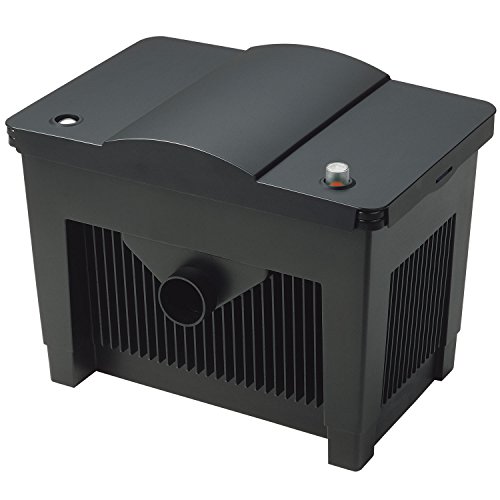
OASE BioSmart 5000 Pond Filter
The filter that works behind the UV. The clarifier kills the suspended algae, but something has to trap the dead cells and process the waste that fed the bloom, and this gravity box does both. Size it to your fish load, not the box number.

hygger 32W Pond UV Light Water Clarifier
The low-cost way to hit real wattage, and at 32W it out-doses pricier compact units. This one is a submersible unit that sits in the water on a weighted base, not plumbed inline, so the flow-throttling advice above doesn't apply.
What owners say
Real owner reports from the threads and editorial sources we drew on for this guide.
“A 9 watt U.V is more than adequate for a 650 gal pond... my 1200 gal pond clears in a few days with a 9 watt.... a 55 watter will do a great job. if the price is right, why not?”
“I have a 450+ gallon above ground pond and my 9-watt UV is rated for 1800 gallons. The only reason I went with that one as opposed to the smaller one that is rated for 660 gallons is because the smaller one wouldn't have worked well with my 1000 gph pump.”
“UV's have ratings from their manufacture. The "suggested" flow range will kill the algae and bacterias flowing through it, but if you are trying to kill protozoas, they then suggest a slower flow, as low as 15-20% of their typical suggested flow rate.”
“I used one for about a week, to clear up a green water issue. Worked like a charm! I pulled it out at that point, and haven't used it since. That's the only use I can see for it.”
“Point is I plug in my UV for a few days or a week when I notice the pond water starting to get a little hazy and after it clears up I unplug it and it stays clear, usually for the rest of the year.”