OASE BioSmart 5000 Review + Verdict for Koi Ponds
By The Pond Review · Updated August 2026
Independent editorial review. We never accept payment for coverage, though we may earn a commission if you purchase through our links.
Verdict
Owner sentiment on the pond forums is split, and the split tracks almost perfectly with whether people sized the filter to their fish. Experienced keepers there independently arrive at the same rule we do: as one put it, they "half the manufacturer specifications," treating the 5000 as roughly 1,250 gallons of koi. Owners who stayed inside that rating are content, and at least one runs two of the 5000 filters happily, partly for redundancy. Owners who bought by gallons describe the opposite, foams clogging within days early in the season, which longtime keepers explain as the filter carrying the whole load before the plants and bacteria wake up. The recurring gripe beyond cleaning is running cost, since the replacement foam pads aren't cheap. The single most useful caution is mechanical, from a Reddit thread rather than the forums: because it's a gravity filter, pushing too strong a pump through it makes it leak and filter poorly. Our own read lines up with the content owners, with one asterisk none of them dispute: this does nothing for green water, which passes straight through and needs a UV the BioSmart doesn't include.
Read full take ↓Similar pond filters
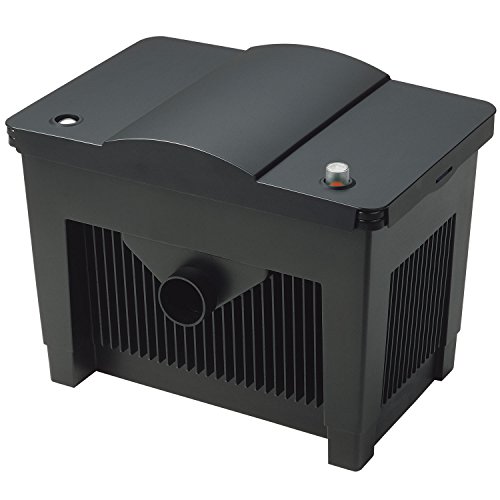
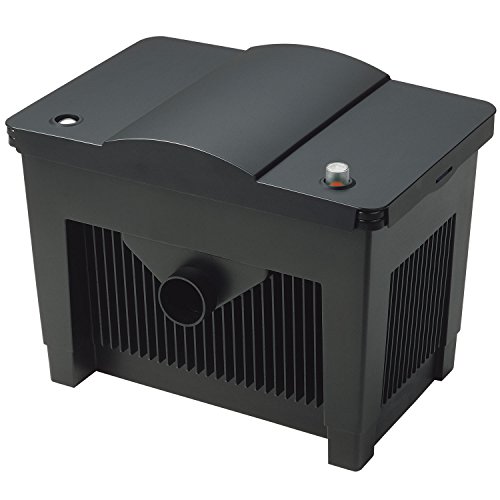
The OASE BioSmart 5000 is the filter we point most new koi keepers to first, and the reason is boring in the best way: it's hard to get wrong. It's a gravity-fed box filter, four foam pads and a mechanical scrubber over a bed of biological media, with a red indicator that pops up when the foams need a rinse. There's very little to fail and very little to think about, which for a piece of gear that runs every hour of every day is most of the battle.
The catch is the number in the name. The "5000" is a fishless rating. Put koi in the pond and OASE's own guidance drops it to around 1,250 gallons, and the keepers who ignored that math are the ones who end up disappointed. Rate it for your fish load rather than your gallons and it's close to set-and-forget. Rate it for the box and you'll be rinsing foams every day and still chasing clear water.
The short version
What works:
- A cleaning indicator owners actually act on, so the filter gets maintained instead of clogged and quietly abandoned.
- Genuinely large biological capacity for the footprint, once it's sized to the fish rather than the water.
- Foam pads pull and rinse without tools, and the whole unit is about as simple as pond filtration gets.
- Years of trouble-free reports in cold climates. There's almost nothing on it to freeze or seize.
What to watch:
- The model number badly overstates real koi capacity. Size down, hard.
- It's gravity-fed, so it must sit at the pond edge above the water line, and it won't tolerate a strong pump.
- There's no UV. It won't clear a green-water bloom on its own.
- The foams are a running cost, and on a heavily stocked pond the cleaning is frequent.
Who it's for, and who should skip it
Buy the BioSmart 5000 if you keep koi or goldfish in roughly a 1,000 to 1,500 gallon pond, you can hide a box filter at the edge above the water line, and you want a filter you'll maintain in any climate. It's the first filter we'd put on a stocked backyard pond.
Skip it if your pond is a lightly planted water garden under 500 gallons, where it's overkill and a small all-in-one unit does the job for less. Skip it too if you run a heavily stocked show pond, where you want the bigger BioSmart or a bead or vortex system. And skip it if you can't place a gravity filter above water, in which case a sealed pressure filter is the right tool, not this one.
The spec that decides it: rate for fish, not gallons
OASE publishes three numbers for the BioSmart 5000: about 5,000 gallons with no fish, roughly 2,500 with a light fish load, and around 1,250 with koi. Those aren't marketing padding so much as a genuine statement about bioload. Koi are large, they eat a lot and they produce a lot of waste, and biological filtration is sized to that waste, not to the volume of water it's dissolved in.
This is the single most common way the filter disappoints. A keeper buys the "5000" for a 2,000 gallon koi pond because the gallons line up, then finds the water won't clear and the foams clog within days. The filter isn't underperforming. It's being asked to process roughly twice the fish load it was built for. If your koi pond is much over about 1,200 gallons, look at the BioSmart 10000 or step up a filter class.
How it keeps the water clear, and where it stops
Mechanically it's straightforward: water enters, passes a coarse scrubber and four foam pads that trap solids, then moves through biological media where the bacteria that process fish waste live. When it's sized right and fully cycled it does this well, and the recurring positive from owners is simple: the water clears and stays clear.
Two honest limits. First, the design lets fish waste travel straight onto the foams, which is part of why they load up quickly and why the cleaning indicator earns its keep. Second, and more important, the BioSmart does nothing about green water. Single-celled algae blooms pass straight through it. If your pond turns pea-soup green, that's a job for a UV clarifier, which this filter doesn't include. Pair one and the two together handle both the muck and the bloom. On their own, neither does.
Cleaning and living with it
This is where the BioSmart earns both its reputation and its complaints, in the same breath. The cleaning is easy: the foams lift out and rinse in a bucket of pond water, no tools, a few minutes. The issue is how often. On a correctly sized pond it's a roughly weekly job in high summer. On an oversized fish load it can be near daily, which is the source of the frequent-cleaning complaints you'll find on the pond forums. The filter didn't change; the stocking did. Keep it inside its fish rating and the maintenance stays sane.
The build itself is about as durable as pond gear gets. It's a plastic box with foams and a simple indicator, nothing pressurized and nothing electronic beyond the pump you supply. Cold-climate owners run it for years. The foams degrade and get replaced eventually, and that's the main running cost to plan for.
How it compares
- Versus a pressure filter like the Laguna Pressure-Flo: the decision is almost entirely about placement, not quality. A gravity box like the BioSmart gives you more biological capacity per dollar and cheaper upkeep, but it has to sit at the edge above water. A sealed pressure filter can be buried or sit below the water line and can push water uphill to a waterfall, and it usually includes a UV, but it holds less media and you backflush it more often. Choose the BioSmart when you can hide a box at the edge; choose pressure when you can't.
- Versus the BioSmart 10000: the same filter, just more of it. If your koi pond runs past about 1,200 gallons, the 10000 is the more honest buy, and it's the upgrade we'd make before adding a second 5000.
Setting it up
Place the BioSmart at the pond edge, above the water line, so it can drain back by gravity. Feed it with a pump matched to its intake, not the biggest pump you own. As one keeper put it plainly, push too much flow through a gravity filter and it leaks and stops filtering. Size the pump to turn your pond over about once an hour, then let the filter cycle for a few weeks before you judge the water. For the green-water half of the problem, our UV clarifier picks cover what to pair it with.
The bottom line
Sized to your fish rather than your gallons, and placed where a gravity filter belongs, the BioSmart 5000 is close to the easiest good decision in pond filtration: simple, durable, maintainable, and effective on a 1,000 to 1,500 gallon koi pond. Add a UV for green water and it's most of a filtration system in one cheap box.
The only real way to be unhappy with it's to buy the number on the label. Treat the "5000" as a fishless figure, halve it for koi, and the complaints about endless cleaning and stubborn water mostly disappear. That isn't so much a flaw in the filter as a labeling problem you can design around.
Our Ratings
Overall score
A plastic box, four foams and a mechanical cleaning indicator, with nothing pressurized or electronic to fail beyond the pump you supply. Cold-climate owners run it for years, and the only planned running cost is replacing foams as they degrade. It loses a little only because gravity feeding means it has to be placed correctly to work at all.
Sized to the fish rather than the box number, it clears and holds a koi pond well, and the cleaning indicator keeps it maintained instead of clogged. Two real limits keep it off the top of the scale: the design lets waste load the foams quickly, and it does nothing about green water, which passes straight through and needs a separate UV.
Cheap for the biological capacity you get, and simple enough that most owners never pay anyone to service it. Docked because the misleading model number leads people to buy the wrong size, and because foams are an ongoing consumable on a heavily stocked pond.
OASE BioSmart 5000 on Amazon.
The Evidence Behind Our Verdict
Owner sentiment on the pond forums is split, and the split tracks almost perfectly with whether people sized the filter to their fish. Experienced keepers there independently arrive at the same rule we do: as one put it, they "half the manufacturer specifications," treating the 5000 as roughly 1,250 gallons of koi. Owners who stayed inside that rating are content, and at least one runs two of the 5000 filters happily, partly for redundancy.
Owners who bought by gallons describe the opposite, foams clogging within days early in the season, which longtime keepers explain as the filter carrying the whole load before the plants and bacteria wake up. The recurring gripe beyond cleaning is running cost, since the replacement foam pads aren't cheap. The single most useful caution is mechanical, from a Reddit thread rather than the forums: because it's a gravity filter, pushing too strong a pump through it makes it leak and filter poorly.
Our own read lines up with the content owners, with one asterisk none of them dispute: this does nothing for green water, which passes straight through and needs a UV the BioSmart doesn't include.
Our rating above is our own editorial call. What follows is the field evidence we weighed to reach it: first-hand reports from pond owners on Reddit and dedicated pond forums, which we lean on more than manufacturer-influenced published reviews because unsponsored owners tend to be the more candid signal.
What Reddit Is Saying
“I believe the Biosmart is a gravity filter and won't tolerate even a modest flow rate. I would call OASE or look up what's recommended. A strong pump will cause the filter to leak and it won't do much filtration, either.”View thread →
What Pond Forums Say
“I have 2 of the 5000 filters. I am very happy with them. I used 2 so that I essentially have 2 independent filters should 1 go out and I wanted the extra water flow.”Source →
“Oase specifications say this is good for max 5000gallons with no fish, max 2500 with fish and max 1250gallons with koi. I usually half the manufacturer specifications”Source →
“Your filter is most likely clogging up early in the season due to it being the only means of filtering during that period. As the weather warms, the beneficial bacteria and your plants kick in and help immensely with the filtering process.”Source →
“remember like others have found out the replacement pads are not cheap”Source →
Frequently asked questions
Is the OASE BioSmart 5000 worth it?
Cheap for the biological capacity you get, and simple enough that most owners never pay anyone to service it. Docked because the misleading model number leads people to buy the wrong size, and because foams are an ongoing consumable on a heavily stocked pond.
How reliable is the OASE BioSmart 5000?
A plastic box, four foams and a mechanical cleaning indicator, with nothing pressurized or electronic to fail beyond the pump you supply. Cold-climate owners run it for years, and the only planned running cost is replacing foams as they degrade. It loses a little only because gravity feeding means it has to be placed correctly to work at all.
How well does the OASE BioSmart 5000 perform?
Sized to the fish rather than the box number, it clears and holds a koi pond well, and the cleaning indicator keeps it maintained instead of clogged. Two real limits keep it off the top of the scale: the design lets waste load the foams quickly, and it does nothing about green water, which passes straight through and needs a separate UV.
What do real owners say about the OASE BioSmart 5000?
Owner sentiment on the pond forums is split, and the split tracks almost perfectly with whether people sized the filter to their fish. Experienced keepers there independently arrive at the same rule we do: as one put it, they "half the manufacturer specifications," treating the 5000 as roughly 1,250 gallons of koi. Owners who stayed inside that rating are content, and at least one runs two of the 5000 filters happily, partly for redundancy.
Options Worth Checking Out
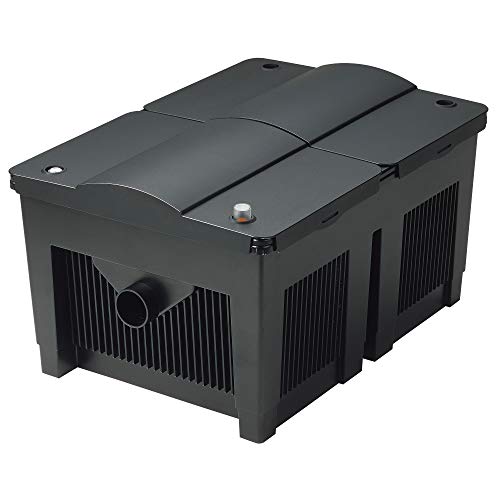
OASE BioSmart 10000 Pond Filter
The same filter with more capacity. If your koi pond runs past about 1,200 gallons, this is the more honest buy than stretching the 5000, and the upgrade we'd make before running two smaller boxes.

Laguna PF4000 Pressure-Flo Filter
The pick when you can't place a gravity box above water. A sealed pressure filter you can bury or sink below the water line, with a built-in UV, at the cost of less media and more frequent backflushing.
You Might Also Need
Accessories worth grabbing alongside your purchase