The Best Pond Filter for a Koi Pond
By The Pond Review · Updated August 2026
Independent editorial guide. We never accept payment for coverage, though we may earn a commission if you purchase through our links.
Quick Take
For a koi pond, buy a gravity-fed box filter and size it to your fish, not to the gallons your pond holds. Our default is the OASE BioSmart 5000 for a stocked koi or goldfish pond of roughly 1,000 to 1,500 gallons, stepping up to the BioSmart 10000 for a heavier koi load. A gravity box holds more biological media per dollar than a sealed pressure canister, and for koi that biological capacity is what keeps the water safe.
Two things to keep in mind before you buy. The number in a filter's name is a fishless rating, so halve it for a fish load and halve it again for koi: a "5000" is really about 1,250 gallons of koi. And a koi filter is a system, not one box, so plan for mechanical trapping, biological media, and a separate UV clarifier if your pond turns green. A pressure filter earns its keep only when you can't place a gravity box above the water line.
We've matched five filters to real koi loads below, from the box we'd start with to the pressure options for ponds where a gravity filter won't fit. See picks ↓
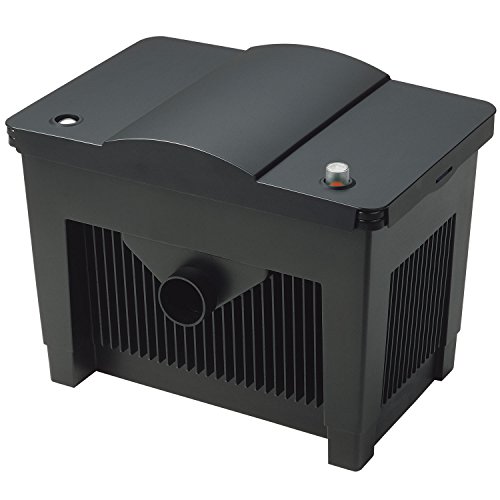
Koi are the reason pond filtration gets hard. They're big fish that eat a lot and put out a lot of waste, and a filter that keeps a quiet goldfish pond clear will fall behind a koi pond by midsummer. So a koi filter is a bioload problem first, and most buying mistakes come from answering it with the wrong number.
Our view runs against a lot of the advice you'll read online. For a backyard koi pond, a gravity-fed box filter gives you more biological capacity per dollar than a pressure canister, and the costliest error is sizing the filter by how many gallons your pond holds instead of how much fish it carries.
Our take: a gravity box beats a pressure canister for koi
We recommend a gravity-fed box filter as the default for a stocked koi pond, and the OASE BioSmart line is where we'd start. A gravity box is a plain plastic tub: a few foam pads and a bed of biological media, sitting at the pond edge above the water line, draining back down by gravity. It's about as simple as pond filtration gets, and simple is a feature in a device that runs every hour of every day for years.
The case for it over a sealed pressure canister comes down to media. For a given price, a gravity box holds more of it, and more media means more surface area for the nitrifying bacteria that convert fish waste. For koi, that biological capacity is the number that matters most, because koi produce the ammonia load a filter exists to process. A pressure filter earns its place for one reason above all, placement, which we'll come to. On biological capacity per dollar the box wins, and on a koi pond that's the axis to optimize. The model we reach for first is covered in full in our OASE BioSmart 5000 review, which doubles as the reasoning behind the top pick below.
The sizing mistake almost everyone makes
The most expensive mistake in koi filtration is sizing the filter by pond volume. It goes like this. Someone reads that a filter is rated for 2,000 gallons, their pond holds 1,800, the numbers line up, and they buy it. By July the water is cloudy, the foams clog within days, and the filter gets blamed. The filter is doing exactly what it was built to do. It was rated for water, and that water is full of koi.
Biological filtration is sized to waste, not to the volume the waste is dissolved in. Two ponds of identical gallons can need wildly different filters: a lightly planted water garden with three goldfish sits at one end, a 1,500 gallon pond with six growing koi at the other. Same water, very different ammonia load. Koi are big, they eat hard, and they keep growing, so the load climbs over the seasons as the fish put on size. Rate the filter for the fish it'll carry at full size, not the gallons it sits in today.
Do the arithmetic the label skips
OASE is unusually honest about this, if you read past the name on the box. The BioSmart 5000 isn't a 5,000 gallon koi filter. The 5,000 is a fishless rating, the figure for a water feature with no livestock at all. Put a light fish load in and OASE's own number falls to about 2,500 gallons. Make those fish koi and it falls again, to roughly 1,250. So the badge overstates real koi capacity by about four to one.
The rule we use, and the one experienced keepers land on without any prompting from the manufacturer, is to halve the label once for a fish load, then halve it again for koi. A "5000" becomes about 1,250 gallons of koi. A "10000" becomes about 2,500. Do that division at the store instead of after the water goes cloudy, and most of the disappointment never happens, because you'll have bought the filter your fish need rather than the one your gallons flattered you into.
A koi filter is a system, not one box
The other half of the problem is treating a filter as a single box that handles everything. A koi setup has three jobs, and one product rarely does all three well. Mechanical filtration traps solids, the foams and screens that catch waste and uneaten food before it breaks down. Biological filtration is the media bed where nitrifying bacteria turn toxic ammonia first into nitrite and then into far less harmful nitrate, and it needs a few weeks to cycle before it does anything, often with a bacteria starter to get going.
Then there's clarity, which is a separate job again. A UV clarifier is what clears green water, the suspended single-celled algae that turns a pond pea-soup green overnight. A gravity box like the BioSmart handles the mechanical and biological work and does nothing for green water, so if your pond blooms you pair it with a UV clarifier plumbed inline. Two things worth keeping straight: a UV clarifier doesn't touch string algae, the stringy stuff you scrape off the waterfall and rocks, and on its own it isn't a filter. Buy for the three jobs. A label that implies one box covers all of them is selling you short on at least one.
Where a pressure filter still makes sense
None of this makes pressure filters bad. There's one situation where a sealed pressure canister is the right answer, and it comes down to placement rather than capacity. A gravity box has to sit at the pond edge, above the water line, so it can drain back down. If you can't hide a box up there, or you want to push filtered water uphill to feed a waterfall, a pressure filter is built for exactly that. You can bury it or sink it below the water line, it moves water under pressure, and most models include a UV lamp for the green-water job. That's why the OASE FiltoClear and the cheaper Laguna PF4000 stay on this list.
Where we part company with a good deal of forum wisdom is the reflex to just buy the biggest pressure canister and call it done. For a koi pond that's usually the wrong move. A pressure canister holds less biological media than a gravity box of similar price, you backflush it more often, and scaling one up to cover a real koi bioload gets costly in a hurry. If you can place a gravity box, place one. Reach for pressure when placement is the thing forcing your hand, not when someone tells you a bigger canister is a shortcut to more capacity. It usually isn't.
Matching filter to fish load
Here's how we'd choose among the five picks. For a stocked koi or goldfish pond around 1,000 to 1,500 gallons where you can tuck a box at the edge, the BioSmart 5000 is our default and the one most backyard koi keepers should start with. For a heavier load, or a pond carrying more than about 1,200 gallons of koi once you've done the halving math, step up to the BioSmart 10000 rather than stretching the smaller box or running two of them to catch up.
If you can't place a gravity filter above water, the FiltoClear is the pressure option we'd pick, with a built-in UV that covers the green-water half of the job in one unit. The Laguna PF4000 is the cheaper pressure route for a lightly stocked pond. The Goplus is the lowest-cost way in, fine for a modest goldfish or young-koi pond, with one caveat: koi grow into their waste, and a small canister gets outrun as the fish put on weight, so buy it knowing you may replace it. Match the box to the fish and each of these has a pond it fits.
Setup, cycling, and the running costs
A filter is only as good as the pump feeding it and the time you give it to mature. Size the pump to turn the whole pond over about once an hour for a lightly stocked pond, and closer to twice an hour for koi, and quote that flow at your actual head height, because the number on a pump box is measured at zero lift and drops fast once the water has to climb to a waterfall. Feed a gravity box with a pump matched to its intake, not the biggest one you own, since too much flow makes a gravity filter leak and skip filtering rather than clean faster.
Then leave it alone to cycle. A new filter has no bacteria colony yet, so it does little for the first few weeks until the nitrifying bacteria establish, and a bacteria starter speeds that along. Judging the water on day three is how people talk themselves into returning a filter that hadn't finished cycling. Plan for one running cost either way: foam pads wear out and get replaced every year or two, and on a heavily stocked pond you rinse them often through summer. Budget for the pads and the maintenance stays a chore, not a surprise.
How we'd spend the money
If it were our pond and our budget, we'd buy the largest gravity box the fish load justifies, cycle it properly over a few weeks, and add a separate UV clarifier only if the water blooms. A well-sized BioSmart plus a UV when it's needed covers the mechanical, biological, and clarity jobs for less than a single oversized pressure canister that still holds less media than the box.
Three habits separate the happy owners from the frustrated ones. They size for the fish, not the gallons. They give the media weeks to cycle before judging the water. And they read the number on the box as a figure to divide, not a promise to trust. The buyers who do those three things spend less and think about their filter far less. The ones who skip them are the source of every clogged-foam, cloudy-water thread on the pond forums.
The picks
Products we recommend for this guide.
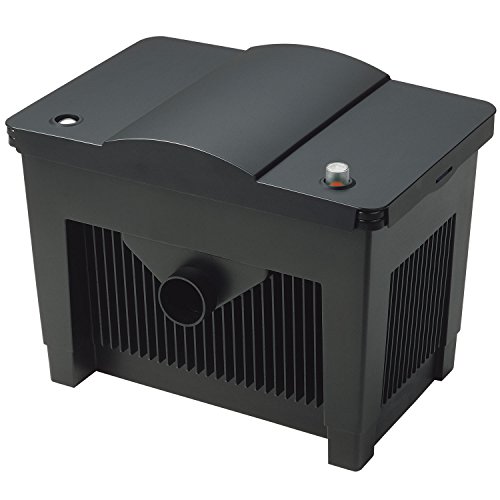
OASE BioSmart 5000 Pond Filter
Our default koi filter: a simple gravity-fed box, four foams over biological media, with a pop-up clean indicator. Rate it for fish rather than the badge, so treat the "5000" as roughly 1,250 gallons of koi, and it runs close to set-and-forget.
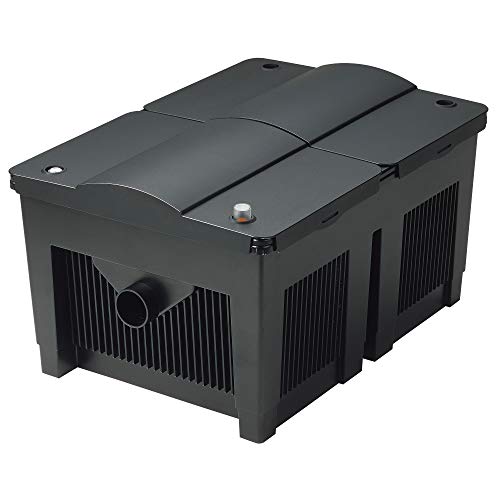
OASE BioSmart 10000 Pond Filter
The same box with more media for a heavier koi load. Once your pond carries more than about 1,200 gallons of koi, this is the better step up than stretching the 5000 or running a second small filter alongside it to catch up.

OASE FiltoClear Pressure Filter
The pick when you can't hide a box above the water line. A sealed pressure canister you can bury or sink below the surface, with a built-in UV clarifier for green water, at the cost of less media and more frequent backflushing than a gravity box.

Laguna PF4000 Pressure-Flo Filter
A cheaper sealed pressure filter with its own UV lamp, for a lightly stocked koi or goldfish pond where you want the canister hidden and a mild bloom cleared. Expect less biological capacity and more backflushing than a gravity box of similar price.

Goplus 2642 GPH Pressure Pond Filter
The lowest-cost way in: a small pressure canister with a 13W UV and bio balls, fine for a modest goldfish or young-koi pond. Undersized for a stocked adult koi pond, so buy it knowing the fish will likely outgrow it as they put on weight.
What owners say
Real owner reports from the threads and editorial sources we drew on for this guide.
“This is especialy true if the intention is to keep Koi as the OP indicated. You almost never have enough filtration for a Koi pond!”
“My pond is 6500 gal. Have had it for at least 10 years. It was installed by pros with whatever they use and we Never saw the bottom of the pond until I joined this forum last Spring and installed a Skippy filter! Pond was crystal clear in a week!”
“The ? was the best Filter for a large koi pond I run skippys but if i spent more $$$$ i could do better”
“The build of my pond and bog could handle a large load of koi with no difficulty, I just don't care to have koi.”
“there are factors in the efficiency of a filter..media used, flow rate. etc... what makes a skippy is the "swirl bar" upflow plumbing inside the filter. not the container, not the media used.”
