Pressurized vs Gravity Pond Filter
By The Pond Review · Updated August 2026
Independent editorial guide. We never accept payment for coverage, though we may earn a commission if you purchase through our links.
Quick Take
For most backyard koi ponds, buy the gravity box. The choice between a gravity-fed box and a sealed pressurized canister is about where the filter sits and how you clean it, not which one is better on paper. A gravity box sits above the water at the pond's high point, opens up for a quick rinse, and shows you its dirt, so it stays clean because cleaning it's easy. That's why the OASE BioSmart 5000 is our top pick and the default for most stocked koi ponds.
A pressurized canister earns its place for one thing: placement. Because it's sealed, you can bury it below grade and pump its cleaned water uphill to a waterfall or stream, and it usually has a UV lamp built in. The cost of that seal is that it clogs faster, needs frequent backwashing, and hides the clog until your flow drops off. So reach for pressurized only when your layout forces it, and halve any gph rating, then halve it again for koi.
We've lined up three filters below, one gravity box and two pressurized canisters, matched to the site each one fits. See picks ↓
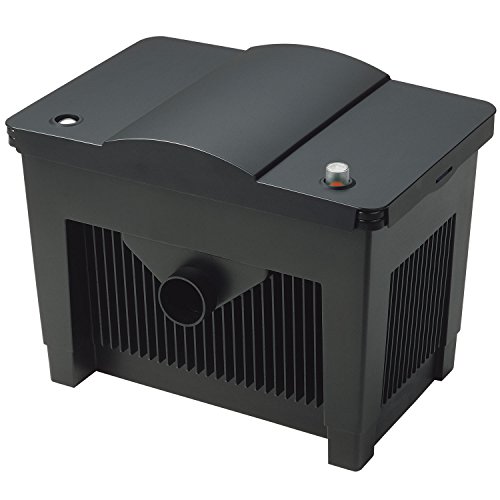
Sooner or later every koi keeper stands in front of the same two filters and can't tell them apart on price. One is a plain plastic box that sits at the pond edge. The other is a sealed canister that can go underground. They get sold as rivals, cheap versus premium or old versus new, and that framing sends a lot of people to the wrong one for their pond.
Our call is that they aren't competing on quality at all. A gravity box and a pressurized canister answer two different questions about your yard: where can the filter physically sit, and how much work are you willing to do to keep it clean, week in and week out. Answer those honestly and the choice makes itself. For most backyard koi ponds the gravity box is the one we'd fit, and the pressurized canister is what you buy when the ground and the plumbing leave you no room for a box.
Our take: placement and cleaning decide it, not quality
Put the two designs side by side and the difference is mechanical, not a matter of one being cheap and one being good. A gravity box takes dirty water in at the top, lets it fall down through foam and biomedia, and drains the clean water back to the pond under nothing but gravity. A pressurized canister seals the same job inside a pressure vessel, so the pump can shove water through it and out the far side still under pressure. Both trap solids and grow the bacteria that process koi waste. What separates them is where each one is allowed to sit and how you get inside it to clean it.
For most backyard koi ponds we'd fit the gravity box, and the reason is unglamorous: it's easy to clean, so it gets cleaned. A filter that's a chore to open is a filter you put off, week after week, and a pond doesn't wait for you to find the motivation. The gravity box wins the default slot on that habit alone, before any spec enters the argument. The pressurized canister is the answer for the narrower case where your layout gives a box nowhere to sit, and we'll draw that line clearly below rather than pretend either one is wrong.
What a gravity box is and where it has to sit
A gravity box is close to the simplest thing in pond keeping: a large plastic tub holding a stack of foam pads over a bed of biological media, with a lid you lift off. Water is pumped up into it, works down through the media, and returns to the pond by gravity, which is why the box has to sit above the pond's surface at the high point of your waterfall or stream. Because it's open and roomy, it holds a lot of media, gives that media air, and lets you see exactly how dirty the foams are the moment you raise the lid. Cleaning is a rinse of the pads and a swirl of the settled muck, done in minutes without special tools.
The price you pay for all that's visibility. The box has to sit high and out of the water, so it's bulky and it's above grade, and hiding it behind rock or planting is the main design problem it hands you. That trade is the main reason the gravity box is the one we reach for first, and it's the model behind our top pick; the full case for it's in our OASE BioSmart 5000 review. Give a gravity box a spot at the top of the falls and it's close to set-and-forget.
What a pressurized canister buys you
A pressurized canister does the same filtering inside a sealed drum, and that seal is what the design is built around. Because the water never has to fall back to the pond by gravity, the filter doesn't need to sit up high. You can set it below the water line, bury it to the neck so only the lid shows, and let the pump push the cleaned water back out under pressure, uphill if you need to, to feed a waterfall or the head of a stream some distance away. Most canisters also fold a UV clarifier into the same housing, so the unit that filters your water also clears a green-water bloom.
That's real capability, and it's why a pressurized canister is the right buy in the yards that need it. It hides where a box can't, it feeds features a box can't reach, and it does the UV job in one box. The premium version of this is our OASE FiltoClear review, and the cheaper Grech below covers the same idea for a smaller pond. What you're buying with either is placement freedom, and you're paying for it in maintenance.
The catch with a sealed canister
Sealing the filter is what makes the canister flexible, and it's also what makes it more work. A pressure vessel packs its media tight and gives it less air, so it clogs faster than an open box, and clearing it means backwashing on a schedule rather than lifting a lid for a rinse. Worse, the seal hides the state of the filter from you. You can't see the clog building the way you can with an open box, so the first sign of trouble is usually the flow to your waterfall dropping off, by which point the media is already choked. One keeper who ran two of them described backwashing six or seven times a day and still fighting dirty water, which is the failure mode a sealed filter walks you into if you undersize it.
For koi that trap matters more than it does for a lightly stocked water garden, because koi are heavy feeders and you almost never have enough filtration for a koi pond to begin with. Load a sealed canister with a real koi bioload and the backwash treadmill gets relentless, and every backwash you skip is a step toward a clog you can't see. That isn't an argument against pressurized canisters, it's the reason we treat them as the exception and not the default. When the seal isn't buying you a placement you need, it's only buying you more cleaning.
When the layout forces you to go pressurized
There's a clear set of yards where the pressurized canister is the right answer, and all of them come down to placement rather than performance. The first is an uphill feed: your filter's clean water has to climb to a waterfall or stream head that a gravity box can't sit above. The second is a must-hide site, where there's nowhere high and out of view to put a bulky box, and a keeper's usual fix, tucking the filter into a garage or bank and running hoses to it, tells you how far people will go to solve the hiding problem. The third is a long feed to a stream or distant feature, where pushing filtered water under pressure across the yard is exactly what the sealed design is for.
If one of those describes your pond, buy the canister and buy it deliberately oversized for your fish so the backwash schedule stays sane. For a modest koi or goldfish pond that needs the hidden, uphill feed, the Grech CPF-2500 is the pressurized pick we'd start with, with its own UV built in. For a larger or long-term setup where you want stronger build and a bigger UV, the FiltoClear is the step up. In both cases you're choosing the seal on purpose, to solve a placement the box couldn't, not because it filters better.
Size for the fish, then halve the gph
Whichever design you land on, the arithmetic the box hopes you skip is the same, and it decides more than the gravity-versus-pressurized question does. The gallon rating on any pond filter is a fishless number, so halve it for a fish load and halve it again for koi, which means a filter badged for a couple thousand gallons is closer to a few hundred gallons of koi. The pump matters just as much: the gph printed on a pump is measured at zero lift and falls off fast once the water has to climb to your falls, so quote the flow at your actual head height, not off the box.
Do that division before you buy and most of the disappointment never happens, on either design. Undersize a gravity box and you rinse foams more often than you'd like; undersize a sealed canister and you're backwashing it several times a day and still losing to the clog. The sizing rule and the model we default to are both laid out in the OASE BioSmart 5000 review. Halve the badge, quote the pump at head, and buy the filter your fish need rather than the one the label flatters you into.
How we'd choose between them
If it were our pond, the decision tree is short. Can a box sit above the water at the top of the falls, hidden well enough to live with? Then fit the gravity box, because it holds more media, gives it air, shows you its dirt, and cleans in minutes, and a filter that's easy to clean is a filter that stays clean. Only when the answer is no, when the feed is uphill, the site has nowhere to hide a box, or a stream needs feeding from a distance, do we go to a sealed canister, and then we oversize it for the fish so the backwash stays manageable.
Match the filter to the site and both designs do their job for years. Force the wrong one onto your yard and you spend the summer fighting it: a gravity box you could never hide, or a sealed canister you backwash on repeat because it was the wrong tool for a spot a box would have owned. The two filters aren't better and worse, they're built for different yards, so buy for the yard you have, not the one in the product photo, and then do the sizing math the label quietly hopes you'll skip.
The picks
Products we recommend for this guide.
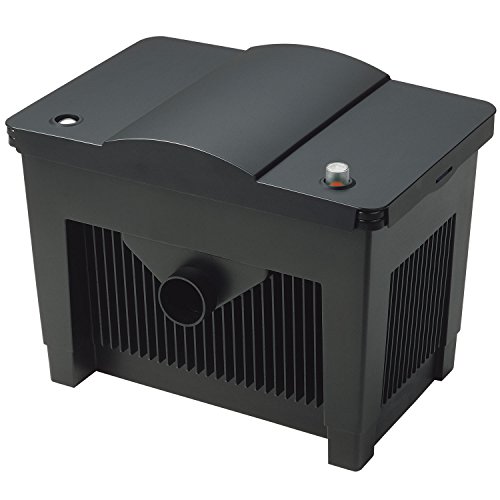
OASE BioSmart 5000 Pond Filter
Our default for most backyard koi ponds: a gravity box that sits above the water and opens up for an easy rinse. Easy cleaning is why it stays clean, and it shows its dirt instead of hiding a clog. Read the "5000" as roughly 1,250 gallons of koi.

Grech CPF-2500 Pressurized Pond Filter with UV
The pressurized pick when the layout forces your hand: sealed, so you can bury it below grade and pump clean water uphill to a waterfall, with a 13W UV built in. Expect more frequent backwashing and less media than a gravity box of similar price.

OASE FiltoClear Pressure Filter (3rd Gen)
The premium sealed canister for a hidden, uphill-feed setup where you want OASE build and a strong integrated UV. It buries out of sight and pushes filtered water to a stream, at a price and a backwash schedule a gravity box doesn't ask of you.
What owners say
Real owner reports from the threads and editorial sources we drew on for this guide.
“You will still be back flushing it a lot .I have 2 of them in the basement from my small pond i used to have and they never worked right .They stunk and no matter how many times I back flushed a day the water was dirty .Sometimes I would back flush them 6 or 7 times a day .”
“Those removable chamber filters are the most practical design for non-DIY backyard ponders. The filter material in the separate chambers is easily monitored and serviced. You can clean and change the stuff in one chamber without disturbing the other chambers or even shutting down the pumps.”
“I couldn't find a location by the pond to hide it reasonably well, so since the pond was up against the wall of my garage, I just bored a couple of holes in the wall so the hoses could enter and exit.”
“Nexus will be below pond level well where it should be”
