Submersible vs External Pond Pump: Which to Buy
By The Pond Review · Updated August 2026
Independent editorial guide. We never accept payment for coverage, though we may earn a commission if you purchase through our links.
Quick Take
For most backyard ponds, buy a good mag-drive submersible pump and skip the external. You drop it in the water, plug it in, and it feeds your filter or waterfall with no priming, no dry well, and less noise to plan around. Our default is the OASE AquaMax Eco Premium, an efficient solids-handling submersible sized to real backyard ponds, with cheaper submersibles below it for smaller features.
Go external only when three things are all true: the pond is large, roughly 2,000 gallons or more, the head is high, and the pump runs around the clock. That's the one place an external's better efficiency pays back its higher price and its plumbing hassle. Below that, the running-cost gap is too small to matter, and true external pumps are barely sold under about 2,000 GPH and mostly live off Amazon anyway.
We've matched four submersibles to real pond sizes below, plus the one pick you can also run inline if you're leaning external. See picks ↓

A submersible pump sits underwater and pushes water out. An external, or inline, pump sits dry beside the pond and pulls water through itself under suction. Both move water to the same filter and the same waterfall, so the choice isn't about what they do. It's about efficiency, cost, and how much plumbing you want to own.
Most of the advice you'll read online skips the number that decides it, and leans on preference instead. So here's our position up front, with the arithmetic behind it: for a typical backyard pond the submersible is the smarter buy, and the external only earns its keep at the large, high-head, always-on end of the hobby.
Our verdict: a submersible wins for most backyard ponds
For a pond up to a couple of thousand gallons, we'd buy a submersible almost every time. The reasons are practical before they're technical. A submersible drops into the water and runs, with no priming step and no dry housing to build. It's quieter to live with, because the water muffles the motor instead of a pump box humming next to your seating area. And it costs less to buy, because the whole external category starts at a higher price and a bigger size than a backyard pond needs.
The knock on submersibles is real but narrow. Sitting in the water, an open-motor submersible is less efficient at pushing water uphill than a good external, so it draws more watts to move the same gallons against the same head. On a small pond that gap is a few dollars a year and not worth a second thought. It only turns into real money on a big pump that never switches off, which is exactly the case we'll hand to the external.
When an external pump is worth it
An external pump makes sense when three conditions line up at once: the pond is large, roughly 2,000 gallons or more, the head is high, meaning the water has to climb a tall waterfall or run a long pipe, and the pump runs 24/7 through the year. Miss any one of those and the case weakens fast. A 24/7 pump on a small pond doesn't save enough to matter. A big pump you only run in summer never banks a full year of savings. The external wins only where high wattage, high hours, and high head all stack up.
Long-time keepers on the pond forums land in the same place from experience rather than math. One put the rule bluntly for a long run up to a tall waterfall feeding an extra stock tank: that setup is external territory, not a job for a submersible. Even keepers who run submersibles agree the split flips with size, saying a small pond is fine on a submersible but a large one would send them external. The external also gives you a clean-out basket you service without reaching into the water, and it keeps any electrical fault out of the pond entirely.
Do the running-cost math the label skips
Here's the number that should decide it, and the one no listing prints. Say an external saves you 100 watts moving the same water as a submersible, which is a fair gap at real head on a larger pump. That's 2.4 kilowatt-hours a day, and about 876 kilowatt-hours across a year of running around the clock. On a typical residential rate that's roughly $100 to $175 a year, and in a high-cost state it runs far past that. One California keeper priced an aging 2,500 GPH pump at about $55 a month to run non-stop, which is the kind of bill that makes efficiency worth chasing.
Now weigh that against the purchase. An external costs more up front, needs a primed dry well, and asks for more plumbing. But if it shaves 100 watts on a pump that never turns off, it claws back the price difference in a few seasons and keeps saving after that. Under about 2,000 gallons, or running only part of the year, the yearly saving shrinks to pocket change and never catches up to the higher sticker. So the honest rule isn't that external pumps are better. It's that their efficiency only pays back when the wattage is high, the hours are constant, and the head is steep. Size the decision on your electric bill, not on which type sounds more serious.
Why true external pumps are hard to buy on Amazon
There's a supply reason this guide is mostly submersibles, and it's worth saying plainly. True external pond pumps, the Sequence and similar inline units keepers name, are barely sold below about 2,000 GPH and mostly move through pond dealers and direct sellers rather than Amazon. If your pond is squarely in external territory, expect to call a specialty pond supplier or a builder, and expect a real installation with a dry well, isolation valves, and priming, not a plug-and-drop.
One product bridges the gap, and it's on our list for that reason. A mag-drive pump like the Pondmaster Pond-Mag can run wet as a submersible or dry as an inline pump, so it's the low-commitment way to try external plumbing without buying a big dedicated unit. It won't match a large true external for efficiency at high head, but for a mid-size pond it lets you place the pump outside the water and keep a clean-out basket in the line. If you want the external's serviceability without its price or its dealer hunt, that convertible design is where we'd start.
Sizing a submersible: turnover, head, and the number on the box
Whichever type you buy, size it the same way, and don't trust the flow rate printed on the box. Aim to turn the whole pond over about once an hour, and closer to twice an hour for a koi pond, because koi carry the waste load that filtration has to keep up with. Then quote that flow at your actual head height. The GPH on the box is measured at zero lift, and real output falls as the water has to climb, so a pump rated at 5,300 GPH on the shelf may deliver only half that once it's pushing up a waterfall through a run of pipe.
Add up your head before you shop. Every foot the water rises counts, and so does pipe friction and each elbow fitting along the way, which is why a long horizontal run to a tall waterfall can double the effective lift the pump fights. Buy for the flow you need at that total head, not the headline number, and match the pump to your filter's intake rather than reaching for the biggest one on the shelf. Oversizing a pump wastes watts and can push more water through a gravity filter than it can handle.
Our four picks, and who each is for
Every pick here's a submersible, because that's what most readers should buy and what Amazon stocks well. The OASE AquaMax Eco Premium is our default: an efficient solids-handling pump built to run continuously, which blunts the main reason people reach for an external in the first place. The Aquascape AquaForce 1000 is the mid-size waterfall and filter feeder with a prefilter cage that keeps debris out of the impeller. The Pondmaster Pond-Mag is the flexible mag-drive that also runs inline if you want to experiment with external placement. And the VIVOSUN 5300 is the cheap way to move a lot of water for a big waterfall on a tight budget, with the shorter service life that price implies.
None of these is a true high-head external, and that's on purpose. If your pond clears the bar for one, the picks here are the wrong tool and a dealer is your next call. For everyone else, the split is simple: start with the AquaMax for an efficient forever pump, drop to the AquaForce or the VIVOSUN for smaller or budget builds, and reach for the Pond-Mag when you specifically want the option to plumb it dry.
How we'd spend it
If it were our pond, we'd buy the most efficient submersible the job justifies, run it, and never think about an external until the pond grew past a couple of thousand gallons and the pump was running every hour of every day. That's the only place the efficiency math turns real money, and even then we'd price a true external against a year of the submersible's electric bill before committing to the dry well and the dealer order.
The keepers who agonize over submersible versus external usually have small ponds where the answer was a submersible all along. The ones who need an external already know it, because their electric bill told them. Let the wattage, the hours, and the head make the call. On a typical backyard pond, all three point the same way, and it isn't toward the external.
The picks
Products we recommend for this guide.
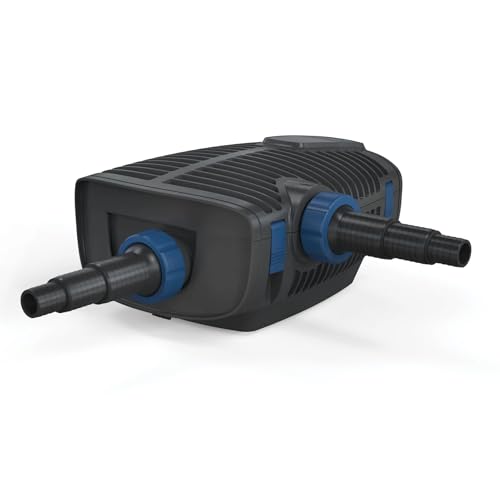
OASE AquaMax Eco Premium
The submersible most backyard ponds should buy: an efficient, solids-handling pump built to run continuously, where a submersible usually loses to an external. Feed a filter or waterfall and the running-cost gap to an inline pump nearly closes.
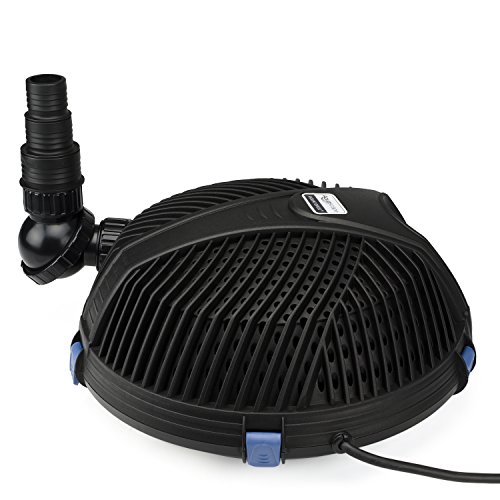
Aquascape AquaForce 1000 Solids Handling Pump
The mid-size waterfall and filter feeder, with a prefilter cage that keeps leaves and muck out of the impeller so it clogs less. An asynchronous motor keeps the draw modest for a pond running one filter and a modest fall around the clock.
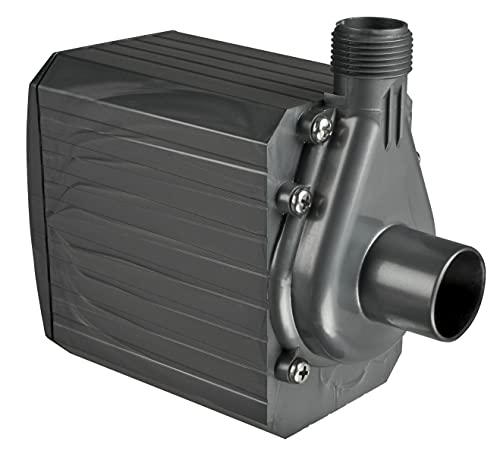
Pondmaster Pond-Mag Magnetic Drive Pump 1800 GPH
The flexible pick: a mag-drive pump that runs wet as a submersible or dry as an inline pump. It's the low-commitment way to try external placement and a clean-out basket without buying a big dedicated unit or hunting a pond dealer.

VIVOSUN 5300 GPH Submersible Pond Pump
The cheap way to move a lot of water for a big waterfall or feature. The 5,300 GPH is a zero-head number that drops with lift, and the low price buys a shorter service life than the OASE, so treat it as the budget path, not a forever pump.
What owners say
Real owner reports from the threads and editorial sources we drew on for this guide.
“i also have a laguna but i dont think they are as powerfull as the titan ...but my pond is only small so maybe if i had a large pond i would go external”
“I would not do a 32 foot run to a 5' high waterwafall with a sumbersible. And then a 100g stock tank to boot. What you're describing is external pump territory.”
“I like submerged because i don't have to pull it but the external have the advantage of a clean out basket .I look more at energy cost and head height than anything”
“much easier to remove for winter or not just unplug and leave sitting at the bottom of the pond. in warmer climates submersibles add heat to the pond. cost more, you can work on the pump without effecting the pond. Quieter and less vibration for the fish i use external”
“Here in CA, the cost for elec is $0.45/kwhr. My current pump is using ~$55/mo to run 24/7. I'd like to reduce that cost if possible.”
“I like my submersible Laguna Max flo as I can leave it on all winter underwater and allow water circulation to continue even in our cold months.”