How Much Electricity Does a Pond Pump Use?
By The Pond Review · Updated September 2026
Independent editorial guide. We never accept payment for coverage, though we may earn a commission if you purchase through our links.
Quick Take
A pond pump is almost always the single biggest electricity user in a backyard pond, because unlike a light or an AC it runs 24 hours a day, every day. The cost is pure arithmetic: take the pump's wattage, divide by 1,000 to get kilowatts, multiply by 24 hours and by 30 days, then multiply by the price you pay per kWh (read it off your electric bill). A common mid-size pump around 100 watts uses about 72 kWh a month, which lands somewhere between roughly 11 and 22 dollars a month depending on your local rate. Small energy-efficient DC pumps can run for a few dollars a month; big high-head waterfall pumps can top 50 or 60. The two things that swing your bill most are the pump's wattage (not its flow rating) and your local electricity price, and both are fixable: measure what your pump draws, then right-size and, if needed, upgrade to a high-efficiency pump.
The meter we use to measure a pump's real draw, and the efficient pumps that cut the bill, are below. See picks ↓
Most pond owners never think about the pump's electricity until the first full-summer power bill arrives and something looks off. That reaction is not imagined. A pond pump is one of the only appliances in a house that runs flat out around the clock, so even a modest pump quietly adds up to more kWh per month than a refrigerator, and a big waterfall pump can rival a second AC unit. The good news is that this is one of the most predictable costs in the whole hobby: it is a single wattage number times the hours times your rate, and once you can run that calculation you can see exactly where the money goes and how to cut it.
This guide gives you the formula and a plain wattage-to-cost table so you can estimate your own pump in under a minute, then shows you how to measure its real draw with a plug-in meter (because the wattage printed on the box is often optimistic), why two pumps rated for the same flow can cost wildly different amounts to run, and the two honest ways to lower the bill: right-sizing and a high-efficiency pump. It also settles the question everyone asks, whether you can just shut the pump off at night to save money, which has a different answer for a decorative waterfall than for the filter pump keeping fish alive.
The short answer, and the formula
Electricity is billed by the kilowatt-hour, so the cost of running any pump is its power draw in kilowatts multiplied by how many hours it runs and your price per kWh. Written out for a pump running nonstop, it is: watts divided by 1,000, times 24 hours, times 30 days, times your dollars-per-kWh rate. One forum member laid out the exact calculation for a 165-watt pump: "Typical price for electricity in the US is about 11 cents/killowatt hour. So the calculations works out like this: 165 W / (1000 W/kW) *24 hr per day * 30 days/month * $0.11 per kWh and I come up with $13 a month." That is the whole method. The only two numbers you need are your pump's wattage, from the label or its spec sheet, and your rate, which is printed on your electric bill (US rates commonly run from about 12 to over 30 cents per kWh).
What that works out to, by wattage
Run the formula across common pump sizes and a range of rates and you get a quick lookup table. These are estimates for a pump running 24/7; halve them if you run a decorative feature only 12 hours a day. The rate range shown, roughly 15 to 30 cents per kWh, covers most of the US:
- 50 watts (a small all-in-one or an efficient DC pump): about 36 kWh a month, roughly $5 to $11.
- 100 watts (a typical mid-size submersible): about 72 kWh a month, roughly $11 to $22.
- 200 watts (a large submersible or small external pump): about 144 kWh a month, roughly $22 to $43.
- 300+ watts (a big external or high-head waterfall pump): about 216 kWh a month, roughly $32 to $65, and up from there.
Multiply any of those by 12 for the yearly cost, and this is where the sticker shock lives: a 300-watt pump at 20 cents can quietly cost over 500 dollars a year. Note that the number that drives all of this is watts, not the flow rating in gallons per hour. A pump's GPH tells you nothing about its running cost on its own, which is exactly why the next two sections matter.
Measure your own pump (the label often lies)
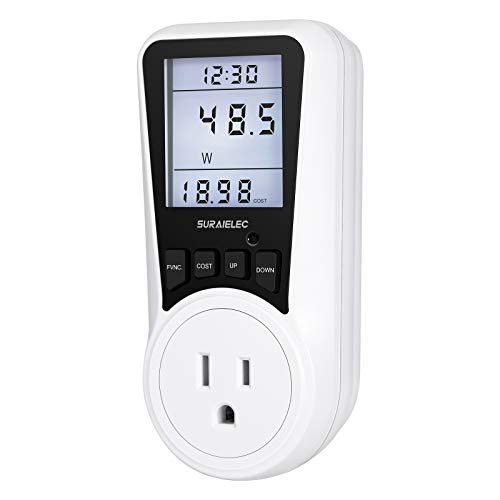
Before you trust the wattage on the box, know that it is frequently optimistic, and the real draw can be higher, especially on cheaper pumps. The fix is a plug-in watt meter: you plug the pump into the meter, plug the meter into the outlet, and it reads the real watts and accumulates kWh over time so you can see the true cost, and the better ones let you enter your rate and read the cost directly. Experienced keepers reach for one for exactly this reason. As one put it after a pump's rated numbers did not add up: "The manufacturer lied to you about its watt usage, which is common and is why I use a watt meter." For a couple of dollars per year of accuracy, measuring your real draw is the single most useful thing you can do, and it turns every estimate above into a hard number for your specific pump.
Why two pumps at the same flow can cost triple
Two pumps can both be rated at, say, 2,000 GPH and yet one costs three times as much to run, because they convert electricity to water flow with very different efficiency. The metric that captures this is gallons per hour per watt: divide a pump's flow by its wattage and you can compare any two pumps directly. Old-style mag-drive (magnetic-drive) pumps often manage only around 8 to 12 GPH per watt. Modern DC and asynchronous pumps can hit 25 to 35 or more. One owner's efficient setup shows the gap plainly: "New heat pump and laguna pond pumps .1 uses 95 watts and is 2900 gph and other one is using 75 watts and is 2400 gph laguna," which is over 30 gallons per hour per watt, a figure an older pump cannot touch.
That efficiency is real money, every hour, forever, which is why keepers who have done the math push newcomers toward high-efficiency pumps and note the payback is fast. As one advised an owner running a power-hungry pump: "I suggest that you switch to a high efficiency pump. It will pay for itself in less than a year." When you shop, compute GPH per watt from the box specs and let it, not the headline flow number, guide the choice.
The oversizing and head-height traps
Two setup mistakes inflate the bill more than the pump brand does. The first is oversizing: buying far more flow than the pond needs. A pond generally only needs its full volume turned over about once an hour, and a waterfall needs flow matched to its width, so a pump chosen two sizes too big just burns extra watts around the clock for water you do not need. The second is head height. Every foot the pump has to lift water, and every fitting and foot of pipe, costs flow, and a pump straining against 15 or 20 feet of head can draw its full wattage while delivering only a fraction of its rated GPH. Your local electricity rate then multiplies whatever that draw is: one owner with a very efficient 135-watt pump still felt it because, as they noted, "The issue is the price of electric, here it costs 17.59p per kwh, that is $0.30 per kwh in america." Right-size the pump to the pond and match its performance curve to your actual head, and you fix the cost at the source.
Can you shut it off to save money?
For a purely decorative waterfall or stream pump, yes: putting it on a timer so it runs only during the day, when you are around to enjoy it, can cut that pump's cost roughly in half, and many owners do exactly that. But the filter and circulation pump on a stocked pond is a different animal, and this is the one safety line to respect. That pump is life support: it keeps the biofilter fed and the water oxygenated, and shutting it off overnight, especially in warm weather, stalls the filter and lets oxygen crash, which is dangerous for fish. As one keeper warned an owner asking about a nightly shutoff, it is "Not a good idea, especially if you have fish." The honest rule is simple: you can timer the decorative water feature, but the pump keeping fish alive runs 24/7, and you cut its cost through efficiency and right-sizing, not by turning it off.
Pond pump electricity questions, answered
How much does it cost to run a pond pump per month?
It depends almost entirely on the pump's wattage and your electricity rate. Using the standard formula (watts / 1000 x 24 x 30 x your rate), a 50-watt efficient pump runs about $5 to $11 a month, a typical 100-watt pump about $11 to $22, and a large 300-watt waterfall pump roughly $32 to $65, at rates from 15 to 30 cents per kWh. Find your pump's wattage on its label and your rate on your electric bill to get your exact number, or measure it with a plug-in meter.
Does a pond pump use a lot of electricity?
It uses more than most people expect, not because the pump is powerful but because it runs 24 hours a day, every day. A mid-size pond pump can quietly use more kWh per month than a refrigerator. The draw of a right-sized, efficient DC pump, though, is modest, often just a few dollars a month, so "a lot" really comes down to whether the pump is oversized and inefficient or matched to the pond.
How do I lower my pond pump electricity bill?
Three honest levers. First, right-size: do not run more flow than the pond needs (about one turnover per hour, plus your waterfall). Second, upgrade to a high-efficiency DC or asynchronous pump, which can move the same water for a third of the watts and often pays for itself within a year. Third, put a purely decorative waterfall pump on a timer. Do not save money by shutting off the filter pump on a pond with fish; that pump has to run continuously.
Are DC pond pumps really more efficient?
Yes, and measurably so. Compared on gallons per hour per watt, older mag-drive pumps often deliver around 8 to 12 GPH per watt while modern DC sine-wave pumps reach 25 to 35 or more, moving the same water for far fewer watts. Many DC pumps are also controllable, so you can dial the flow down and drop the wattage further. Over years of 24/7 running, that efficiency gap is the difference between a pump that costs a few dollars a month and one that costs 30 or 40.
The picks
Products we recommend for this guide.
SURAIELEC Watt Meter with Cost Calculator
The most useful few dollars you can spend on this question: it answers it exactly for your pump. Plug the pump in, enter your kWh rate, and its built-in cost calculator shows the real watts and the running cost, so you see your true number instead of the optimistic label.

Jebao DCP-4000 DC Sine Wave Pump
The efficient-upgrade path when a meter shows your old pump is the power hog. A controllable DC sine-wave pump with one of the best flow-per-watt ratings in its class: serious flow on a fraction of a mag-drive’s wattage. On 24/7 duty it pays back fast.

POPOSOAP 1600 GPH DC Pond Pump
A budget way into DC efficiency for a small to mid pond. Low-voltage 24V DC keeps the draw low and the plug safe near water, and controllable speed lets you match flow instead of over-pumping. Right-sized, it runs for a few dollars a month.
What owners say
Real owner reports from the threads and editorial sources we drew on for this guide.
“Typical price for electricity in the US is about 11 cents/killowatt hour. So the calculations works out like this: 165 W / (1000 W/kW) *24 hr per day * 30 days/month * $0.11 per kWh and I come up with $13 a month. If the other pump is double that, it's $26 a month. You can see you quickly save the extra money spent.”
“The manufacturer lied to you about its watt usage, which is common and is why I use a watt meter.”
“New heat pump and laguna pond pumps .1 uses 95 watts and is 2900 gph and other one is using 75 watts and is 2400 gph laguna”
“I suggest that you switch to a high efficiency pump. It will pay for itself in less than a year.”
“The issue is the price of electric, here it costs 17.59p per kwh, that is $0.30 per kwh in america”


