The Best Pond Water Test Kit
By The Pond Review · Updated August 2026
Independent editorial guide. We never accept payment for coverage, though we may earn a commission if you purchase through our links.
Quick Take
For a stocked pond, buy a liquid drop test kit and treat test strips as a convenience, never the reading you trust when a fish looks sick. Our default is the API Freshwater Master Test Kit: it reads ammonia, nitrite, nitrate, and pH with drops and reagents, and on a pond that carries koi or goldfish those first two numbers are the ones that decide whether the water is safe.
Strips still have a place. For a quick weekly glance to confirm nothing has moved, the API Pond 5-in-1 strips are fast and fine, and the JNW Direct 7-in-1 pack is the cheapest way to keep strips on hand. What they aren't is accurate, and they lose what accuracy they have as soon as air and moisture reach the unused pads in the bottle. So keep a bottle for the quick look and keep a drop kit for the reading that matters.
We've matched three kits to how you'll use them below, from the drop kit we test with to the strips worth keeping for a fast check. See picks ↓

A pond test kit answers one question: is the water safe for the fish right now. On a stocked pond that safety comes down to two invisible poisons, ammonia and nitrite, and the tool you reach for has to read them well enough to trust. That's where the choice between liquid drops and paper strips stops being about price and starts being about whether the number in front of you is real.
Our view cuts against the reflex to grab the cheapest strip pack for a new koi pond. A new pond is exactly when the water is most likely to turn dangerous and exactly when you need an accurate ammonia and nitrite reading, so it's the worst moment to rely on the least accurate tool. Buy the drop kit first. Add strips for convenience once you know what a safe pond looks like.
Our take: on a stocked pond, buy the liquid drop kit
We recommend a liquid drop kit as the one to own for any pond with fish in it, and the API Freshwater Master Test Kit is where we'd start. It's a box of glass vials and reagent bottles: you fill a vial with pond water, add a set number of drops, and match the color that develops against a printed card. It takes a couple of minutes and a steady hand, and in exchange you get a reading you can act on.
The reason we lead with drops over strips is accuracy on the numbers that matter. A drop kit measures a reaction in a fixed volume of water, so a careful test gives you a repeatable result you can compare week to week. Strips read a patch of chemistry on paper that you dip for a few seconds and eyeball against a chart, and they drift. For a pond carrying a real fish load, that gap in accuracy is the difference between catching an ammonia spike early and finding out when a fish is already gasping at the surface. The kit is also cheaper per test over its life, since one master kit runs to hundreds of readings.
What a pond test needs to measure
Five numbers cover almost everything a backyard pond owner needs, and they don't all mean the same thing. Ammonia and nitrite are the safety readings, and on a cycled pond both should sit at zero. Any measurable amount of either is a problem to act on, because both are toxic to fish at low concentrations. Nitrate is the far less harmful end product of the same cycle, and you watch it as a trend rather than a pass-fail line, since a slow climb tells you the pond is loading up and due for a water change.
pH and KH are the stability pair, and here the goal is steadiness, not a magic target number. pH tells you how acidic or basic the water is, and fish tolerate a range as long as it holds steady. KH, the carbonate hardness, is the buffer that keeps pH from swinging, so a healthy KH is what stops a dangerous overnight pH crash. Test for a stable reading over time rather than chasing a single perfect figure. One note on the kit we picked: the freshwater master version reads nitrate, while the pond-labeled version swaps nitrate for phosphate, and for tracking a stocked pond's load the nitrate trend is the more useful of the two.
Why strips drift, and why that matters most when it counts
Strips are the least accurate option on the shelf, and the reason is built into how they're stored. The reactive pads sit in a bottle, and every time you open it to pull a strip you let in air and moisture. That humidity slowly degrades the pads still in the bottle, so a strip you use in month six can read differently from one you used the week you opened it. The kit doesn't warn you it has drifted. You find out when a reading disagrees with reality.
Owners run into this constantly. A strip reads chlorine in a pond filled from a well that has none, or gives a nitrite number that a drop kit later contradicts. None of that means the pond is fine or ruined; it means the tool can't be trusted for a reading you plan to act on. When a fish looks sick and you need to know whether ammonia is the cause, a strip that might be off by a full step is the last thing you want in your hand. That's the moment a drop kit earns its keep.
Ammonia and nitrite are the numbers that kill, not pH
The most useful thing to understand about pond water is the nitrogen cycle, and it comes from aquatic-vet and extension fishkeeping guidance rather than forum habit. Fish waste and uneaten food break down into ammonia, which is highly toxic. A colony of beneficial bacteria converts that ammonia into nitrite, which is also toxic, and a second bacteria group converts the nitrite into far safer nitrate. A pond is cycled once those bacteria colonies are established and both ammonia and nitrite read zero.
That's why we weight a kit by how well it reads ammonia and nitrite. Those two harm fish at low levels, and they're invisible in the water, so the test is the only warning you get. pH matters for stability, but a pond rarely loses fish to a pH sitting a little high; it loses them to an ammonia spike during cycling or after an overstock. A kit you trust on ammonia and nitrite is doing the job that keeps fish alive. Reach for the drops for those two above all, and lean on strips only for the readings where a rough answer is good enough.
Where strips earn their place
None of this makes strips useless. For a quick weekly glance to confirm nothing has moved, a strip is faster than setting up vials and drops, and speed is worth something when the alternative is skipping the test that week. If a strip flags something odd, you follow it with the drop kit to get a real number. Used that way, as a fast screen backed by an accurate kit, strips are a fine convenience. The API Pond 5-in-1 is the strip we'd keep on hand for that, and the JNW Direct 7-in-1 pack is the cheapest way to have strips in the drawer.
Where we disagree with common advice is buying a cheap strip pack as your only kit for a new koi pond. A new pond is in the middle of cycling, which is when ammonia and nitrite are most likely to spike and when an accurate reading matters most. Starting with the least accurate tool at the moment you most need precision is backwards. Buy the drop kit for the setup phase, and let strips join later as the quick check once the pond is stable.
Getting a clean reading from the kit
A drop kit only rewards you if you run it the same way each time. Rinse the vial in pond water before you fill it, hold it to the printed number of drops rather than eyeballing, cap and shake for the full time the instructions call for, and read the color against the card in daylight rather than under a kitchen bulb that shifts the hue. The nitrite and nitrate tests in particular reward a firm shake and the full wait, since a rushed read is where a scary number that isn't real comes from.
Store the reagents somewhere cool and out of the sun, and replace a kit that has aged past its printed life, because old reagent drifts the same way a damp strip does. The point of all this is repeatability: a test is worth running only if today's reading can be compared to last month's, and that comparison is what turns a number into a decision. Do it loosely and you're back to guessing, which is the problem the drop kit was there to fix.
Reading the results without chasing numbers
A test kit is a decision tool, so read it that way. Ammonia or nitrite above zero on a stocked pond means act now, usually with a water change and by easing off feeding until the number drops, since feeding adds the waste that becomes ammonia. Nitrate creeping up over weeks means schedule a water change, not panic. pH that holds steady is fine even if it isn't the number on some chart, and a KH reading tells you whether that stability is going to last.
The trap is chasing a perfect set of numbers instead of watching trends and watching the fish. Water parameters move with the seasons, with rain, and with how much you feed, so a single reading is a snapshot, and the pattern over time tells you more than any one test. Keep a rough log, test on a schedule rather than only when something looks wrong, and let the fish's behavior back up what the kit tells you. A calm pond with fish feeding normally and a clean ammonia reading is the goal, not a spreadsheet of ideal figures.
How we'd spend it
If it were our pond, we'd own one liquid master kit and treat it as the tool of record, then keep a bottle of strips for the fast weekly look. The drop kit costs more up front and pays it back over hundreds of tests, and it's the reading we'd trust the day a fish looks off. Strips ride along for convenience, never as the kit that decides whether the water is safe.
Two habits separate the owners who keep fish alive from the ones who lose them to a spike they never saw. They test ammonia and nitrite with a kit accurate enough to trust, especially while a new pond is cycling. And they read the results as a trend to manage rather than a number to chase. Do those two things with a drop kit in the cabinet, and most of the water-quality emergencies that fill the pond forums never reach your pond.
The picks
Products we recommend for this guide.

API Freshwater Master Test Kit
The drop kit we test with and trust on a stocked pond. Vials and reagents read ammonia, nitrite, nitrate, and pH, and this freshwater version tracks nitrate not phosphate, the number to trend on a pond. Runs to about 800 tests.
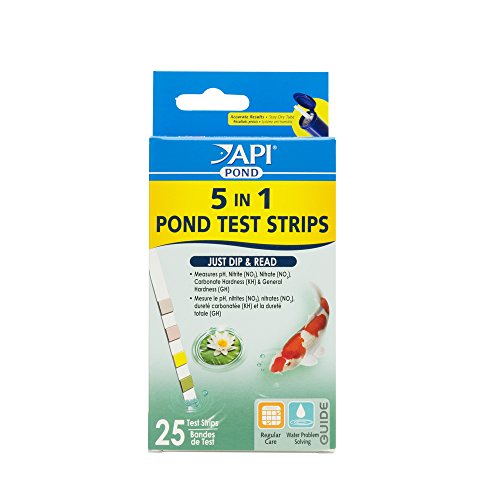
API Pond 5-in-1 Test Strips (25-Count)
The strip to keep for a quick weekly glance. Dip it, read the pads against the chart, and confirm nothing has moved in seconds. Read it as a screen: if it flags something, follow up with a drop kit before you act on it.

JNW Direct Pond 7-in-1 Test Strips (50 Pack)
The cheapest way to keep strips in the drawer, 50 to a pack across seven readings. Fine for a fast look to confirm the pond hasn't shifted. Expect the usual strip limits: rough accuracy that fades as air reaches the bottle.
What owners say
Real owner reports from the threads and editorial sources we drew on for this guide.
“Use the liquid drops test kits for best results. Most people I know use the API master test kit. The strips are not very reliable.”
“Because strips come in the little bottles, every time you open the bottle [even if you are quick and close it tightly] you are letting in moisture that, over time can effect the accuracy of the results -- CAN, not does. Also, in the long run, the strips are going to cost more.”
“Willow they are useless as Andy is finding out wiith his on pond, your best bet is the pond drop test either the Tetra Pond Test kit or the API pond test kit they are both as good as each other. Dave”
“In addition to the API master kit, also pick up an API KH/GH test kit. Maintaining KH and GH within parameters will ensure you have a stable PH.”
“After several weeks of non stop rain, I finally used my new API kit for the first time. I was very impressed conpared with test strips that my friend let me try. After 12 yrs of not checking the water, now I can see that my pond is doing good.”