API Master Test Kit Review + Verdict for Ponds
By The Pond Review · Updated August 2026
Independent editorial review. We never accept payment for coverage, though we may earn a commission if you purchase through our links.

Verdict
Pull the pond forums together and the verdict is close to unanimous, which is why we state it flat: for a pond you care about, use the liquid drops, and keep strips only for quick checks. Keepers describe the liquid kits as more accurate and longer-lasting, and note that the strips are notoriously inaccurate and start to deteriorate as soon as air hits the tube. The pattern holds across years of threads and different users, from the ones who say most people they know run the API master kit to those who point out that strips cost far more per test in the long run. The dissent is narrow and fair: strips have a place for a fast quickie check, and even a strip fan concedes cost per test is their biggest problem. The most useful caution comes from a keeper who stored an API liquid kit in a garage that ran hot and cold and watched it drift, which is our reliability knock in one anecdote: the drops are the accurate standard, but only if you keep them cool and shake the bottle. Our own read matches the room, with the one refinement none of them dispute: on a fish pond, take the Freshwater kit's nitrate test over the pond kit's phosphate, and buy the KH test they all wish came in the box.
Read full take ↓Similar water test kits
For a stocked fish pond, the API liquid Master Test Kit is the accurate standard and the one to own. It reads ammonia and nitrite reliably, and those two are the ones that kill fish, invisibly and quickly, when a pond is new or has just crashed. Test strips are the least accurate option on the shelf, and they get worse the moment air hits them, so the tool you'd trust least is the one you'd be leaning on in the exact emergency where being wrong costs fish.
None of that makes strips useless. They're fine for a quick weekly glance to confirm nothing has moved, and they're faster and less fiddly than lining up glass vials and counting drops. The liquid kit is what you reach for when something looks wrong, when the fish are hanging at the surface or the water has gone cloudy and you need a number you can act on. One note before you buy: the kit here's API's Freshwater Master, which reads pH, ammonia, nitrite and nitrate. That nitrate pad, not the phosphate one the pond-labeled kit swaps in, is the set we'd want on a fish pond, and we get into why below.
The short version
What works:
- It reads ammonia and nitrite, the two toxins that kill pond fish, and reads them accurately enough to act on in an emergency.
- Hundreds of tests per kit, so the cost per reading works out to a fraction of what strips run over a season.
- The reagents keep for a long time stored cool and dark, where strips start degrading the moment the tube is opened.
- The Freshwater Master's four tests, pH, ammonia, nitrite and nitrate, are the right set for tracking a pond's nitrogen cycle.
What to watch:
- It's slower and fiddlier than a strip: multiple bottles, timed waits, and bottle two needs a hard shake or the nitrate reading runs low.
- Color-matching against the card is subjective, most at the high end of the nitrate scale where the shades bunch together.
- Reagents fade with heat and age, so a kit cooked in a garage or years past its prime can drift.
- No KH or GH test in this kit, and no phosphate; a pond keeper often wants KH tracked and buys that test separately.
Why a stocked pond needs accurate ammonia and nitrite
Fish waste, uneaten food and decaying leaves all break down into ammonia. In an established pond, one colony of bacteria converts that ammonia into nitrite, and a second colony converts nitrite into far less toxic nitrate, which you export with water changes and plants. That chain, ammonia to nitrite to nitrate, is the nitrogen cycle, and it's the single thing standing between your fish and poisoning. Aquatic-vet and extension fishkeeping guidance all point the same way: in a cycled pond, both ammonia and nitrite should read zero, and any detectable amount of either is a problem to fix, not to watch.
The danger window is a new pond or a crashed one. Before the bacteria colonize, or after a medication, a big cleanout or a die-off wipes them out, ammonia climbs with nothing to convert it, and once ammonia falls the nitrite spikes behind it. Both are invisible and both burn gills and stress fish at low concentrations. This is precisely when you can't afford a testing tool that's off, and it's the case for owning the accurate kit before you need it rather than trusting a strip you bought last season.
Freshwater master kit versus the pond kit: which four tests you get
API sells this in two near-identical boxes, and the difference matters more than the shared name suggests. The Freshwater Master Kit reads pH, ammonia, nitrite and nitrate. The Pond Master Kit swaps the nitrate test for a phosphate one. For a fish pond we'd take the nitrate version every time. Nitrate is the end product of the cycle: watching it climb tells you the biofilter is working and tells you when a water change is due. Phosphate mostly informs algae, which you can usually attack through shade, plants and less feeding without a test in hand.
What neither box includes is a KH test, and on a pond that's a real gap. Carbonate hardness is the buffer that keeps pH stable, and a pond whose KH bottoms out can drop into a dangerous pH swing overnight. Experienced keepers on the pond forums flag this repeatedly, treating KH as essential and buying the separate API KH test to sit alongside the master kit. Budget for that extra test if you keep koi. Do the same for GH only if you have soft tap water and sensitive fish.
Liquid versus strips: what the accuracy buys you
Strips work by dipping paper pads and reading colors, and they carry two structural weaknesses that no brand engineers away. First, the reagent pads start degrading the moment air reaches them, so a tube opened weeks ago reads differently from a fresh one, and a tube stored in a humid shed is worse still. Second, they compress a lot of chemistry onto tiny pads, which is why they land in the right neighborhood more often than on the right number. For a quick glance at a stable pond that's enough. For deciding whether ammonia is at a level that needs an emergency water change, it isn't.
The liquid kit trades convenience for that precision. You measure water into a vial, add counted drops of reagent, wait the specified time and match the color. It takes a few minutes and a steady hand, and it rewards you with a reading you can base a decision on. This is the consensus among the keepers who have used both, and it's ours too: strips for the quick check, the liquid drops for anything that matters. The one caveat is the color card. At the top of the nitrate scale the shades run close together, and reading it in warm indoor light against a white background is worth the trouble.
Living with it: timing, shaking and storage
Three habits separate a trustworthy reading from a misleading one. Shake nitrate bottle two hard, for a good half minute, before you use it; the reagent settles and an unshaken bottle reads low, which is the most common way people get a falsely comforting nitrate result. Respect the wait times printed for each test, because reading early gives you the wrong color. And store the kit somewhere cool and dark. A kit that lives in a garage that bakes in summer and freezes in winter will drift over time, exactly the storage mistake owners own up to when their strips and liquid stop agreeing.
The physical kit is glass vials, plastic dropper bottles and a paper card, so the failure modes are mundane: a cracked vial, a lost cap, a smeared card. Reagents are the consumable, and rather than rebuy the whole kit you can buy the individual ammonia or nitrite reagent when one runs dry. Kept cool and handled with a little care, one master kit outlasts a long run of strip tubes and stays honest the whole way.
How it compares
- Versus API Pond 5-in-1 strips: the fast weekly glance. Five pads cover pH, KH, GH, nitrite and nitrate on one dip, with no ammonia test at all, which is a real hole given ammonia is half of what you're watching for. Fine for confirming a stable pond hasn't moved; not the tool for an emergency, and not as cheap per test as the drops once you run the numbers over a season.
- Versus JNW Direct 7-in-1 strips: a different brand at the lowest cost per strip, fifty to a pack, reading seven parameters at once. It has the same built-in ceiling every strip does, drifting as the pack ages and air gets in, but as a cheap gut-check to tell you whether to bother pulling out the liquid kit, a fresh tube earns its keep.
How to use it on a pond
Test on a schedule and after anything eventful. In a new pond, check ammonia and nitrite every couple of days until both hold at zero and nitrate begins to register, which is the cycle finishing. On an established pond, a weekly or fortnightly check is plenty, with an extra one any time you add fish, medicate, do a big cleanout, or see fish gasping at the surface or gulping at dawn. When ammonia or nitrite shows up, the immediate response is a partial water change plus a dechlorinator that binds ammonia, then retest.
Two practical notes. Test the pond, not the tap: fill the vial from the pond itself, mid-depth and away from the waterfall, so you read what the fish live in. And keep a log. A column of dated numbers turns a single scary reading into a trend you can act on, and it's the difference between guessing and knowing when a green tinge or a sluggish fish shows up.
Where we land
For anyone keeping fish in a backyard pond, the API liquid Master Test Kit is the one to own. It measures the two toxins that kill fish accurately, it costs a fraction per test of the strips it replaces, and it stays reliable for a long time if you keep it cool and shake bottle two. The Freshwater version's nitrate pad is the more useful fourth test than the phosphate the pond box substitutes, and the one thing worth buying alongside it's the separate KH test.
Keep a tube of strips too. There's no contradiction in owning both: the strips are for the ten-second weekly glance that tells you nothing has moved, and the liquid kit is what settles the question the moment something looks off. If you only buy one, buy the drops. It's the tool you'll wish you had the night the water goes wrong.
Our Ratings
Overall score
The weak point, and the reason it does not score higher, is that the reagents are perishable and the reading depends on you. Bottles fade with heat and age, an unshaken nitrate bottle reads low, and glass vials crack. Stored cool and handled with care a kit stays honest for years and you can rebuy single reagents rather than the whole box, but it asks more of the owner than a sealed strip tube does.
As a measurement tool it does the core job better than anything else at this price: it reads ammonia and nitrite, the two killers, accurately enough to act on in an emergency, and its nitrate pad tracks the cycle to completion. It falls short of a perfect mark only on the color card, where the high end of the nitrate scale bunches together and reading it well takes good light and a steady eye.
The sticker is higher than a tube of strips, but the arithmetic runs the other way fast: hundreds of tests per kit put the cost per reading far below any strip over a season, a point the experienced keepers make themselves. It loses a little because this kit omits KH, which a pond keeper usually wants and has to buy separately.
API Master Test Kit on Amazon.
The Evidence Behind Our Verdict
Pull the pond forums together and the verdict is close to unanimous, which is why we state it flat: for a pond you care about, use the liquid drops, and keep strips only for quick checks. Keepers describe the liquid kits as more accurate and longer-lasting, and note that the strips are notoriously inaccurate and start to deteriorate as soon as air hits the tube. The pattern holds across years of threads and different users, from the ones who say most people they know run the API master kit to those who point out that strips cost far more per test in the long run.
The dissent is narrow and fair: strips have a place for a fast quickie check, and even a strip fan concedes cost per test is their biggest problem. The most useful caution comes from a keeper who stored an API liquid kit in a garage that ran hot and cold and watched it drift, which is our reliability knock in one anecdote: the drops are the accurate standard, but only if you keep them cool and shake the bottle. Our own read matches the room, with the one refinement none of them dispute: on a fish pond, take the Freshwater kit's nitrate test over the pond kit's phosphate, and buy the KH test they all wish came in the box.
Our rating above is our own editorial call. What follows is the field evidence we weighed to reach it: first-hand reports from pond owners on dedicated pond and koi forums, which we lean on more than manufacturer-influenced published reviews because unsponsored owners tend to be the more candid signal.
What Pond Forums Say
“The liquid test kits are more accurate and should maintain quality much longer than the strips.”Source →
“The strips are notoriously inaccurate and, from what I understand, they start to deteriorate as soon as air hits them when you open the tube. As @JRS stated, the liquid tests are a better choice.”Source →
“Use the liquid drops test kits for best results. Most people I know use the API master test kit. The strips are not very reliable.”Source →
“Strips are generally used more to just do quickie checks, to let you know things might be off. They can be accurate, but most on here would prefer a liquid [drops] test kit for general use.”Source →
“I like the Tetra strips, but they are the only strips I've seen worth using. The biggest problem with strips is the cost per test, which is many times greater than a liquid kit.”Source →
“I did have that API liquid test stored in the garage, which gets very hot in summer and cold in winter. Probably not the best way to store that test kit.”Source →
Frequently asked questions
Is the API Master Test Kit worth it?
The sticker is higher than a tube of strips, but the arithmetic runs the other way fast: hundreds of tests per kit put the cost per reading far below any strip over a season, a point the experienced keepers make themselves. It loses a little because this kit omits KH, which a pond keeper usually wants and has to buy separately.
How reliable is the API Master Test Kit?
The weak point, and the reason it does not score higher, is that the reagents are perishable and the reading depends on you. Bottles fade with heat and age, an unshaken nitrate bottle reads low, and glass vials crack. Stored cool and handled with care a kit stays honest for years and you can rebuy single reagents rather than the whole box, but it asks more of the owner than a sealed strip tube does.
How well does the API Master Test Kit perform?
As a measurement tool it does the core job better than anything else at this price: it reads ammonia and nitrite, the two killers, accurately enough to act on in an emergency, and its nitrate pad tracks the cycle to completion. It falls short of a perfect mark only on the color card, where the high end of the nitrate scale bunches together and reading it well takes good light and a steady eye.
What do real owners say about the API Master Test Kit?
Pull the pond forums together and the verdict is close to unanimous, which is why we state it flat: for a pond you care about, use the liquid drops, and keep strips only for quick checks. Keepers describe the liquid kits as more accurate and longer-lasting, and note that the strips are notoriously inaccurate and start to deteriorate as soon as air hits the tube. The pattern holds across years of threads and different users, from the ones who say most people they know run the API master kit to those who point out that strips cost far more per test in the long run.
Options Worth Checking Out
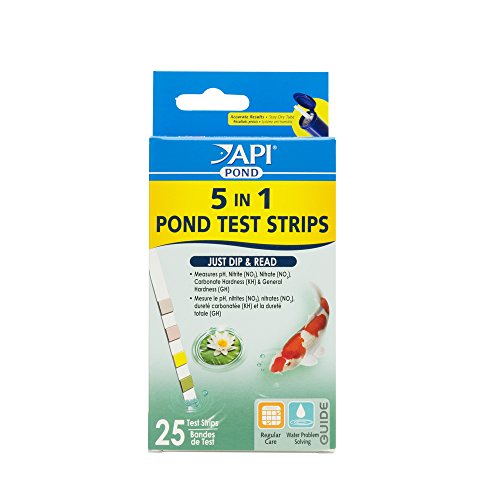
API Pond 5-in-1 Test Strips (25-Count)
API's own pond strips: five pads for pH, KH, GH, nitrite and nitrate on one dip, with no ammonia test. Fast enough for a weekly glance, but they drift once air reaches the tube, so read a bad result as your cue to reach for the liquid kit.

JNW Direct Pond 7-in-1 Test Strips (50 Pack)
A different brand at rock-bottom cost per strip, fifty to a pack, reading seven parameters at once. Handy for a quick dip before you commit to the drops, but it carries the same weakness: the numbers wander as the pack ages and air gets in.
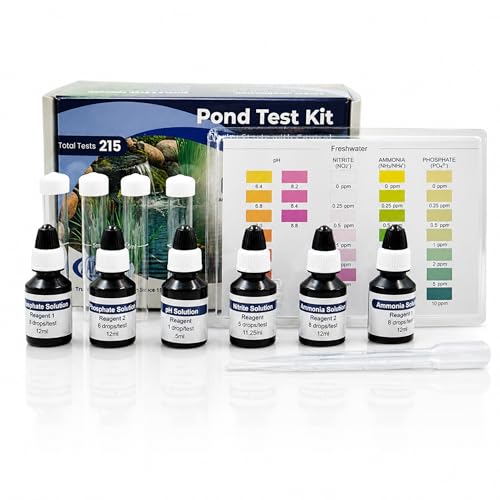
Half Off Ponds 4-in-1 Pond Water Test Kit
A distinct-brand liquid test kit covering the four readings that matter, pH, ammonia, nitrite and nitrate, at a fair price. A real alternative to the API line if you want liquid accuracy without the API name, though it runs fewer tests per bottle.


