The Best Pond Air Pump
By The Pond Review · Updated August 2026
Independent editorial guide. We never accept payment for coverage, though we may earn a commission if you purchase through our links.
Quick Take
Buy a pond air pump on three things and ignore the fourth. Match the pump's LPM to your pond's depth and fish load, buy a build that can run 24 hours a day for years, and keep the noise down because it lives outside by the house. Price is the thing to weigh last, not first. For a typical koi pond that means a linear-diaphragm pump in the 40 to 60 LPM range, and our top pick is the HIBLOW HP-40: a rebuildable linear pump that sips power and takes a service kit instead of a trip to the landfill.
Size up from there if your pond is deep or heavily stocked, drop to a quiet complete kit if the pump sits near a patio, and treat the cheap throwaway pumps as a summer backup rather than the main aerator on a pond you care about.
Below: the rebuildable linear pump we'd buy, the premium system for deep or big water, the quiet kit for near the house, a bigger kit, and the budget stopgap. See picks below

Most air-pump listings want you to shop on one number: the price, or a headline bubble rating that means nothing without knowing your pond. We think that's backwards. An aerator runs every hour of every day, in the weather, for years, so the questions that matter are how much air it delivers at your depth, whether the build survives that duty cycle, and how loud it's where you have to live with it. Get those right and the price mostly sorts itself out.
So here's the reasoning we'd use, the arithmetic the box hopes you skip, and the five pumps we'd put on a koi pond, from the rebuildable linear pump we'd buy first to the cheap one that's fine as a backup and no more.
The short version
What we'd buy, and why:
- For a typical koi pond, a linear-diaphragm pump around 40 to 60 LPM. It moves enough air at real pond depth and is quiet and cheap to run 24/7.
- A build you can rebuild. The diaphragm is the wear part; a good linear pump takes a replacement kit, so it outlasts the throwaways by years.
- Quiet, because it runs outside by the house. A pump that buzzes on a patio is a pump you end up unplugging, which defeats the point.
- Size to your pond, not your budget. Deep or heavily stocked water needs more air; a small water garden needs far less.
Where the cheap pumps bite you:
- The diaphragm or the whole motor is throwaway. Over a 24/7 life you replace the pump, not a part, and the running cost catches up with the sticker saving.
- Bubble ratings are quoted at zero depth. Push that air down to the bottom of a koi pond and real delivery drops, which is why LPM at your depth beats the number on the box.
- Noise. The budget pumps are the loud ones, and loud is the reason a pump gets moved into a shed or switched off.
The spec that decides it: LPM at your depth, not the price
The number that matters on an air pump is LPM, liters per minute, and it has to be read against your pond's depth and fish load, not on its own. Deeper water means more back-pressure at the diffuser, so a pump that looks strong on the box delivers less air the deeper you push it. For a typical backyard koi pond, roughly two to four feet deep with a real fish load, we'd aim for something in the 40 to 60 LPM class. Our top pick, the HIBLOW HP-40, is a 40 LPM pump, which lands it squarely in that range for a normal koi pond rather than a show pond. LPM read against your depth, not the sticker price, is the number that tells you what you're getting.
Then do the part the listing hopes you skip. A diffuser doesn't raise dissolved oxygen only by the bubbles it releases; it raises it as much by the circulation those bubbles drive, lifting bottom water to the surface where it can exchange gas with the air. That's why a single well-placed diffuser on a strong pump often does more than a bigger pump feeding a stone that just fizzes in one corner. It also tells you when to size up: if your pond is deep enough or big enough that one diffuser can't turn the whole volume over, you don't need a louder stone, you need more air and more diffusers spread across the bottom. One keeper on the pond forums put the same idea plainly:
Match the LPM to the job, place the diffuser to move the whole pond, and you're buying oxygen delivery, not bubble theater.
Why a linear-diaphragm pump outlasts the cheap throwaways
A linear-diaphragm pump, the Hiblow, Medo, and Hakko class, is built around a rubber diaphragm driven by an electromagnet. It's efficient, it runs cool, and critically the diaphragm is a serviceable wear part: when it finally hardens and cracks after years of duty, you fit a rebuild kit and the pump runs on. That one fact is the reliability argument. On a piece of gear that never gets switched off, a pump you can rebuild for the price of a diaphragm beats a sealed pump you throw away, even when the linear pump costs more up front.
The forums bear this out with the kind of long-run report you can't get from a spec sheet. A keeper running a Hakko, the same linear class as our pick, reported it going strong on a 2,000 gallon pond years in with nothing replaced. That's the pattern across the linear pumps: they're boring, and boring is exactly what you want from something that runs 8,760 hours a year. The cheap pumps, by contrast, are fine on day one and a question mark by the second summer. That's why we treat a pump like the VIVOSUN as a backup or a stopgap, not the aerator you build a koi pond's life support around.
Noise matters because it runs by the house
Aerators are the one piece of pond gear that has no water noise to hide behind. A waterfall masks its own pump; an air pump sits in a box on the bank and hums, often near a patio, a bedroom window, or a neighbor's fence. If it's loud, you'll move it or unplug it, and an unplugged aerator oxygenates nothing. So noise isn't a comfort feature here, it's part of whether the pump does its job over the years you own it.
This is why one of our recommended picks is chosen specifically for being quiet rather than for raw output. It's also why experienced keepers go to real lengths to hush these pumps, setting them on foam and running weighted line so the box can sit low and out of the way. A couple of keepers described exactly that:
If your pump has to live within earshot, buy for quiet first and make up any output with placement and diffuser choice.
The safety part: aeration is dissolved-oxygen life support
This is where we defer to the authorities rather than the forums, because it's a life-and-death spec, not a matter of taste. Aeration is dissolved-oxygen life support for your fish, and the two danger windows are predictable. In summer, warm water holds less oxygen exactly when fish and pond bacteria are burning through it fastest, and a still pond can crash overnight; aquatic and koi veterinary guidance is consistent that continuous aeration is how you carry a stocked pond through a heat wave. In winter, an air pump run near the surface keeps a hole open in the ice so toxic gases can escape and oxygen can enter, which is what keeps koi alive under an iced-over pond. Note the winter nuance keepers raise: you want that gas exchange without churning warm bottom water up into the cold, so many run a smaller pump or a shallower diffuser through the freeze.
The electrical side isn't optional either. An outdoor pond pump belongs on a GFCI-protected circuit, per the manufacturer's instructions and standard electrical code for outdoor and wet locations. That's the authority's answer, and it doesn't change no matter what a forum thread says: water plus a 24/7 outdoor appliance means GFCI, full stop.
How the five picks compare
- HIBLOW HP-40 (top pick): the rebuildable 40 LPM linear pump for a typical koi pond. Quiet, efficient, and serviceable, it's the pump we'd buy first and the reason the rest of this list exists to size around it.
- Airmax PS10 (premium): the answer when depth and volume beat a 40 LPM pump, rated for large or deep water up to about an acre. Far more than a small backyard pond needs, and priced like it, but the right tool for a big pond.
- Aquascape Pro Air 20 (quiet kit): the pick when the pump has to sit near the house. A complete outdoor-rated kit with tubing and a self-cleaning diffuser, sized for small to mid koi ponds, chosen here for keeping the noise down.
- Aquascape Pro Air 60 (bigger kit): the same idea with more output and multiple diffusers, for a larger or more heavily stocked pond where one diffuser can't turn the whole volume over. Step up to this when the Pro Air 20 runs short.
- VIVOSUN commercial air pump (budget): the cheap way to get air moving today. It pushes plenty of bubbles for the money, but it's a throwaway on a 24/7 life, not a rebuildable one, so we'd keep it as a backup rather than the main aerator.
Setting it up and living with it
Put the pump in a weatherproof box on the bank, above the water line, sitting on foam to kill vibration, with a flap cut for the cord and the air line so nothing gets pinched. Run weighted tubing to a diffuser near the pond's deep point, not right at a shallow edge, so the rising column lifts the whole volume. Keep the pump on a GFCI outdoor circuit. In winter, move the diffuser shallower or run a smaller pump so you hold an ice hole open without chilling the fish. For the pump itself, our top pick is covered in depth in our HIBLOW HP-40 review, including the rebuild kit that makes it a buy-once pump.
Where we land
Shop the pump, not the price tag. For a typical koi pond, a rebuildable linear-diaphragm pump around 40 to 60 LPM, placed and plumbed to move the whole pond quietly, is the buy-once decision, and the HIBLOW HP-40 is where we'd start. Go bigger only when depth or stocking demands it, go quiet-first when it sits near the house, and keep a cheap pump on the shelf as a backup. Whatever you buy, remember what it's for: on a hot night in July or under the ice in January, the air pump is the thing keeping your fish breathing, so buy the one that'll still be running when it counts.
The picks
Products we recommend for this guide.
HIBLOW HP-40 Pond and Septic Air Pump
The pump we'd buy for a typical koi pond. A rebuildable linear-diaphragm pump that moves about 40 LPM, runs quiet, and sips power around the clock. When the diaphragm finally wears you fit a service kit instead of buying a whole new pump.

Airmax PondSeries PS10 Aeration System
Built for deep or big water, rated for ponds and lakes up to about an acre, where a 40 LPM pump runs out of push. Overkill for a small backyard pond, but the right call when depth and volume work against you and you need real bottom circulation.
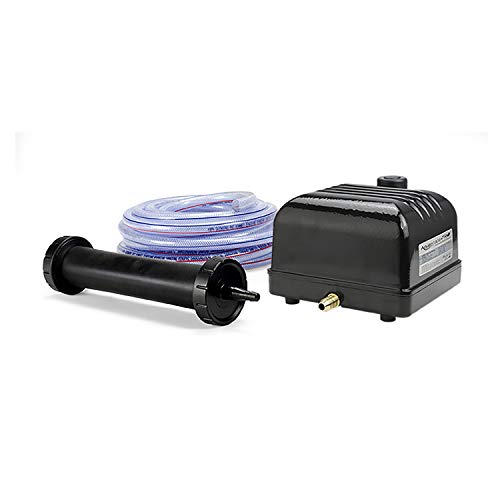
Aquascape Pro Air 20 Pond Aeration Kit
The quiet one for a pump that has to live near the house or a patio. A complete outdoor-rated kit with tubing and a self-cleaning diffuser, sized for small to mid koi ponds where keeping the noise down matters more than raw output.

Aquascape Pro Air 60 Pond Aeration Kit
The bigger Aquascape kit for a larger or more heavily stocked pond, with more output and multiple self-cleaning diffusers so you can spread circulation across the bottom. Step up to this when one diffuser can't turn the whole pond over.
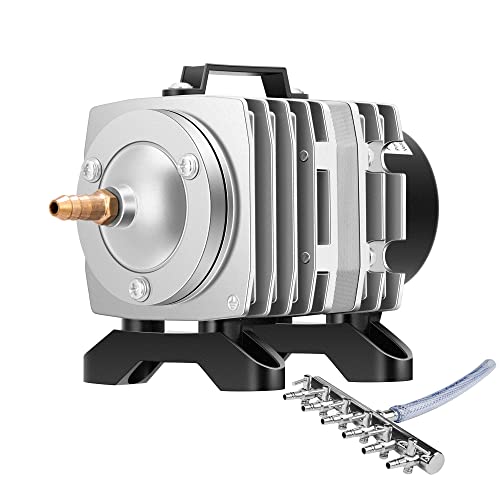
VIVOSUN Commercial Air Pump, Aluminum Housing
The cheap way to get air moving today. An aluminum-housed pump that pushes plenty of bubbles for the money, but it's a throwaway on a 24/7 life, not a rebuildable one. Keep it as a summer backup or a stopgap while you save for a linear pump.
What owners say
Real owner reports from the threads and editorial sources we drew on for this guide.
“I have the Hakko40 running 24/7 - 365 days a year with 2 lines, one in my skimmer and one in the pond itself. I'm on year 6 and haven't changed any parts expect for cleaning the filter”
“An air stone does more to add dissolved oxygen by creating water movement then it does by infusion.”
“If you're going to install an aerator, I would suggest using weighted air-line. It's easier to hide, is black and blends in well. Aerators should be placed into a weatherproof container, a Rubbermaid lidded box for example.”
“I run a strong air pump in the summer and a smaller one, through the winter. I love the weighted lines, much nicer looking I also place mine on one of those foam things, to protect knees while gardening, to muffle it's sound.”
“I use AP100 air pump but only in the Summer as in winter I don't want the cold water stirred up much so as to chill the fish.”
“It throws out tons of bubbles and causes a pretty big disruption at the surface. I have seen large ponds with aerators evenly spaced across the pond. I think that makes more sense than trying to have one large one do it all.”