The Best Pond Aerator for a Koi Pond
By The Pond Review · Updated August 2026
Independent editorial guide. We never accept payment for coverage, though we may earn a commission if you purchase through our links.
Quick Take
On a stocked koi pond, treat a dedicated air pump and a bottom diffuser as life-support, not a nice-to-have. Our top pick is the HIBLOW HP-40, a linear diaphragm pump that sips power running around the clock and holds the pressure a typical two-to-six-foot koi pond needs. For a deep or large pond step up to the Airmax PS10 compressor, and for a small pond the Aquascape Pro Air 20 kit arrives ready to sink. Aeration is the difference between a pond that carries koi through a heat wave and one that loses them overnight.
The buying mistake is sizing by gallons. Air delivery has to match depth and fish load, because every foot of water adds backpressure the pump has to push against, and a warm summer pond holds less oxygen at the very moment your koi are demanding more. Place the diffuser on the bottom to turn the whole water column in summer, then raise it near the surface in winter so it holds an open gas-exchange hole without chilling the deep water where the fish rest. And put it all on a GFCI-protected outdoor circuit.
We've matched five air pumps to real koi ponds below, from the one we'd run year-round to the deep-pond compressor and the budget starter. See picks ↓

Aeration is the one piece of koi gear that's about keeping fish alive rather than keeping water pretty. A koi pond can look perfect and still be running out of oxygen, and by the time the fish are hanging at the surface gulping air, you're already late. That's why we lead this guide with the safety case before we ever get to which pump to buy: dissolved oxygen isn't a water-quality nicety on a stocked koi pond, it's survival.
Our view is blunt and it runs against the "my waterfall handles it" reflex you'll read on a lot of forums. On a stocked koi pond, a dedicated air pump feeding a diffuser near the bottom isn't optional. The two moments that kill koi, a still summer night and a sealed-over winter, are both oxygen problems, and a waterfall alone doesn't solve either. Here's the authority behind that, the arithmetic for sizing a pump to your pond, and the five we'd buy.
Aeration on a koi pond is life-support, not decoration
Start with what aeration is for, because the marketing blurs it. Fountains and bubbling diffusers get sold as ambiance, but on a pond carrying koi the job is dissolved oxygen, and dissolved oxygen is what stands between a healthy fish and a fish kill. Koi are large, hungry eaters that put a heavy oxygen demand on the water, and unlike gallons or clarity, oxygen is invisible until it's gone. You can't see a crash coming, which is exactly why you engineer against it in advance instead of reacting to it.
So we treat a stocked koi pond as needing a dedicated air pump and a diffuser as standard equipment, not an upgrade. A waterfall or a spitter agitates the surface and adds some oxygen there, but it does very little for the bottom third of the pond, which is where the water goes stagnant and where oxygen sits lowest. An air pump pushing bubbles up from the floor does two things a waterfall can't: it lifts that low-oxygen bottom water up to the surface where it can breathe, and it keeps the whole column from stratifying into a warm oxygenated top and a dead cold bottom.
What the extension guidance says about oxygen
This is a safety topic, so the number that matters comes from authority, not from forum consensus. Pond guidance from agricultural extension services puts a healthy pond's dissolved oxygen at roughly 6 milligrams per liter or better, with fish sliding into distress once it drops under about 3. An aquatic vet will tell you the same thing from the other direction: a summer fish kill is almost always an oxygen crash, not a mystery disease, and the fish found dead at dawn suffocated in the hours before sunrise.
The mechanism is worth understanding because it explains why the danger is nighttime and seasonal. During the day, pond plants and algae produce oxygen through photosynthesis. At night they stop producing and instead consume it, right alongside the fish and the bacteria breaking down waste. On a warm, still, heavily planted or algae-green pond, that overnight demand can pull dissolved oxygen down to lethal levels by the pre-dawn hours. Mechanical aeration is the insurance policy that keeps oxygen coming in through the night, when the pond's own supply has switched off.
The summer squeeze: warm water, hungrier fish
Summer is the classic killer, and it's a squeeze from both sides at once. Warm water physically holds less dissolved oxygen than cool water: a pond at the height of a heat wave can hold on the order of a third less oxygen at saturation than the same pond held in spring. At the same time, koi are cold-blooded, so their metabolism climbs with the water temperature and they burn through oxygen faster. Less supply, more demand, and the gap opens fastest on exactly the hot, still nights when there's no wind to ruffle the surface.
That's why the owners who run air pumps hardest are running them in summer, above the low-80s Fahrenheit, purely to hold oxygen up for the fish. It also reframes what you're buying. You aren't sizing a pump for the average day; you're sizing it for the worst night of the year, the heat wave with no breeze, when the pond's own plants have flipped from making oxygen to consuming it. If the aerator can carry the pond through that night, it's enough. If it can only keep up on a mild evening, it isn't.
Winter is the other killer, and it needs the opposite setup
The second oxygen crisis comes in the cold, and it kills in a different way, so it needs a different setup. When a pond freezes and snow covers the ice, the surface seals shut. Decomposing leaves and waste on the bottom keep consuming oxygen and releasing gases like carbon dioxide, and with the lid closed those gases have nowhere to go. Fish can suffocate under the ice not because the water is too cold but because the pond can no longer exchange gas with the air. The fix is to keep an open hole in the ice so the pond can breathe.
Here the safety detail is placement, and it's the opposite of summer. In winter you don't want to run bubbles from the bottom. Koi overwinter almost motionless in the deepest, warmest water the pond has, which sits near 39 degrees because that's where water is densest. Driving air up from the floor destratifies the pond and drags near-freezing surface water down onto the resting fish, super-chilling the one refuge they have. So in winter you raise the diffuser up onto a shallow shelf, a foot or so down, where it holds a gas-exchange hole open without stirring and chilling the deep water. And to be clear about what the device does and doesn't do: an aerator or a de-icer keeps a hole open, it doesn't heat the pond.
Size the pump to depth, not just the pond gallons
Now the arithmetic the product listings hope you skip. Air pumps get sold on airflow, usually liters per minute or GPH, and buyers pick a number that sounds big for their gallons. But airflow on the box is measured against almost no resistance, and your pond is full of resistance. Every foot of water depth adds backpressure the pump has to push against, roughly 0.43 psi per foot, so a pump that froths a two-foot water garden can barely manage a weak trickle of bubbles at six feet. Depth, not gallons, is the spec that decides whether a pump can work your pond at all.
So size in two steps. First match the pump to your depth: a linear diaphragm pump like the HP-40 is built for the two-to-six-foot range most backyard koi ponds live in, while a very deep pond or a small lake needs a rocking-piston compressor like the Airmax PS10 that makes real pressure. Second, scale the air delivery to the fish load, because bioload is what consumes the oxygen, and a heavily stocked pond needs more air than a lightly stocked one of the same size. When you're unsure, buy up: an aerator that's slightly oversized just makes a livelier boil, while an undersized one leaves you exposed on the worst night.
Placing the diffuser to turn the whole column
A pump is only half the system; where the air comes out decides what it does. Use a fine-bubble diffuser disc rather than a coarse airstone, because many small bubbles have far more surface area and transfer more oxygen as they rise, and set it on the bottom in summer so the rising column lifts the low-oxygen deep water all the way to the surface. One diffuser turns a cone of water above it, so a long or multi-basin pond needs diffusers spread out, one per zone, to avoid leaving a dead corner the current never reaches.
Two practical gotchas that catch people. Air line floats, so weighted tubing or a diffuser base is what keeps the disc pinned to the bottom instead of drifting up. And there's a real trade to placing the diffuser too deep even in summer: push it into the coldest bottom layer and you can warm and mix water the fish were using as a cool refuge. The owner-measured evidence for all of this is genuine but sits underneath our verdict, not above it: one keeper tested 6 mg/l before switching on a bottom diffuser and 9 mg/l the next morning at the same temperature. The kits we point to, like the Aquascape Pro Air line, ship with weighted tubing and self-cleaning diffusers so you aren't sourcing those parts separately. Our koi filter guide covers the other half of koi water quality, the waste processing an aerator doesn't do.
Wiring it safely: GFCI and the outdoor circuit
One rule before any pump goes in. An air pump runs on mains electricity next to a body of water, so it belongs on a GFCI-protected outdoor circuit, which is what electrical code requires for outdoor receptacles and what protects both you and anyone who ever reaches into the pond. Mount the pump itself above the waterline and out of the weather, since these units aren't waterproof, and protect the cord and the air line from being pinched or chewed. This is the sort of rule where you follow the authority and the manufacturer's instructions rather than a forum shortcut, every time.
Matching the five picks to your pond
Here's how we'd choose. For most backyard koi ponds, the two-to-six-foot range, the HIBLOW HP-40 is our default: a linear diaphragm pump quiet and efficient enough to run 24/7 without punishing your power bill, with the pressure to work a normal koi pond and the reliability to do it for years. For a deep pond or a small lake where an ordinary pump would stall against the backpressure, the Airmax PS10 is the compressor-grade step up, rated to serve water far bigger than a backyard pond.
The two Aquascape Pro Air kits are the plug-and-play route for owners who want the pump, weighted tubing, and self-cleaning diffusers in one box: the Pro Air 60 for a mid-size to larger pond running dual diffusers, the Pro Air 20 for a smaller koi or goldfish pond that needs one. The VIVOSUN commercial air pump is the budget way in, a cheap high-output unit in an aluminum housing, but buy it clear-eyed: it's aquarium-grade, so it's happiest at shallow depth, and it comes without the weighted line or diffusers a pond needs. It's a starter, not the pump we'd trust a deep, fully stocked pond to.
The setup that keeps koi alive
If it were our koi pond, we'd run a properly sized air pump feeding a fine-bubble diffuser on the bottom all summer, hardest through the heat waves and overnight, and we'd raise that diffuser onto a shallow shelf in winter to hold an open hole in the ice. We'd put it on a GFCI circuit, weight the air line so the disc stays down, and treat the whole rig as standard equipment on a stocked pond rather than an accessory.
The through-line is simple: oxygen is the one thing your fish can't wait for. A waterfall dresses up the surface, but the summer and winter crashes both happen down in the water column where a waterfall doesn't reach, and both arrive faster than you can react. Size the pump to your depth and fish load, place the diffuser for the season, wire it safely, and you have insured your koi against the two nights most likely to kill them. That isn't decoration. That's the point of the pond staying alive.
The picks
Products we recommend for this guide.
HIBLOW HP-40 Pond and Septic Air Pump
Our default koi aerator: a linear diaphragm pump quiet and efficient enough to run 24/7 without punishing the power bill, with the pressure to work a typical two-to-six-foot pond for years. Pair it with weighted line and a bottom diffuser.

Airmax PondSeries PS10 Aeration System
The deep-pond answer. A rocking-piston compressor that makes the pressure a deep pond or small lake needs, where an ordinary pump stalls. Rated for water far larger than a backyard pond, so it's overkill until depth demands it.
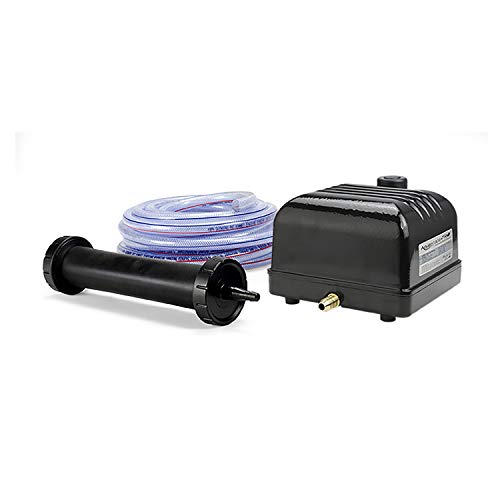
Aquascape Pro Air 20 Pond Aeration Kit
The small-pond version of the same kit: pump, weighted tubing, and a single self-cleaning diffuser, ready to sink. The right complete setup for a smaller koi or goldfish pond that needs one diffuser rather than a bank of them.
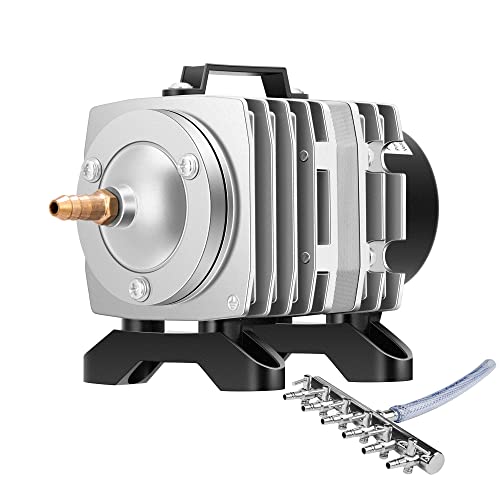
VIVOSUN 634 GPH Commercial Air Pump
The cheapest way in: a high-output aquarium-grade pump in an aluminum housing. Buy it clear-eyed, it's happiest at shallow depth and ships without the weighted line or diffusers a pond needs. A starter for a small pond, not a deep stocked one.
What owners say
Real owner reports from the threads and editorial sources we drew on for this guide.
“I use one in the summer months especially with temps above 80f. It does nothing for water clarity but keeps O2 levels up for koi.”
“Waterfalls do not plunge air deeply into a pond as does an air stone at the bottom of the pond. Waterfalls, spitters and fountains are all surface action. To add oxygen where it's most needed, which is the bottom 1/3 of the pond, you need to get down in there.”
“I tested my water for oxygen saturation before I turned on my diffuser and the readings were very good(6 mg/l) Oxygen after turning on the aeration in the pond the next day read (9 mg/l). The test were made at the same time of day and the water temps were the same.( 70 F)”
“In the Summer I keep the air stones on the bottom. For Winter I suspend them with a string to keep them just below the water surface. As stated, during Winter you don't want super cold air infusing the bottom where the fish are hibernating.”
“Yep. The deeper the diffuser, the more water is properly aerated. I am careful not to placed it too deep though. It will warm up the water in the bottom too much.”
“If you have a waterfall, that will do far more than an airstone, IMHO.”