API Pond AlgaeFix Review: Effective, With a Real Catch
By The Pond Review · Updated August 2026
Independent editorial review. We never accept payment for coverage, though we may earn a commission if you purchase through our links.
Verdict
Pond-forum sentiment on AlgaeFix isn't so much split as cautionary, and the caution is consistent enough that we adopt it as our own read. Owners confirm the mechanism we warn about firsthand: fish come to the surface searching for oxygen in the hours after dosing, and the danger climbs with heat and dose. The bluntest verdict, from a keeper whose pond had lost fish, is that an overdose "has killed fish," and the recurring rescue in those threads is an immediate large water change with the aeration turned up. What stands out is where experienced owners land after being burned: one bought a UV system and swore off algaecide after reading how lethal it can be, and another replaced it with plants and restrained feeding and hasn't looked back. That's exactly the path we argue for. The forums don't dispute that AlgaeFix clears green water; they demonstrate that clearing it carelessly, or treating it as a permanent fix instead of nutrient control, is how backyard keepers lose a pond of fish overnight. Our verdict lines up with theirs: a careful short-term knockdown, dosed to measured volume with aeration running hard, and never the answer on its own.
Read full take ↓Similar algae treatments
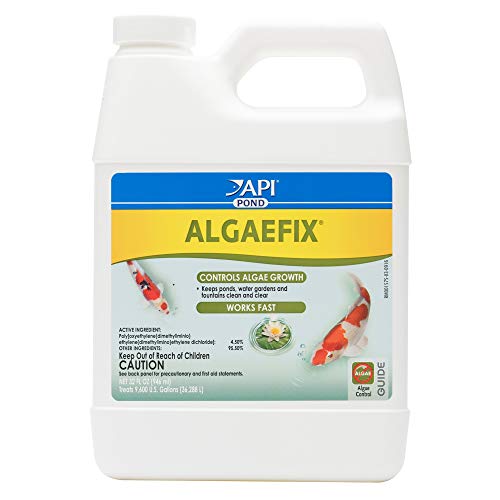
API Pond AlgaeFix is a copper-free liquid algaecide, and on the algae it's built for it works: dose a green, cloudy pond and the suspended bloom fades over a few days. We can say that flatly. What we won't say is that it fixes anything. It knocks back a symptom, and the more you understand about how it does that, the sharper the real hazard comes into focus. It isn't the chemical in the bottle that kills fish. It's the mountain of dead algae it leaves behind.
Two things separate a clear pond from a dead one. The first is knowing what AlgaeFix treats. It goes after green, single-celled and suspended algae, the pea-soup cloudiness that floats through the water; it's a weak tool against thick string and blanket mats clinging to rocks and waterfalls, and reaching for it there mostly wastes the bottle. The second, and the one that matters, is what happens when a big bloom dies all at once. Decomposing algae pulls dissolved oxygen out of the water as it rots, and in a warm pond that already holds little oxygen it can suffocate fish overnight. Dose to measured volume, never double up, treat in sections, and run aeration hard through and after. Do that and it's a careful short-term knockdown. Skip it and it's the tool behind the fish-kill threads.
The short version
What works:
- Clears green, suspended algae. On the pea-soup bloom it targets, a correct dose fades the water over a few days.
- Copper-free chemistry, so it won't accumulate in the pond or the substrate the way copper algaecides can.
- Cheap and covers a lot of water. One 32 oz bottle treats a large pond, and it's an inexpensive emergency knockdown.
- Labeled safe for fish and plants at the correct dose, unlike copper products that can burn sensitive plants.
What to watch:
- The die-off, not the bottle, is what kills fish. A big bloom that dies at once can crash dissolved oxygen overnight.
- Wrong tool for string and blanket algae. It targets suspended green algae; the mats on your rocks shrug it off.
- The label warns against freshwater crustaceans, naming shrimp, crabs and lobsters. As a polyquat it's a risk to snails and other inverts too.
- It treats a symptom. The water greens again while the nutrients feeding the algae are still in the pond.
What it's, and what it kills
AlgaeFix is a polyquat, a polymeric quaternary ammonium compound, and it's worth being precise about that because it's often lumped in with copper algaecides that behave nothing like it. It contains no copper. Copper products work by staying in the water and the substrate, which is exactly why they build up over time and why they're hard on plants and lethal to snails and shrimp at doses fish tolerate. The polyquat in AlgaeFix instead breaks down over a day or two, which is both its safety margin and the reason it's a repeat purchase rather than a one-time fix.
What it kills is narrow and specific: green, single-celled and suspended algae, the free-floating cells that turn a pond into pea soup. That's the job it's built for and the job it does. It isn't built to clear the thick string, hair and blanket algae that anchors to rocks, liners and waterfalls. People pour it on filamentous mats, watch nothing happen, and conclude the product is junk; it isn't junk, it's the wrong tool. For string algae you want a granular oxidizer you can spot-treat directly, and for a green-water bloom you want either this, briefly, or a UV clarifier, permanently. One caution the label makes plainly and we'll repeat: don't use it with freshwater crustaceans, and it names shrimp, crabs and lobsters. As a polyquat it's a risk to snails and other inverts too, so a pond stocked with any of them is a pond to treat carefully or not at all.
The die-off is the danger, not the bottle
This is the load-bearing part of the review, and it isn't a matter of forum opinion. Aquatic extension guidance and pond veterinarians converge on the same mechanism, and the product label carries the aeration warning itself: when a large volume of algae dies at once, bacteria decomposing it consume dissolved oxygen, and that oxygen is pulled straight out of the water your fish breathe. Warm water already holds less oxygen than cool water, so a hot day is the worst time for a big kill-off, and it's precisely the scenario where a heavy or doubled dose turns fatal. The classic sign is fish hanging at the surface, mouths at the air, in the hours after you dose. That isn't the chemical poisoning them. That's the pond running out of oxygen.
The discipline that prevents it's simple and non-optional. Dose to your pond's measured volume, not a guess: length times width times average depth in feet, times 7.48, gives gallons. Never double up, and if you're unsure, dose low. Treat a heavily fouled pond in sections over several days rather than clearing it all at once, so the oxygen draw is spread out instead of stacked into one night. And run your aeration, a pump, waterfall or air stone, hard during treatment and for days after. If you overdose, the fix owners use and that works is an immediate large water change, and it saves fish. The pattern in every fish-kill story is the same: a full or double dose, a warm pond, weak aeration, and a bloom big enough that its death took the oxygen with it.
Why nothing stays clear while the nutrients remain
Algae isn't the disease. It's the symptom of a pond carrying more nutrients than its plants and filter can absorb, fed by fish waste, overfeeding, runoff and sunlight on open water. Kill the algae and the nutrients are still there, so the bloom returns, and now you have added a load of decomposing algae that becomes the next bloom's fertilizer. That's the trap of treating clarity as the goal. You can dose your way to clear water for a week and be back to green in two, permanently on the treadmill, permanently buying more bottles.
The durable fixes are unglamorous and they all attack the nutrients rather than the algae. Feed less, because uneaten food is the fastest way to fertilize a bloom. Add plants, as many as the pond will hold, because they outcompete algae for the same nutrients and starve it out. And for green water specifically, a UV clarifier is the durable answer: it kills suspended algae continuously as water passes through it, in small amounts, so you never get the single massive die-off that AlgaeFix risks. Put those in place and you may never need an algaecide again. That's the point of understanding what AlgaeFix is: a careful, short-term knockdown to buy time while the real work happens, not the work itself.
Who should reach for it, and who shouldn't
Reach for AlgaeFix if you have an active green-water bloom, a pond whose volume you can measure, real aeration running, and no snails or shrimp you care about. Used as a bridge while you sort out plants, feeding and a UV clarifier, it's a fine, cheap tool. It clears the water you have now so you can fix the pond you want.
Skip it if your problem is string or blanket algae on the rocks, where it does almost nothing and a granular oxidizer is the right buy. Skip it in a heavily stocked show pond in a heatwave, where the oxygen math is against you and a slower approach is safer. Skip it in an invertebrate pond. And skip it entirely as a standing solution: if you find yourself dosing every couple of weeks, the pond is telling you the nutrients are winning, and the money is better spent on plants and a clarifier than on another bottle.
Dosing it without a fish kill
If you have decided to use it, here's the routine we'd follow. Measure the pond and write the number down, so every dose from now on is to volume. Turn every bit of aeration you own up to maximum before you add anything. Dose in the morning of a cool day, never in the afternoon heat, and never during a heatwave. On a badly fouled pond, treat a third or a half of it, wait several days, watch the fish, then treat the next section. If fish come to the surface gasping, do a large water change immediately and add more air. Keep a dechlorinator on hand for that water change. None of this is complicated, and all of it's the difference between a clear pond and a dead one.
Where it earns its place
AlgaeFix does what it says on green, suspended algae, it's cheap, and copper-free is a genuine advantage over the products it sits beside on the shelf. It earns a spot in the shed as an emergency knockdown for pea-soup water, held to a strict rule: dose to measured volume, aerate hard, treat in sections, and never in the heat. Inside that rule it's a useful tool. Outside it, it's the most common way we see backyard keepers lose a pond of fish in a single night.
The verdict is a small one because the product is a small tool honestly labeled. It clears a symptom and buys you time. It doesn't fix a pond, and treated as if it could, it becomes dangerous, because the durable route to clear water runs through less feeding, more plants and a UV clarifier, none of which come in this bottle. Use it for what it's, respect the die-off, and it's worth the shelf space. Ask it to be the answer and it'll eventually cost you more than the algae ever did.
Our Ratings
Overall score
Reliability here is mostly a question of margin for error, and that is where it loses ground. It acts predictably, but the gap between an effective dose and a dangerous one is small: in warm water the die-off it triggers can crash dissolved oxygen and kill fish overnight, and the fish-gasping and overdose reports are exactly that. A treatment that works but punishes a measuring mistake this hard cannot rate high on dependability.
On the algae it targets, green and suspended, it works: a correct dose clears pea-soup water in a few days, and that is real. It is docked because it is the wrong tool for string and blanket mats, which it barely touches, and because clearing a bloom treats a symptom. The water greens again while the nutrients driving it sit untouched. Effective, narrow, and temporary by design.
Cheap up front and it covers a lot of water, so as an emergency knockdown it is inexpensive. It loses points because it is a recurring buy that never touches the cause, so you keep reaching for it, and because the money is often better spent on the plants and a UV clarifier that end the problem instead of pausing it.
API Pond AlgaeFix on Amazon.
The Evidence Behind Our Verdict
Pond-forum sentiment on AlgaeFix isn't so much split as cautionary, and the caution is consistent enough that we adopt it as our own read. Owners confirm the mechanism we warn about firsthand: fish come to the surface searching for oxygen in the hours after dosing, and the danger climbs with heat and dose. The bluntest verdict, from a keeper whose pond had lost fish, is that an overdose "has killed fish," and the recurring rescue in those threads is an immediate large water change with the aeration turned up.
What stands out is where experienced owners land after being burned: one bought a UV system and swore off algaecide after reading how lethal it can be, and another replaced it with plants and restrained feeding and hasn't looked back. That's exactly the path we argue for. The forums don't dispute that AlgaeFix clears green water; they demonstrate that clearing it carelessly, or treating it as a permanent fix instead of nutrient control, is how backyard keepers lose a pond of fish overnight.
Our verdict lines up with theirs: a careful short-term knockdown, dosed to measured volume with aeration running hard, and never the answer on its own.
Our rating above is our own editorial call. What follows is the field evidence we weighed to reach it: first-hand reports from pond owners on dedicated pond and koi forums, which we lean on more than manufacturer-influenced published reviews because unsponsored owners tend to be the more candid signal.
What Pond Forums Say
“I used to use Algaefix, the fish would come to the surface (obviously searching for oxygen) for a few hours after I dosed the pond, and then they'd go back to their normal behavior so I assume in a day or two the Algaefix would lose it's effect. I stopped using algicide, now I add plants instead, as many as I can fit, and watch how much I feed my fish until the pond cycle, my plants have never been so beautiful and healthy since I stopped using chemicals to control algae”Source →
“Biggest problem I know of with OD of algaefix in the heat is lowering the warm water's already challenged ability to dissolve oxygen. You did great with the airstone, I'm sure it helped a lot.”Source →
“Over dose of algaefix is not good. It has killed fish. You did good with your water change.”Source →
“I decided to go against my judgement and try one (lower than recommended) dose of algaecide for my pond and immediately read about how lethal and harmful it is. I have since purchased a UV filtration system for my 125 gal pond and want to know if there is a safe and effective way to get rid of the algaecide already in the pond?”Source →
“My husband accidentally put a double dose of PondCare algaefix in our pond. I did a 75% water change within 15 min. put new water in with dechlorinator/stress coat. There is a waterfall and airstone....any more suggestions?”Source →
Frequently asked questions
Is the API Pond AlgaeFix worth it?
Cheap up front and it covers a lot of water, so as an emergency knockdown it is inexpensive. It loses points because it is a recurring buy that never touches the cause, so you keep reaching for it, and because the money is often better spent on the plants and a UV clarifier that end the problem instead of pausing it.
How reliable is the API Pond AlgaeFix?
Reliability here is mostly a question of margin for error, and that is where it loses ground. It acts predictably, but the gap between an effective dose and a dangerous one is small: in warm water the die-off it triggers can crash dissolved oxygen and kill fish overnight, and the fish-gasping and overdose reports are exactly that. A treatment that works but punishes a measuring mistake this hard cannot rate high on dependability.
How well does the API Pond AlgaeFix perform?
On the algae it targets, green and suspended, it works: a correct dose clears pea-soup water in a few days, and that is real. It is docked because it is the wrong tool for string and blanket mats, which it barely touches, and because clearing a bloom treats a symptom. The water greens again while the nutrients driving it sit untouched.
What do real owners say about the API Pond AlgaeFix?
Pond-forum sentiment on AlgaeFix isn't so much split as cautionary, and the caution is consistent enough that we adopt it as our own read. Owners confirm the mechanism we warn about firsthand: fish come to the surface searching for oxygen in the hours after dosing, and the danger climbs with heat and dose. The bluntest verdict, from a keeper whose pond had lost fish, is that an overdose "has killed fish," and the recurring rescue in those threads is an immediate large water change with the aeration turned up.
Options Worth Checking Out

BioSafe GreenClean Granular Algaecide
The tool AlgaeFix isn't. A granular oxidizer you sprinkle straight onto string and hair algae mats on rocks and waterfalls; it burns them off on contact, which the polyquat liquid can't. Spot-treat, don't broadcast, and run aeration after.

Microbe-Lift Algaway 5.4
Another copper-free liquid for the same green-water job, if you want an alternative to API. Same discipline: dose to measured volume, treat in sections, and aerate hard, because the oxygen crash from dying algae is the real risk, not the chemical.

Summit Clear-Water Barley Straw
Prevention, not a knockdown. As barley straw breaks down it releases compounds that suppress new algae growth, heading off blooms rather than killing an existing one. Cheap and gentle on fish and inverts; start it in early spring, not mid-crisis.
