The Best Pond Filter Media
By The Pond Review · Updated November 2026
Independent editorial guide. We never accept payment for coverage, though we may earn a commission if you purchase through our links.
Quick Take
Shop filter media on structure and cleanability, not on the surface-area figure printed on the bag. Decide first whether the media is doing mechanical work, straining solids out of the water, or biological work, housing the bacteria that convert ammonia, because one media rarely does both jobs well at the same depth in the filter. For most backyard ponds we would build the box out of pad media staged coarse to fine, the open grades first to catch solids and denser grades behind them to polish, and our pick is the Aquatic Experts Classic Pond Filter Pad in coarse, a cut-to-fit roll you can shape to any filter. Aquatic Experts describes it as an open bonded, nonwoven polyester pad rather than the extruded filament of a Matala-style mat, which matters when you compare it to one.
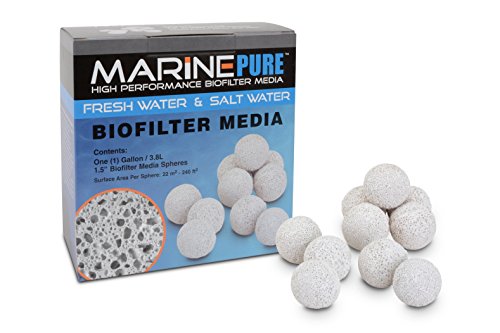
Spend up only where it earns its keep. A high-porosity ceramic like MarinePure is the standard answer when the chamber is a fixed size and you need more bacterial capacity inside it, though CerMedia publishes no surface-area figure of its own, only comparisons against bio balls, so take the size of the advantage on trust. K1-style moving-bed media is worth it if you want a stage that scours itself instead of asking you for a seasonal rinse. Bio balls are the one category we would not build a pond around.
Below: the matting we would start with, the fine pad that polishes behind it, the ceramic worth paying for, the moving-bed option, and the bio balls we would only use in a splash chamber. See picks ↓

Filter media is sold on one number, square feet of surface area per cubic foot, and that number is close to useless on its own. It is measured on clean, dry media in a lab, and your filter is neither. Once biofilm grows and pond solids arrive, a chunk of that advertised area closes off, and what you are left with depends on how big the pores are, how freely water moves through the structure, and whether you can clean the thing without destroying the bacteria living in it.
We would shop media the way an experienced keeper stages a filter box: pick the structure for the job that stage is doing, size it to your fish load rather than your pond volume, and accept that the media you can clean easily is worth more than the media that wins on paper.
The short version
What we would buy:
- A coarse pad as the backbone of a home-built or retrofitted filter box. It strains solids, carries some bacteria, cuts to fit anything, and rinses clean in a few minutes.
- Coarse grades where the dirty water hits first, finer grades behind them. Staging is the whole value of matting, and buying one grade throws it away.
- A high-porosity ceramic if space is tight. It buys bacterial capacity per cubic foot that matting cannot match, which is why it turns up in shower filters.
- Moving-bed media if the seasonal rinse is the part you want to avoid. The media tumbles in an aerated chamber and scours its own biofilm.
What we would avoid:
- Buying on the advertised surface-area figure. It is a clean-media number, and small pores close off once a biofilm forms.
- Asking one media to do both mechanical and biological duty in the same stage. A pad fine enough to polish is a pad that blinds fast under raw pond water.
- Upholstery or craft foam from a general retailer. It is not sold for immersion in water a fish lives in, and you cannot find out what is in the sheet.
- Aquarium media scaled up. The pieces are small, the price per cubic foot is high, and pond solids are coarser than tank waste.
Mechanical or biological: decide what the stage is for
A pond filter does two unrelated jobs. Mechanical filtration physically strains solids, fish waste, leaf fragments and algae, out of the water so they can be removed. Biological filtration gives nitrifying bacteria somewhere to live so they can convert ammonia to nitrite and nitrite to nitrate. The jobs want opposite things from a media. Mechanical work wants a structure open enough to hold a lot of debris without blocking flow. Biological work wants surface area with water moving gently past it, and it wants to be left alone, because every hard clean sets the bacteria back.
That is why a filter box is staged rather than filled. Coarse media meets the raw water and takes the big material out. Progressively finer media sits behind it, seeing water that is already mostly clean, which is the only condition under which a fine media stays usable for more than a week. If you put the dense media first it blinds, flow collapses, and you end up cleaning the stage you most wanted to leave undisturbed.
Pond waste is also coarser and heavier than aquarium waste, which is why media borrowed from the tank hobby disappoints in a pond. Keepers who have weighed that question point to the same thing, that the ceramic sold for ponds is deliberately larger than the rings sold for tanks.
Why the number on the bag is the wrong number to shop on
Matala publishes figures for its four densities, and they are a useful illustration because the gradient is the product. Its own characteristics sheet gives black at 62 square feet of biological surface area per cubic foot with 92 percent free volume, green at 96 and 93 percent, blue at 124 and 94 percent, and gray at 171 and 94 percent. So the coarsest grade carries roughly a third of the surface area of the finest, and all four sit at 92 percent open space or better. That last column is the one most buyers skip, and it is the one that keeps water moving through the media instead of around it. Worth noting that Matala's own factory datasheet publishes a lower set of figures for the same four colours, roughly 58 to 140 square feet per cubic foot against the US sheet's 62 to 171. When one manufacturer publishes two different ceilings for one product, that tells you what kind of number this is.
Now the caveat that matters more than the figures. Surface area is measured on clean media. Pores below a few microns across are closed off by biofilm once the media matures, so a material that looks extraordinary on a lab instrument can deliver a fraction of that area in a working filter. We have not found an independent, published test that settles this for pond media, and we are not going to pretend otherwise. Treat every manufacturer's surface-area claim as a ceiling, not a working figure, and weight cleanability and pore size at least as heavily.
Experienced keepers land in the same place, and they say it more bluntly than a manufacturer ever will, drawing a hard line between a calculated pore area and the area a filter can use.
The counter-argument is worth hearing too, because footprint is a real constraint. If you are filling trays in a shower or a box with fixed dimensions, the media that packs the most usable area into a cubic foot wins on space even at a higher price per bag, and keepers who have built that way say the smaller footprint is exactly what they paid for.
The four media worth considering
Pad media, which splits into two families worth telling apart. Extruded filament mat, Matala and the Japanese mats, is springy monofilament bonded at its crossings and sold in graded densities. Bonded nonwoven pad, which is what most Amazon pond rolls are including our pick, is polyester fibre set with resin and often stiffened, sold as coarse or fine rather than on a density scale. Both strain solids, keep free volume high and rinse with a hose; the filament mats hold their shape harder and come in a proper gradient, which is why keepers who stage four densities are usually talking about those. Matala's sheet notes that its open grades can be shaken out before you drain the sump while its dense grades want a hose wash, which is a fair description of how a graded filament mat behaves.
High-porosity ceramic. Fired blocks or spheres with a deliberately engineered pore structure. This is the media to buy when space, not money, is the limit, and it is the standard choice for trickle and shower filters. Be aware that CerMedia publishes no square-feet-per-cubic-foot figure for MarinePure, only ratio claims against bio balls, so by our own rule above you are buying its structure and its track record rather than a verified number. It wants clean water in front of it: run it behind a settling stage or a sieve, because it is not built to be a solids trap and it is tedious to clean if you let it load up.
Moving-bed media. Small plastic carriers, K1 and its relatives, that tumble in an aerated chamber. The tumbling keeps the biofilm thin and self-scouring, which is why a moving bed is the one biological stage that largely maintains itself. The carriers are buoyant by design, and Evolution Aqua lists K1 as a floating media, so the airstone underneath is what keeps the whole bed turning over instead of letting it pack against the lid. That tumbling, not the raw surface area, is the property keepers name when somebody asks why pond filters use this media and not something cheaper.
On surface area, Evolution Aqua publishes 500 square metres of protected area per cubic metre for genuine K1, out of a 950 total. Treat both as manufacturer figures rather than measurements. And note what you are buying: most K1-format media on Amazon, including the carrier we link below, is a generic of a different size made by somebody other than Evolution Aqua, with its own unverified surface-area claim. Buy a moving bed for the self-cleaning behaviour, which is real and observable, and do not assume a lookalike carrier inherits the original's numbers.
Bio balls and lava rock. Bio balls are open plastic spheres built for a trickle or splash chamber, where air moves freely around them. They are cheap and they resist clogging, and that is the end of the case for them. Their surface area is poor next to matting or ceramic, and submerged in still water they lose the oxygen exchange that justifies them. Lava rock works and costs almost nothing, but it is heavy, bulky, and awkward to move. Both still have defenders, and the honest position is that an old media that is working is not a problem to be solved.
How much media you need, and how to tell if it is working
Size the biological stage to what you feed, not to pond volume. Ammonia comes from food going through fish, so two ponds of the same size with different stocking need different beds. Matala's sheet gives a conversion worth borrowing when you are planning a box: eight square feet of sheet makes up one cubic foot of media, and a full sheet works out to about 1.6 cubic feet, roughly a twelve gallon volume. That lets you turn a filter chamber's dimensions into a shopping list instead of guessing.
The honest test of a biological stage is not how it looks. It is your water tests. A matured bed shows zero ammonia and zero nitrite under your normal feeding, and the way you find out whether a media is pulling its weight is to test, not to inspect. A media that still looks factory-fresh after years in a filter is telling you something, and keepers who notice it say so plainly.
If you are starting a new box, or you have just replaced most of your media, the bed has to cycle before it can process anything. Seed it with a bottled bacteria culture and keep feeding light until ammonia and nitrite read zero. The same logic is why you never replace all your media at once: the colony lives on the media, so a full swap restarts the filter.
Cleaning, which is where most media goes wrong
Rinse the mechanical stage often and the biological stage rarely. Solids that sit in the filter break down into the ammonia you installed the filter to remove, so the coarse stage wants a rinse on a schedule rather than when flow drops off. The biological stage wants the lightest touch that restores flow.
Rinse the biological media in pond water, not tap water. Municipal water is chlorinated, and chlorine kills the bacteria you spent weeks growing. If you have to use a hose on a bio stage, treat that stage as partly restarted and watch your ammonia for a week afterwards. Never clean media with bleach and then return it to the pond.
Fit the media snugly to the chamber. Water takes the easiest path, so a pad that leaves a gap at the edge lets most of the flow slip past the media instead of through it, and the filter quietly stops filtering while still looking full.
What we would not buy
Foam that was not sold as filter media. General-purpose foam is sold with no disclosure of dyes, biocides, antimicrobial finishes or processing aids, none of them chosen with a fish in mind, and it compacts in a way filter-grade foam does not. Flame-retardant treatment used to be the standard warning here, and you still see it repeated on the forums, but US upholstery foam has largely moved away from it since the California standard dropped its open-flame test in 2014. The reason to avoid the stuff is that you cannot find out what is in it. Buy foam rated for aquarium or pond use even though it costs more per sheet.
Media that is only sold with a surface-area claim and no description of its pore size or how to clean it. The claim is unverifiable and the omissions tell you what the seller thinks is important.
A single dense pad as a whole filter. It is the most common way a new pond keeper ends up with a filter that blinds in days, and it is the reason staging exists.
The picks
Products we recommend for this guide.




What owners say
Real owner reports from the threads and editorial sources we drew on for this guide.
“I think part of the reason is because pond waste is more robust than from aquariums. You'll notice that Cermedia, although small, is still much larger than the ceramic rings used in the aquarium hobby.”
“Huge difference between theoretical electron microscope microscopic pores bio area calculation and what is actually real world usable.”
“The study showed that feather rock has extremely high surface area, but much of it is less than 5 microns in pore size. Pores that small generally get closed off by the bio film and this greatly reduces the total surface area for feather rock.”
“After all it's surface area you're paying for. Will lava rock work?……of course it will, and so will feather rock, bio-balls, plastic army men, hair curlers, you name it. MP2C just allows you to use a much smaller footprint for the same amount of surface area.”
“bioballs dont have much of a surface area.. lava rock works, but takes up alot of realestate.. synthetic media is expensive, but costs have come down”
“Most people use K1 for moving bed filters because it is slightly positively buoyant, in other words it doesn't float or sink, it stays suspended with air and moves around in the filter.”
“But just because lava rock is an old method DOES NOT MEAN IT DOESNT WORK. And if something is working, there is no need to fix it.. look at jap mat. that stuff has been around forever and is still used and favored by many over newer matting.”
“I have very little media in my pond as I can't decide which to get, but the Springflow that I have had in my filter fall for 6 years looks as if I could put it back on the shelf and sell as new. I don't see how it is doing me any good at all.”