Matala Pond Filter Media Review + Verdict
By The Pond Review · Updated August 2026
Independent editorial review. We never accept payment for coverage, though we may earn a commission if you purchase through our links.

Verdict
The pond forums are unusually consistent on Matala, and the consensus is one we adopt outright: the mat is durable, easy to clean and does its job for years, and the people who struggle with it almost always staged the grades wrong. Owners report pads that look brand new after two years and hold up through repeated cleanings, and keepers with a settling stage ahead of the mat rinse it just once a year at season's end. The one recurring gripe is clogging, and it tracks precisely with grade placement: put a dense pad like the blue where raw water hits first and it plugs up fast, which is why experienced keepers stage the denser grades for mechanical catch and leave the coarser black or green to grow bacteria. On the alternatives, owners are clear-eyed that bio balls are a coarse first-stage trickle media rather than a mat's equal, and that a K1 bed is the self-cleaning route if the seasonal rinse is the dealbreaker. Our own read is the same: this is the most versatile media in the pond as long as you layer the densities and accept one cleanout a year, and the complaints are a setup problem, not a fault in the mat.
Read full take ↓Similar filter media
Matala progressive-density mat is the durable, affordable default for pond media: it lasts years, and it does mechanical and biological duty in the same mat. The trick is the density gradient. The open coarse layers grab big solids and the tighter fine layers polish what gets through, so one stack of mat stages the water in a way that a single-density media only does with a whole rack of separate pads behind it. Cut it to fit any box, run coarse to fine, and it clears a stocked koi pond and keeps clearing it.
The honest tradeoff is a chore. Because Matala catches solids, it loads up with debris and has to be pulled and rinsed roughly once a season, more if you run the fine grades up front. A K1 moving bed doesn't ask that of you, it scours itself clean, but it needs a mechanical pre-filter ahead of it and a constant air feed to work at all. Bio balls skip the maintenance too, but they're a trickle-tower first stage meant to sit in the splash of a waterfall, not a submerged mat. Matala is the pick when you want one media that does both jobs and you'll trade one seasonal rinse for it.
What Matala gets right, and the chore it asks back
What works:
- One media covers both jobs: coarse layers do mechanical straining, fine dense layers carry the bacteria, so you aren't buying and plumbing two separate media types.
- It's durable in a way foam isn't. Owners run the same pads for several years, and they hold their shape through repeated cleanings where flat foam pads pack down and collapse.
- It cuts with a knife to fit any box, tray or pre-filter, so it drops into gear that was never designed around it.
- Cleaning is a rinse in a bucket of pond water, no special tools and nothing to replace on the day.
What to watch:
- It isn't self-cleaning. It traps solids, so it clogs and has to be pulled and rinsed, roughly once a season on a coarse setup and far more often if you run a dense grade at the front.
- Grade choice matters. Put the fine dense mat where the raw dirty water hits first and it blinds over in days.
- A mat on its own isn't a filtration plan. It needs to sit in a housing with real flow, staged coarse to fine, or it just channels water around the clogged face.
- The upfront cost per sheet is higher than a bag of foam or a box of balls, even though it outlasts them.
Who should run Matala, and who should skip it
Run Matala if you have a filter box, a skimmer, a gravity tank or a homemade barrel filter and you want a single media you can stage from coarse to fine and forget about for years. It's the media we reach for first in any pond that has room for a mat and a keeper who doesn't mind one seasonal cleanout. On a koi pond, where the fish load is heavy and the solids are constant, that mechanical-plus-biological combination in one product is exactly what you want feeding the filter.
Skip it if your setup has no mechanical pre-filter and you're chasing a filter you never touch. That's a K1 moving bed job, not a mat job. Skip it too if all you need is a splash-through bio stage in the top of a waterfall box, where cheaper bio balls do the same trickle-tower duty for a fraction of the price. And don't buy a single grade and expect it to both strain and polish. Matala works because you layer the densities, so one sheet of one color is only ever half the answer.
The spec that decides it: match the media to the stage
The mistake that turns Matala into a headache is treating it as one thing you dump in a box. It isn't. Filtration happens in stages, and each stage wants a different media. The coarse open mat belongs first, where it can strain leaves, string algae and heavy waste without packing solid. The dense fine mat belongs last, where the water is already mostly clean and it can polish out the fine cloud and hold the bacteria. Stack the mat in that order and it runs a full season between rinses. Get it backwards and you have hidden a fine polishing pad behind nothing, and it clogs almost at once.
This is where the crowd and the physics agree. Longtime keepers stage their pads deliberately, the coarser black or green for the mechanical catch and the denser grades left to grow bacteria without needing constant cleaning, and they don't throw one density at both problems. The rule is simple: coarse mechanical first, high-surface-area bio second. Don't dump one media type in and expect both jobs out of it.
How progressive density stages the water
Matala sells the mat in four densities, and the gradient is the product, not a menu of interchangeable colors. Run them in order and the water gets progressively cleaner as it moves through the stack. The most open grade meets the dirtiest water and grabs the big stuff. The next grade down catches what slipped past. The tightest grade sees water that's already fairly clear and takes out the last haze while its huge internal surface area houses the nitrifying bacteria that convert fish waste. That gradient is why one product can do a job that otherwise needs a coarse sponge, a filter pad and a separate bio media stacked in series.
It also explains the clogging complaints, which are almost always a grade-placement problem rather than a fault in the mat. A dense pad up front loads with solids fast because it's doing fine-polish work on raw dirty water. The same pad, moved to the back of the stack, can go a whole season untouched. The mat didn't change. Where you put it did.
Living with it: the once-a-season rinse
On a sensibly staged setup, Matala is close to low-maintenance. Keepers with a settling stage or a bottom drain ahead of the mat pull and rinse the pads once a year at the end of the season and leave them alone the rest of the time. The cleaning itself is easy: lift the pad, hose or dunk it in pond water to knock the muck loose, drop it back. The rigid weave means it survives that treatment for years instead of tearing or compressing flat.
Push a coarse pad harder, or run a pond with no pre-settling, and the interval shortens to a few times a season for the front grades. That's the real cost of Matala and it's worth naming plainly: it isn't the money, it's the seasonal wet-armed rinse. If that single chore is a dealbreaker, look at a self-cleaning K1 bed, not a mat you convince yourself you'll never touch.
How it compares to bio balls and a K1 bed
- Versus bio balls: bio balls are a first-stage trickle media built to sit wet in the splash at the top of a waterfall box, catching heavy sediment while air moves freely around them. They're cheap and they never clog the way a mat can. But they're open plastic with far less surface area than dense mat, they do little fine polishing, and submerged in still water they lose the oxygen that makes them work. Use them for the coarse splash-through stage; use Matala when you want mechanical straining and a real bacteria bed in one submerged media.
- Versus a K1 moving bed: K1 is the self-cleaning answer. Injected air keeps the media tumbling so solids never settle and choke the bacteria, which is exactly the maintenance Matala asks you to do by hand. The catch is that K1 needs a mechanical pre-filter in front of it to pull the big solids first, plus a dedicated air supply, so it's more kit and more running cost. Matala trades that complexity for one seasonal rinse.
- Versus a smaller cut of the same mat: if your pre-filter is small, you don't need full sheets. The half-sheet Matala is the identical media in a smaller, cheaper cut, made to trim down into a compact box without wasting a full pad. It's the size-down, not a different product.
Setting it up
Cut the mat to fit your housing with a sharp knife and stack it coarse to fine in the direction of flow, dirtiest water hitting the most open grade first. Give it real flow through the face rather than around it, and pair it with a settling stage or a pond vacuum cleanout so the front pad isn't doing all the mechanical work alone. Let the bio grades cycle for a few weeks before you judge clarity, since the bacteria that do the biological half of the job need time to colonize the dense mat. Then plan the one seasonal rinse into your fall shutdown and leave it be.
Where we land on Matala
Matala is the media we'd build a koi filter around: durable for years, cheap over its life even at a higher sheet price, and uniquely able to do the mechanical catch and the biological bed in one staged stack. Layer it coarse to fine, feed it real flow, and it clears a heavily stocked pond and keeps it clear with almost no fuss.
The only way to be unhappy with it's to misuse it, either by dumping a single grade in and expecting both jobs, or by wanting a media you never touch. Stage the densities correctly and accept the once-a-season rinse, and Matala is the most versatile filter media in the pond, full stop. If the rinse is the part you can't live with, that's the signal to look at a self-cleaning K1 bed instead.
Our Ratings
Overall score
This is the strongest part of the product. The rigid weave holds its shape through years of repeated rinsing where flat foam pads pack down and collapse, and owners run the same sheets for several seasons before they fail. It cuts cleanly to fit any housing and there is nothing to break, pressurize or wear out beyond the slow eventual breakdown of the mat itself.
Staged coarse to fine, one mat does the mechanical catch and the biological bed that would otherwise take two or three separate media, and it clears a heavily stocked koi pond and keeps it clear. It falls short of the top only because it is not self-cleaning and it punishes a single-grade or backwards setup, where a dense pad up front clogs almost at once.
Cheap over its life because one durable media replaces a stack of separate pads and lasts years, but the upfront cost per sheet is higher than a bag of foam or a box of bio balls, so the payoff is in the longevity rather than the sticker. Docked too because buying a single grade, which many people do, wastes the whole progressive-density point.
Matala Pond Filter Media on Amazon.
The Evidence Behind Our Verdict
The pond forums are unusually consistent on Matala, and the consensus is one we adopt outright: the mat is durable, easy to clean and does its job for years, and the people who struggle with it almost always staged the grades wrong. Owners report pads that look brand new after two years and hold up through repeated cleanings, and keepers with a settling stage ahead of the mat rinse it just once a year at season's end. The one recurring gripe is clogging, and it tracks precisely with grade placement: put a dense pad like the blue where raw water hits first and it plugs up fast, which is why experienced keepers stage the denser grades for mechanical catch and leave the coarser black or green to grow bacteria.
On the alternatives, owners are clear-eyed that bio balls are a coarse first-stage trickle media rather than a mat's equal, and that a K1 bed is the self-cleaning route if the seasonal rinse is the dealbreaker. Our own read is the same: this is the most versatile media in the pond as long as you layer the densities and accept one cleanout a year, and the complaints are a setup problem, not a fault in the mat.
Our rating above is our own editorial call. What follows is the field evidence we weighed to reach it: first-hand reports from pond owners on dedicated pond and koi forums, which we lean on more than manufacturer-influenced published reviews because unsponsored owners tend to be the more candid signal.
What Pond Forums Say
“I've had mine for 2 yrs and they look brand new it's a good thing that they make 4 different densities so one can decide which works best in that setting The Matala pads are unbelievably easy to clean, and as far as durability you should be set for several years”Source →
“I only clean them once a year at the end of the season.”Source →
“Your brushes should really be the biofilter since they ain't no good as mechanical filters. And your mats should be mechanical filters since they're better at catching solids.”Source →
“bio balls would be a good first media for grabbing heavy sediment like plant branches leaves etc. but your sponge media will have a boat load more surface area for bacteria to grow on but it can clog”Source →
“The blue plugs up pretty fast.. I have never used the grey but I think it is more dense 5hen the blue. I would stay with the green or black.”Source →
Frequently asked questions
Is the Matala Pond Filter Media worth it?
Cheap over its life because one durable media replaces a stack of separate pads and lasts years, but the upfront cost per sheet is higher than a bag of foam or a box of bio balls, so the payoff is in the longevity rather than the sticker. Docked too because buying a single grade, which many people do, wastes the whole progressive-density point.
How reliable is the Matala Pond Filter Media?
This is the strongest part of the product. The rigid weave holds its shape through years of repeated rinsing where flat foam pads pack down and collapse, and owners run the same sheets for several seasons before they fail. It cuts cleanly to fit any housing and there is nothing to break, pressurize or wear out beyond the slow eventual breakdown of the mat itself.
How well does the Matala Pond Filter Media perform?
Staged coarse to fine, one mat does the mechanical catch and the biological bed that would otherwise take two or three separate media, and it clears a heavily stocked koi pond and keeps it clear. It falls short of the top only because it is not self-cleaning and it punishes a single-grade or backwards setup, where a dense pad up front clogs almost at once.
What do real owners say about the Matala Pond Filter Media?
The pond forums are unusually consistent on Matala, and the consensus is one we adopt outright: the mat is durable, easy to clean and does its job for years, and the people who struggle with it almost always staged the grades wrong. Owners report pads that look brand new after two years and hold up through repeated cleanings, and keepers with a settling stage ahead of the mat rinse it just once a year at season's end. The one recurring gripe is clogging, and it tracks precisely with grade placement: put a dense pad like the blue where raw water hits first and it plugs up fast, which is why experienced keepers stage the denser grades for mechanical catch and leave the coarser black or green t
Options Worth Checking Out

Aquatic Experts 1.5" Large Bio Balls for Ponds (100 Count + Mesh Bag)
A distinct media, not a Matala substitute. Bio balls are a first-stage trickle media for the splash at the top of a waterfall box, cheap and clog-proof, but with far less surface area than dense mat. Use them for the coarse wet-and-aerated stage.

LemonRoad Cut-to-Fit Pond Filter Pad Roll (12 x 39 in, coarse)
A distinct alternative to rigid mat: a coarse pad roll you trim to any filter tray, waterfall box, or skimmer, then rinse and reuse. Less structured than a Matala mat, but the cheapest way to add shape-it-yourself mechanical media.
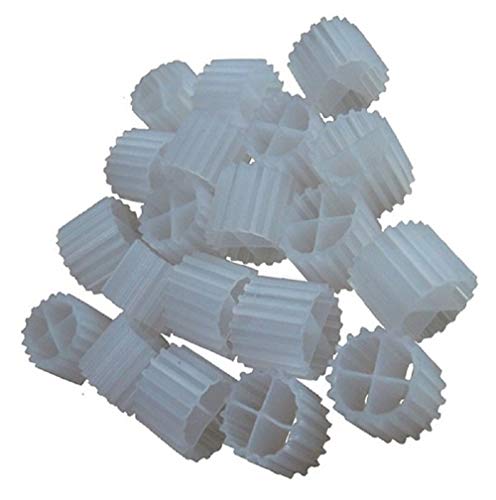
K1 Moving-Bed Filter Media (Premium Grade)
A different media class: free-floating K1 beads for a moving-bed biofilter that tumble and self-clean, so they never clog the way a static mat can. Not a drop-in mat swap; it needs aeration to keep moving, but it's the low-maintenance bio route.


