VIVOSUN Commercial Air Pump Review + Verdict
By The Pond Review · Updated October 2026
Independent editorial review. We never accept payment for coverage, though we may earn a commission if you purchase through our links.
Part of our guide to The Best Pond Air Pump.

Verdict
A note on sourcing before the quotes: no thread on the pond forums names this pump, so what follows is category evidence about cheap commercial and aquarium-style air pumps pressed into pond service, not owner reports of the VIVOSUN itself. Read it that way. Taken as a class, the owner reports line up with where we landed. The clearest statement of the limit comes from a keeper who puts aquarium-style pumps at about two feet of working depth and warns that a stone much lower may not get much air out of it, which is the practical form of the pressure spec. On noise the reports are consistent and unglamorous, including one owner who tried to box the pump in and found the rigid container amplified the vibration instead of damping it. Heat shows up the same way, with the standing advice being to ventilate any cover because these pumps run warm. The counterweight is real and we are not going to bury it: cheap multi-outlet pumps do last, and one owner reports six years out of a sub-thirty-dollar unit, with the common thread among the long-lived ones being that they were sheltered rather than left out. Where the class looks best is winter, and two keepers make the point we would: holding a hole in the ice is a different job from aerating the water column, and it does not want a massive pump. That is the use where this pump's weakness stops mattering.
Read full take ↓Similar aerators

The VIVOSUN commercial air pump is the cheap aluminium-bodied unit that turns up every time somebody asks how to aerate a pond without paying linear-pump money. It moves more air than its price suggests, and for a shallow pond that is a good trade. The catch is not the airflow. It is the pressure behind it, and the noise it makes getting there.
Our verdict is that it is a real budget aerator with two costs the listing does not mention. Its headline airflow is a free-air figure, so what reaches a diffuser at depth is a good deal less than the number implies, and on the makers’ own decibel figures it is a great deal louder than the HIBLOW linear pump we rate above it. Buy it for a small feature, a quarantine tub, or to hold a gas-exchange hole open through the ice. Buy a pond-rated pump if you want a known delivered figure at depth and quiet on the bank.
The short version
What it gets right:
- Real airflow for the money. 40 litres a minute through six valved outlets, which is inside the range a backyard pond wants, from a unit that costs a fraction of a linear pump.
- Oil-free and built to run constantly. An electromagnetic piston in a finned aluminium housing, oil-free, and rated by VIVOSUN for 24/7 running rather than intermittent duty.
- A sensible winter tool. Holding one hole open in the ice is a low-pressure job near the surface, which is exactly where this pump is strongest.
What it gets wrong:
- The 40 LPM is free air. That figure is measured against no back-pressure. Pond pumps publish a loaded number instead, which is why a 40 LPM rating here and a 40 LPM rating on a linear pump are not the same amount of air at your diffuser.
- It is loud. The marketing line is "under 60 dB", which is conversation volume, not quiet. On a pump that sits on the bank near where you sit, that matters.
- It runs hot. Those fins are there for a reason, and owners of this class of pump consistently report the housing getting hot enough to notice.
- You are not finished buying. It ships with a manifold and a short length of tube, not with weighted line, diffusers, or the check valve it needs.
The spec the listing gets wrong
Start with a correction, because the product page contradicts itself and the wrong number is the one most buyers will act on. The Amazon title reads "25W 25L/min". The 25W is right. The 25 litres a minute is not.
The same title rates the pump at 634 GPH of air, and those two figures cannot both be true. 634 gallons an hour is 10.6 gallons a minute, which is 40 litres a minute. VIVOSUN's own manual and its larger sibling use the same conversion: the 55W model is listed at 1,427 GPH and 90 litres a minute, which is the identical ratio. The pump is a 40 LPM unit and the listing has repeated the wattage in the airflow slot.
This matters because 40 LPM is a different pump from 25 LPM in buying terms. It does not, however, put this pump level with a 40 LPM linear pump, and that is the comparison worth refusing. Our own 40 to 60 LPM guidance for a koi pond describes air delivered against the back-pressure of a working diffuser. VIVOSUN's 40 is a free-air figure. Same number, different test, and the next section is about the gap between them.
Free air is not delivered air
An air pump has to push against the weight of the water above the diffuser, and every foot of depth adds back-pressure. So an airflow figure only means something when you know the pressure it was measured at, and that is where the pond brands and the general-purpose brands part company.
Be fair to the pump first, because the easy criticism is the wrong one. VIVOSUN rates it at 0.03 MPa maximum, which is about 4.3 psi, or roughly ten feet of water column at the point flow stops entirely. That is not a weak ceiling for a backyard pond. For comparison, Aquascape's Pro Air 20 lists a maximum of 2.90 psi and is rated by its own manual for ponds up to six and a half feet deep. On maximum pressure alone this pump is not out of its depth at four feet, and anyone telling you a cheap commercial pump cannot reach a pond floor is skipping the spec sheet.
The real gap is what it delivers on the way there. HIBLOW publishes the HP-40 at 40 litres a minute at its rated loading pressure of 12.8 kPa, which its own curve sheet prints as 1.88 psi, so that 40 is air measured while the pump is working against a load. VIVOSUN's 40 is measured against nothing, and it falls away as pressure rises until it reaches zero at 4.3 psi. Two pumps, the same headline number, and only one of them is telling you what you will get at the bottom of the pond. VIVOSUN publishes no loaded figure at all, which is the honest reason to treat its number with suspicion rather than any claim about its ceiling.
Owners reach the same place by feel rather than by spec. One keeper puts the working limit of an aquarium-style pump at about two feet, warning that an airstone much below that may not get much air out of it. Read that as a description of falling output rather than a hard ceiling, because the published pressure says this class can go deeper than two feet. It is still the reason a cheap commercial pump and a linear-diaphragm pond pump are not interchangeable at depth even when their headline airflow matches.
Loud, and it runs hot
Two owner-side costs come up together on pumps built this way, and both are real. The noise first. VIVOSUN markets the pump as quiet and puts a number on it, under 60 decibels, which is roughly the level of a conversation. HIBLOW publishes 32 dBA at one metre for the HP-40 at the same 40 litres a minute. Decibels are logarithmic, and VIVOSUN states no measuring distance for its own figure where HIBLOW gives its 32 dBA at one metre, so do not read the gap as a tidy ratio. It is still large, and it is the difference between a pump you notice from the patio and one you have to walk up to. A pond air pump lives outdoors near where people sit.
The instinct is to box it in, and that is where owners go wrong twice over. Sealing a buzzing pump inside a hard container can amplify it rather than muffle it, because the housing transmits the vibration into whatever it is resting on. One owner who tried exactly that found it made the problem worse, not better. Set the pump on something soft, give it an enclosure with soft walls and an air gap rather than a rigid box clamped against it, and you will do better than sealing it up tight.
Heat is the second cost and it constrains how you solve the first. The aluminium fins are a heat sink doing a job, and owners of this class of pump report the housing running hot in normal use. That rules out the airtight muffling box entirely. Whatever you build has to ventilate, which is the standing advice from people who have covered these pumps through a summer, and it is the reason a vented shelter beats a sealed one even though the sealed one would be quieter.
What you still have to buy
Read the outlet size before you plan the install, because it sets what you can connect. The pump has a single nozzle feeding an included six-way manifold, so the six adjustable valves divide one air stream rather than adding to it, and they take quarter-inch airline, which is aquarium tubing. Pond aeration kits are built around bigger line that sinks and stays put on the pond floor: Aquascape's own weighted tubing is three-eighths of an inch, and the lake-scale kits go larger again. None of it pushes onto a quarter-inch barb without adapting it.
So the realistic shopping list alongside the pump is quarter-inch line, a diffuser or airstone sized to the depth you are running, something to weight the line down, and a check valve on every run. The check valve is the one people skip and regret. If the pump ends up at or below the pond's water level, a power cut lets water run back down the airline into it, and Aquascape's own manual warns that failing to fit the check valve can permanently damage the compressor and void the warranty. Mounting the pump above the water line is the first defence and a one-way valve is the second, because ground settles, water levels rise, and VIVOSUN does not include one.
None of this is a flaw in the pump so much as a gap between what it is sold as and what a pond needs. A pond-specific kit like the Aquascape Pro Air 20 closes part of that gap, arriving with a check valve pre-installed, thirty feet of braided airline and a membrane diffuser. Be precise about what it does not solve, though: its tubing is braided, not weighted, and Aquascape sells weighted line as a separate upgrade. Weighting the line down is on your list either way.
Where it fits in winter
This is the season where a low-pressure pump earns its keep, and it is worth being precise about why. Winter aeration and summer aeration are different jobs. Through the summer you are trying to raise dissolved oxygen in the whole water column, which means pushing air to the deep end against full depth. Through the winter the job is narrower: keep one patch of surface from freezing over so carbon dioxide and ammonia can leave and oxygen can get in.
That second job is done near the surface, deliberately. The standing advice on a frozen pond is to set the stone high, a foot or so down rather than on the bottom, so the rising bubbles keep a hole open without stirring the warm layer at the bottom up into freezing air. A pump that is weak at depth is not weak at a foot. This is the application where the VIVOSUN's pressure limit stops being the deciding flaw, which is why it sits in our winter setups as a sensible pairing with a de-icer.
Keep the distinction straight when you size it, though. A de-icer and an aerator are not substitutes for each other, and neither one warms the pond: both exist to stop the surface sealing over. We work through which to buy, and why running both costs less than running a big de-icer alone, in our pond de-icer guide and in de-icer vs pond heater.
Safety: GFCI, ventilation, and above the water
Three rules, and none of them is optional on a mains appliance running outdoors beside water all year.
- GFCI, always. The pump, the de-icer, the pond pump, everything outdoors goes on a GFCI-protected circuit. That is the code answer and the manufacturer's answer, and no forum shortcut changes it.
- Mount it above the waterline, with a check valve. Water cannot climb above its own surface, so the risk is not the diffuser depth: it is the pump sitting at or below the pond water level, where a power cut lets the airline drain back into it. Height plus a one-way valve is the fix.
- Shelter it, but ventilate it. It needs rain protection and it needs airflow, and this unit runs hot enough that the second is not negotiable. A vented box, a shelter with a gap, a pot raised on a brick. Never a sealed container.
Where we land
Scored for what it is, this is a capable budget air pump sold at a price that makes the compromises easy to accept, and mis-sold on one spec in its own title. The pressure ceiling is fine for a backyard pond. What you are giving up is a known delivered figure at depth, because the 40 LPM is free air and no loaded number is published, along with a noise level well above the linear pump we rate above it, and heat that rules out quieting it the easy way.
Buy it for a shallow feature, a quarantine tub, a stock tank, or to hold a winter hole open alongside a de-icer, and it is a lot of air for the money. For a deep, stocked koi pond that needs oxygen at the bottom through a summer night, buy the pump you can rebuild and sit next to, and treat this one as the spare you keep on the shelf.
Our Ratings
Overall score
The oil-free piston and finned aluminium housing are rated for continuous duty, and owners of this class of pump do report multi-year service when the unit is sheltered. We could not confirm a stated warranty for this model: VIVOSUN publishes one for its larger sibling, but the listing for this pump names none, and we are not going to assume the two match. Against that, the housing runs hot by design, which narrows how you can protect it, and we could find no manufacturer-sold service kit, so the wear parts are not a swap the way a linear pump's diaphragm is. Durability on this class is a coin flip, not a given.
The airflow is real and better than the listing claims, and the 4.3 psi ceiling is adequate for backyard depths, above what Aquascape rates its own 6.5-foot kit at. It loses its points on the two things the number hides: the 40 LPM is a free-air figure with no loaded equivalent published, so delivered air at a working diffuser is materially less than a linear pump quoting 40 LPM at a rated 12.8 kPa, and on the manufacturers' own decibel figures it is a great deal louder than the HIBLOW we rate above it, under 60 dB against 32 dBA, a gap of more than twenty decibels on a scale where ten decibels is already a doubling of perceived loudness.
This is the strongest part of the case. You get genuine pond-scale airflow for a small fraction of what a linear pump costs, which makes it an easy buy for a shallow feature or a winter hole. Docked because the box is not the whole purchase: quarter-inch line, a diffuser, weighting and a check valve are all still to come, and that gap narrows the saving against a complete kit.
VIVOSUN Commercial Air Pump on Amazon.
The Evidence Behind Our Verdict
A note on sourcing before the quotes: no thread on the pond forums names this pump, so what follows is category evidence about cheap commercial and aquarium-style air pumps pressed into pond service, not owner reports of the VIVOSUN itself. Read it that way. Taken as a class, the owner reports line up with where we landed.
The clearest statement of the limit comes from a keeper who puts aquarium-style pumps at about two feet of working depth and warns that a stone much lower may not get much air out of it, which is the practical form of the pressure spec. On noise the reports are consistent and unglamorous, including one owner who tried to box the pump in and found the rigid container amplified the vibration instead of damping it. Heat shows up the same way, with the standing advice being to ventilate any cover because these pumps run warm.
The counterweight is real and we are not going to bury it: cheap multi-outlet pumps do last, and one owner reports six years out of a sub-thirty-dollar unit, with the common thread among the long-lived ones being that they were sheltered rather than left out. Where the class looks best is winter, and two keepers make the point we would: holding a hole in the ice is a different job from aerating the water column, and it does not want a massive pump. That is the use where this pump's weakness stops mattering.
Our rating above is our own editorial call. What follows is the field evidence we weighed to reach it: first-hand reports from pond owners on dedicated pond and koi forums, which we lean on more than manufacturer-influenced published reviews because unsponsored owners tend to be the more candid signal.
What Pond Forums Say
“I have one from petco and it has 4 outlets and cost less than 30 dollars for 6 years and it still works great”Source →
“Using an aerator to keep a hole open in winter isn't the same as providing air to the water column — 2 different applications.”Source →
“The goal is to keep a hole in the ice to allow gas exchange. Your pond is shallow for your hardiness zone. I wouldn't use a massive air pump.”Source →
“Aquarium air pumps are designed to be used in water no more than about 2' deep. If your airstone is much lower than that, you may not get much air out of it.”Source →
“I had mine put in a bowl/bucket thing, to say the least it did not help it only made the problem worse, it made it louder cause of the vibrations.”Source →
“Leave some sort of ventilation if you cover so in the summer, it doesn't overheat. I know my aerator pump gets pretty hot, though I've read they tend that way.”Source →
Frequently asked questions
Is the VIVOSUN Commercial Air Pump worth it?
This is the strongest part of the case. You get genuine pond-scale airflow for a small fraction of what a linear pump costs, which makes it an easy buy for a shallow feature or a winter hole. Docked because the box is not the whole purchase: quarter-inch line, a diffuser, weighting and a check valve are all still to come, and that gap narrows the saving against a complete kit.
How reliable is the VIVOSUN Commercial Air Pump?
The oil-free piston and finned aluminium housing are rated for continuous duty, and owners of this class of pump do report multi-year service when the unit is sheltered. We could not confirm a stated warranty for this model: VIVOSUN publishes one for its larger sibling, but the listing for this pump names none, and we are not going to assume the two match. Against that, the housing runs hot by design, which narrows how you can protect it, and we could find no manufacturer-sold service kit, so the wear parts are not a swap the way a linear pump's diaphragm is.
How well does the VIVOSUN Commercial Air Pump perform?
5-foot kit at. 8 kPa, and on the manufacturers' own decibel figures it is a great deal louder than the HIBLOW we rate above it, under 60 dB against 32 dBA, a gap of more than twenty decibels on a scale where ten decibels is already a doubling of perceived loudness.
What do real owners say about the VIVOSUN Commercial Air Pump?
A note on sourcing before the quotes: no thread on the pond forums names this pump, so what follows is category evidence about cheap commercial and aquarium-style air pumps pressed into pond service, not owner reports of the VIVOSUN itself. Read it that way. Taken as a class, the owner reports line up with where we landed.
Options Worth Checking Out
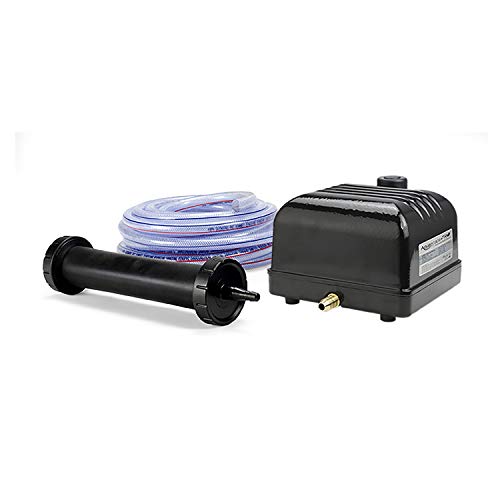
Aquascape Pro Air 20 Pond Aerator and Aeration Kit
The step up for a small-to-mid pond, and the quiet one: a foot away it is a hum. Rated by Aquascape to 6.5 feet, with a check valve pre-installed, braided airline and a membrane diffuser in the box. Weighted line is still a separate upgrade.
Read our full review — we scored it 8.0/10

HIBLOW HP-40 Pond and Septic Air Pump
The buy-it-once linear-diaphragm pump for a deep stocked pond. It holds pressure at depth, it is quiet enough to sit near a patio, and the wear part is a diaphragm you swap from a kit instead of replacing the pump.
Read our full review — we scored it 8.4/10
You Might Also Need
Accessories worth grabbing alongside your purchase

