Beckett Pond Underlayment Review
By The Pond Review · Updated August 2026
Independent editorial review. We never accept payment for coverage, though we may earn a commission if you purchase through our links.

Verdict
The pond forums converge on one thing without much argument: proper non-woven geotextile is the material that lasts, and the cheaper substitutes are where people get burned. Keepers who used real geotextile pull liners after years and find the fabric in the same shape it went in, which is exactly the durability underlayment is supposed to buy. The cautionary threads run the other way, roofing felt disintegrating back into the soil by its fifth season, and a liner holed while shifting a sharp-edged rock that a proper pad would have absorbed. The one substitute that keeps coming up, leftover carpet, is cheap and tough, and we understand the pull, but it holds water and can trap grit against the liner, which is the opposite of what the job needs. The experienced builders there land on a weight rule we share: only the heavier six-ounce non-woven reliably holds up under a demanding install. That's precisely where the Beckett takes its asterisk. It's real geotextile, on the right side of the material argument, but it's a light sheet, so we'd run it on a small pond over smooth ground without a second thought and step up to a heavier fabric the moment the dig is rocky, in-ground, and stocked.
Read full take ↓Similar underlayments
Underlayment is the cheapest insurance in pondkeeping. It's a non-woven geotextile cushion that sits between the ground and the liner, and its only job is to stop a root, a sharp stone, or a settling rock from working a pinhole through the bottom of a $150 liner in a spot you can never reach again. The Beckett Non-Woven is a light, brown, name-brand version of that fabric at about sixteen dollars for a six by twelve foot sheet, and for a lot of small ponds it's enough.
The arithmetic is what makes it an easy call. The failure underlayment prevents is the worst kind a pond can have: a slow leak under a full, planted, stocked pond, where the level keeps dropping and the hole is somewhere under a ton of rock and gravel you can't lift. Paying ten percent of the liner's price to guard against that isn't a close decision. Where the Beckett earns a caution is weight. It's a thin fabric, and a thin fabric over rough, rocky native soil under a heavy in-ground EPDM liner is doing less than the label suggests.
What underlayment does
Mechanically it's a cushion and a load-spreader. Bury a liner straight onto native soil and every root tip, gravel edge, and buried stone becomes a single point of pressure once the pond fills and thousands of pounds of water press the liner down onto it. A layer of non-woven geotextile spreads that point load across a wider area and gives the sharp thing a compressible pad to push into instead of the liner. The material is inert and it doesn't rot, so once it's under a liner and out of sunlight it effectively lasts as long as the pond does.
That's the case for buying purpose-made fabric rather than whatever is in the garage. The question is never whether to protect the liner. It's only what you protect it with, and how much fabric the dig needs.
Why skimping is false economy
The common substitutes all fail in predictable ways. Sand looks like a cushion but washes and settles, so the even bed you tamped in becomes thin spots and channels within a season or two, exactly where a stone can then reach the liner. Old carpet is tough and nearly free, which is why it keeps coming up, but it holds water against the liner, breaks down over years, and can trap grit in its pile that grinds at the same spot every time the liner flexes. Roofing felt disintegrates outright; keepers who used it as underlayment have pulled liners after a few seasons to find the felt crumbled back into the soil and no longer a barrier at all.
None of that saves money once you count the liner it fails to protect. A patched underwater pinhole, if you can even find it, costs a drained pond, displaced fish, and a weekend. A sheet of geotextile costs less than a bag of koi food.
The one spec that decides it: weight
Judge underlayment on weight and puncture rating first, and coverage second. Brand barely matters; a heavier non-woven from an unknown maker beats a lighter one with a familiar name. Weight is usually quoted in ounces per square yard or grams per square meter, and the number is a direct proxy for how much abuse the fabric absorbs before something pushes through it. Experienced pond builders converge on roughly six-ounce (about 200 gram) non-woven as the fabric that reliably holds up under a demanding in-ground install.
This is where the Beckett needs an honest asterisk. It's genuine non-woven geotextile, which puts it on the right side of the material argument against sand and carpet, but it's visibly a thin, light sheet, and Beckett publishes no weight rating for it that would put it near the six-ounce benchmark. On smooth, screened, sand-free ground it has plenty of margin. Over rocky native soil with roots and buried stone, a light fabric is closer to the edge than you want the one part you can never inspect again to be.
The reason weight tracks so closely with protection is that puncture resistance in a non-woven is mostly a function of how much fiber stands between the point and the liner. A heavier fabric is thicker and denser, so a stone tip has more material to compress and spread its load through before it reaches anything that can tear. Double the weight and you roughly double the cushion, which is why builders talk in ounces rather than brands. Coverage matters too, but it's the simpler question: buy enough to run under the whole liner with overlap, in as few pieces as you can manage.
When you can skip it, and when you never should
There's a real case where underlayment is optional. A small preformed shell, or a smooth liner pond dug into clean, sandy, stone-free ground with a raked and screened bottom, has nothing sharp to guard against, and adding fabric there buys little. If that's your build, the Beckett is cheap enough to add anyway as insurance, but you aren't exposed if you skip it.
The opposite case isn't optional. An in-ground EPDM pond over native soil should always have underlayment, and on rocky or rooty ground it should have a heavy one. That's the install where a hidden stone quietly works through a thin spot over a couple of years, and by the time the water level tells you something is wrong the liner is under rock you have to tear out to reach. Match the fabric to the ground, and when the ground is rough, spend the extra few dollars on weight.
Where the Beckett fits
The Beckett Non-Woven is the right buy for a specific pond: a small water garden or preformed-scale liner install on reasonably smooth ground, where you want real geotextile and not carpet, and where a six by twelve foot sheet covers the footprint. At its price it's a sensible default for that job, and the material will outlast the liner. What it isn't is the fabric for a big, rocky, in-ground koi build. There the coverage is too small to cover the dig in one piece and the weight is too light for the load, and stepping up pays for itself the first time a settling rock finds it.
How it compares
- JOSNAAN Underlayment (7x10 with U-pins): a bit more coverage in the same light non-woven class, with pins that hold the fabric in place while you set the liner. The upgrade we'd make on a small sloped dig where a loose sheet keeps sliding.
- Chonway Heavy-Duty 200g (10x15): the fabric to buy when the ground is rough. At around 200 grams per square meter it hits the weight the forums point to for in-ground EPDM over rocky soil, and the roll covers a real koi pond. This is the choice the Beckett is too light to be once the ground gets serious.
- Large geotextile roll (20x25): for a big pond or a long stream, a single sheet with no seams to line up. It costs more, but one continuous piece under the whole liner is the cleanest and safest install on a large build.
Sizing and installing it
Size the underlayment to the finished liner, not to the hole. Figure the liner as length plus twice the depth plus a foot of overlap each side, then buy fabric to match or beat that footprint. Where one sheet won't cover the dig, overlap seams generously, a foot or more, and run the higher piece over the lower one so nothing funnels grit underneath. Our pond liner picks cover sizing the liner itself, and the underlayment should follow the same measurement. Lay it into a raked, stone-picked bottom, press it into the contours, pin or weight it so it doesn't slide while you set the liner, and trim it back only after the liner is in and filling.
One habit worth keeping: run a strip of the same fabric under any heavy rock or edging that'll sit on the liner inside the pond, not just under the liner. A sharp-edged boulder shifted into place is one of the most common ways a finished pond gets holed, and a scrap of geotextile between rock and liner is free protection against it.
Our call on the Beckett
The Beckett Non-Woven is a fair buy for what it's: cheap, genuine geotextile that'll protect a small pond's liner for as long as the liner lasts, and a clear win over sand, carpet, or felt. For a modest water garden on smooth ground it's all the underlayment you need, and at its price there's little reason to fuss.
The mistake would be to let the low price decide a rough job. Underlayment is judged on weight, and the Beckett is light. For an in-ground EPDM koi pond over rocky native soil, treat this as the floor of the category and step up to a heavier six-ounce fabric. The extra cost is still the cheapest line item in the whole build, and it's protecting the one part you can never fix once the water is in.
Our Ratings
Overall score
The material itself is inert and rot-proof, and buried out of sunlight it will outlast the liner over it, which is most of what you want from underlayment. It loses ground only because the light weight leaves less margin against a settling rock or a persistent root than a heavier geotextile carries, and that margin is the whole reason the layer is there.
It does the core job, cushioning a liner against roots and gravel, and it is real non-woven geotextile rather than a substitute that fails. What holds the number down is weight: this is a light fabric, well under the six-ounce class builders lean on for demanding installs, so on rocky native soil it protects less than a heavier sheet and less than the price makes you hope.
This is where it shines. About sixteen dollars of fabric protects a liner many times its cost against the one failure you can never reach to fix, which is close to unbeatable math for a small pond. It is docked nothing on price and only slightly on coverage, since the small sheet limits it to modest ponds rather than big in-ground digs.
Beckett Pond Underlayment on Amazon.
The Evidence Behind Our Verdict
The pond forums converge on one thing without much argument: proper non-woven geotextile is the material that lasts, and the cheaper substitutes are where people get burned. Keepers who used real geotextile pull liners after years and find the fabric in the same shape it went in, which is exactly the durability underlayment is supposed to buy. The cautionary threads run the other way, roofing felt disintegrating back into the soil by its fifth season, and a liner holed while shifting a sharp-edged rock that a proper pad would have absorbed.
The one substitute that keeps coming up, leftover carpet, is cheap and tough, and we understand the pull, but it holds water and can trap grit against the liner, which is the opposite of what the job needs. The experienced builders there land on a weight rule we share: only the heavier six-ounce non-woven reliably holds up under a demanding install. That's precisely where the Beckett takes its asterisk.
It's real geotextile, on the right side of the material argument, but it's a light sheet, so we'd run it on a small pond over smooth ground without a second thought and step up to a heavier fabric the moment the dig is rocky, in-ground, and stocked.
Our rating above is our own editorial call. What follows is the field evidence we weighed to reach it: first-hand reports from pond owners on dedicated pond and koi forums, which we lean on more than manufacturer-influenced published reviews because unsponsored owners tend to be the more candid signal.
What Pond Forums Say
“geotextile is what i used, i have been very happy with it and it's great if you ever need to move a pond, after two years under a liner it was still in the same condition it was when put under the liner.”Source →
“The geotextile that you can buy off of ebay is pretty cheap and cheap to ship. Also, it is hearty as hell.”Source →
“I used some Home Depot “slumlord special” carpet that was leftover from a project, it is tough as heck and only about $0.50/sqft. Extra points if you can repurpose some old carpet that would have otherwise gone to the landfill.”Source →
“Yes, some materials sold as underlayment will not hold up. Only the 6 oz. non-woven geotextile .does the job. This is sold by EasyPro and other well-known manufacturers.”Source →
“I pulled the liner today from the pond and stream. I was surprised to see the amount of roots, depressions in the liner and roofing felt disintegrating . My plan was to use the roofing felt (#15) again as an underlayment but now I am concerned this is not enough of a barrier.”Source →
“I found out the hard way. Holed my liner shifting a large rock with sharp edge. Went back and installed underlayment under the rocks.”Source →
Frequently asked questions
Is the Beckett Pond Underlayment worth it?
This is where it shines. About sixteen dollars of fabric protects a liner many times its cost against the one failure you can never reach to fix, which is close to unbeatable math for a small pond. It is docked nothing on price and only slightly on coverage, since the small sheet limits it to modest ponds rather than big in-ground digs.
How reliable is the Beckett Pond Underlayment?
The material itself is inert and rot-proof, and buried out of sunlight it will outlast the liner over it, which is most of what you want from underlayment. It loses ground only because the light weight leaves less margin against a settling rock or a persistent root than a heavier geotextile carries, and that margin is the whole reason the layer is there.
How well does the Beckett Pond Underlayment perform?
It does the core job, cushioning a liner against roots and gravel, and it is real non-woven geotextile rather than a substitute that fails. What holds the number down is weight: this is a light fabric, well under the six-ounce class builders lean on for demanding installs, so on rocky native soil it protects less than a heavier sheet and less than the price makes you hope.
What do real owners say about the Beckett Pond Underlayment?
The pond forums converge on one thing without much argument: proper non-woven geotextile is the material that lasts, and the cheaper substitutes are where people get burned. Keepers who used real geotextile pull liners after years and find the fabric in the same shape it went in, which is exactly the durability underlayment is supposed to buy. The cautionary threads run the other way, roofing felt disintegrating back into the soil by its fifth season, and a liner holed while shifting a sharp-edged rock that a proper pad would have absorbed.
Options Worth Checking Out

JOSNAAN Pond Liner Underlayment (7x10, with U-Pins)
A step up in coverage with the same non-woven build, and it ships with U-pins that hold the fabric to the ground while you set the liner. The seven by ten foot cut suits a small to mid koi pond, and the pins earn their keep on a sloped dig.

Chonway Heavy-Duty 200g Pond Underlayment (10x15)
The one to reach for when the ground is rough. At 200 grams per square meter this is the heavier fabric the forums point to for in-ground EPDM over rocky native soil, and the ten by fifteen foot roll covers a real koi pond with margin to spare.
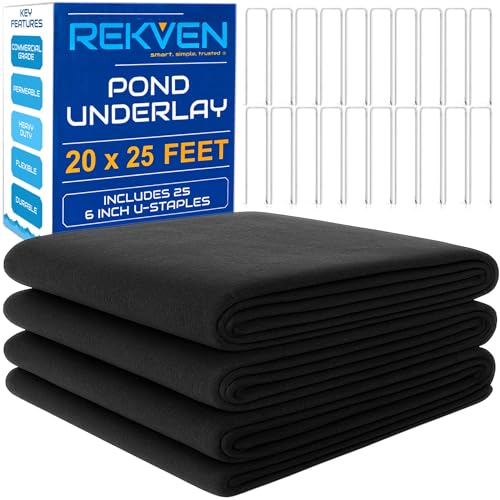
Pond Underlayment Geotextile Roll (20x25)
For a large build, this twenty by twenty-five foot roll cushions a big koi pond or a long stream in a single piece, with no seams to line up. It costs more than the small cuts, but one sheet under the whole liner is the cleanest, safest install.
