Fish Mate P7000 Automatic Pond Feeder Review
By The Pond Review · Updated August 2026
Independent editorial review. We never accept payment for coverage, though we may earn a commission if you purchase through our links.

Verdict
Owner sentiment on the koi forums is sharply split, and the split isn't random: it tracks almost entirely with moisture and mounting. On the happy side are keepers running a P7000 for five years "without skipping a beat," and owners who shelter theirs, one hanging his inside a bucket that keeps off the rain and the critters, report the same trouble-free experience we'd expect. On the unhappy side are owners who watched two consecutive units stick on and empty the whole hopper into the pond, or who had a quarantine-tank feeder fail within days and dump. The recurring middle ground is the rain-clog, food turning to mush at the outlet after a wet stretch, and the durability gripe is real too, with the hopper plastic crazing in direct sun. Read together, the pattern is clear rather than contradictory: exposed to weather this feeder jams and dumps, sheltered and fed dry pellets it runs for years. That's why we treat a rainproof mount as part of the purchase and not an accessory, and it's the single thing that decides which of those two experiences you get.
Read full take ↓Similar automatic feeders
An automatic feeder solves exactly one real problem: it keeps your fish fed while you travel. That's worth having. But it creates a second problem the moment you let it, because the fastest way to foul a pond is a feeder dumping more food than the fish can clear, and a timer has no idea whether that's happening. The Fish Mate P7000 is the category standard for this job, a big 7-liter hopper on a simple rotating drum, and kept dry and mounted right it's the feeder we'd reach for first.
The word "dry" is doing most of the work in that sentence. The single biggest failure mode isn't the motor, it's moisture: humidity and rain clump the pellets, the hopper jams or a stuck drum dumps the whole load at once. Owners split hard along that line. Keep the pellets dry under a shelter and the P7000 runs for years; leave it exposed and you're one wet week from a fouled pond. Buy it for what it's, a cheap and capable travel feeder that needs a rainproof mount, and it earns its keep.
The short version
What works:
- A large 7-liter hopper, so it holds enough to cover a real vacation without a refill.
- Programmable up to several small feeds a day, which is exactly how a pond should be fed.
- The cheapest capable big-hopper feeder in its class, and when kept dry it's close to a set-and-forget travel tool.
- A long track record: plenty of owners run one for years without a single miss.
What to watch:
- Moisture is the enemy. Rain and humidity clump the pellets, and a clogged or stuck drum can dump the entire hopper at once.
- A sheltered, rainproof mount isn't optional. Bare exposure is where most of the horror stories start.
- The LCD programming is basic but does the job; the real soft spots are the plastic and the lid tabs, which aren't the sturdiest.
- A timer can't read a thermometer. It'll keep feeding into cold water unless you shut it off yourself.
What an auto-feeder solves, and what it breaks
Strip away the marketing and a pond feeder does one useful thing: it feeds the fish on the days you aren't there to do it. For a weekend away or a two-week trip, that's a real convenience and a genuine kindness to the fish. Everything past that's where the trouble lives.
The mechanism is deliberately dumb. A drum with a slot rotates a set amount at a set time and drops whatever pellets fall through into a chute. It doesn't weigh the food, it doesn't check the water, and it doesn't know if yesterday's portion was eaten or is still rotting on the bottom. That's fine when the pellets are dry and flow freely. It goes wrong the instant they don't, because the same blind rotation that meters a small portion will also, if the food bridges and then breaks loose, deliver a week's worth in one go. Overfeeding is the number one cause of green water and ammonia spikes in a backyard pond, so a feeder that dumps isn't a minor annoyance, it's a water-quality event.
The reliability split is real, so mount it dry
We won't pretend the reports on this feeder are uniform, because they aren't, and the split is the most useful thing about them. On one side are owners who have run a P7000 for five years without it skipping a beat. On the other are owners who watched two consecutive units stick on and empty the entire hopper into the pond. Both of those are true, and the difference between them is mostly moisture and mounting, not luck.
Trace the failures and they cluster. Extended rain wets the pellets at the mouth of the chute and turns them to mush that clogs; a hopper that bridges and jams either starves the fish or, worse, lets go all at once. Direct sun crazes the hopper plastic over a season. The lid tabs are flimsy. None of that's a mystery, and none of it's unavoidable. The keepers with the flawless multi-year runs almost all did the same thing: they sheltered the unit. One hangs his inside a large bucket cut for the spout, which keeps off both the rain and the critters. That's why we treat a rainproof, shaded mount as part of the purchase, not an optional upgrade. If you wouldn't be willing to build a little shelter for it, this is the wrong feeder for you.
Feed small and often, and let the pellets stay dry
The right way to run any pond feeder is the way that also happens to keep it working: small portions, several times a day, with dry food. A pond fish does better on frequent small meals than on one large drop, and small portions are also what a dry, free-flowing hopper meters most reliably. Set the drum to the smallest slot that still delivers, program a few short feeds rather than one long one, and you get better fish health and far less risk of a bridging jam in the same decision.
Keeping the pellets dry is the other half. Use a hard, floating pellet rather than a soft or crumbly food, keep the hopper lid sealed, and never fill it in the rain. The chute is the vulnerable point, so angle the mount so water runs off it rather than into it. Do a test cycle by hand before you leave town and watch exactly what drops. Two minutes of watching the drum turn tells you more about whether this unit will behave for a week than any spec on the box.
A timer doesn't know the water is 45F
This is the one place we override convenience with authority, because it's a fish-health rule, not a preference. Koi and goldfish are cold-blooded, their digestion slows as the water cools, and below roughly 50F their gut all but stops. Feed into water that cold and the food sits undigested and rots inside the fish, which is how cold-weather feeding kills them. Extension aquaculture and koi-health guidance is consistent on this: as water drops through the 50s you cut back to a wheat-germ cold-water food, and once it holds below about 50F you stop feeding entirely until spring.
An automatic feeder can't do any of that on its own. It'll happily drop pellets into 45F water every day because the calendar told it to. So the rule with a timer is simple but essential: as fall cools the pond, switch to a cold-water pond food, and when the water settles below about 50F, turn the feeder off (or pull its batteries). Don't trust the timer to know the season, because it doesn't. A cheap floating thermometer next to the feeder is what turns this from a guess into a decision.
Who it's for, and who should skip it
Buy the P7000 if you take trips, you keep koi or goldfish in a pond that needs feeding while you're gone, and you're willing to give it a sheltered, rainproof mount. For that owner it's the best value in the category by a wide margin, a large hopper and a real track record for well under a hundred dollars.
Skip it if you can't or won't shelter it, because bare exposure is exactly the condition that produces the dumping and clogging failures. Skip it too if you want a fully sealed, weatherproof housing and finer portion control out of the box, in which case a pricier feeder is the calmer buy. And if a single dump would be catastrophic, on a heavily stocked show pond or a small quarantine tank where there's no margin for a mistake, step up to a heavier feeder built around that risk rather than trusting the cheapest drum on the market.
How it compares
- Versus an LCD feeder like the hygger: the hygger costs about double and buys you a larger LCD, finer per-feed control, and a better-sealed housing, which targets the P7000's real weak point, its exposure to weather. If precise, repeatable feeds and rain resistance matter more than price, it's the more relaxing tool.
- Versus a budget anti-clog feeder like the Briidea: a smaller 4-liter hopper but a design built around an anti-clog auger and a waterproof, wildlife-proof case. It attacks the rain-mush problem head-on at a modest price, at the cost of more frequent refills on a long trip.
- Versus a premium koi feeder like The Pond Guy KoiGrower: a five-gallon hopper and a heavier build aimed at keepers who need weeks of unattended feeding with the dump risk designed down. It costs far more than the P7000, and the reliability margin is what you're paying for.
Setting it up and living with it
Mount it under cover first, before anything else. A shaded spot that keeps rain off the hopper and the chute is the difference between the five-year reports and the one-week disasters, so if a shelf or overhang isn't available, build a simple hood or hang it inside a vented bucket the way experienced owners do. Angle the spout so water sheds away from it, and keep the whole unit out of direct all-day sun to slow the plastic crazing.
Then fill it with a dry, hard floating pellet, seal the lid, and run a manual cycle to confirm the drop before you rely on it. Program several small feeds rather than one big one, check it after the first rainy stretch, and treat the hopper plastic and lid tabs as the parts most likely to need eventual attention. Do that, and the day-to-day of owning a P7000 is close to nothing, which is the reason to buy one.
Our call on the P7000
The Fish Mate P7000 is the right first feeder for most pond keepers who travel, on one honest condition: you have to keep it dry. Give it a sheltered, rainproof mount, feed small and often with a hard dry pellet, and it does its one job, feeding the fish while you're away, cheaply and for years. That's the version of this feeder the happy long-term owners describe, and it's the version we'd buy.
The unhappy version is the same unit left exposed, where wet pellets jam or dump and a convenience becomes a water-quality problem. And whatever you do, don't let the timer feed into cold water: switch to a cold-water food as the pond cools and turn the feeder off (or pull the batteries) below about 50F. The P7000 won't make that call for you, and that one isn't optional.
Our Ratings
Overall score
This is where the split shows up. Plenty of owners run one for years without a miss, but a real cluster of failures is just as real: units that stick on and dump the whole hopper, rain-clogged chutes, and UV crazing that cracks the plastic in a season. The lid tabs are flimsy. A sheltered mount is non-optional, and even then the failure reports keep this score well below the top.
When it is fed dry pellets and mounted under cover, the P7000 does its job well: a large hopper, several programmable small feeds a day, and weeks of hands-off feeding. It loses points for how much its performance depends on you keeping moisture out, since a damp hopper meters unevenly or clogs.
The cheapest capable big-hopper feeder in its class, and for a sheltered travel feeder that is a lot of hopper for the money. Docked because a single dump failure can foul a pond and cost you fish, and because the plastic is a known weak point you may end up replacing.
Fish Mate P7000 Automatic Pond Feeder on Amazon.
The Evidence Behind Our Verdict
Owner sentiment on the koi forums is sharply split, and the split isn't random: it tracks almost entirely with moisture and mounting. On the happy side are keepers running a P7000 for five years "without skipping a beat," and owners who shelter theirs, one hanging his inside a bucket that keeps off the rain and the critters, report the same trouble-free experience we'd expect. On the unhappy side are owners who watched two consecutive units stick on and empty the whole hopper into the pond, or who had a quarantine-tank feeder fail within days and dump.
The recurring middle ground is the rain-clog, food turning to mush at the outlet after a wet stretch, and the durability gripe is real too, with the hopper plastic crazing in direct sun. Read together, the pattern is clear rather than contradictory: exposed to weather this feeder jams and dumps, sheltered and fed dry pellets it runs for years. That's why we treat a rainproof mount as part of the purchase and not an accessory, and it's the single thing that decides which of those two experiences you get.
Our rating above is our own editorial call. What follows is the field evidence we weighed to reach it: first-hand reports from pond owners on dedicated pond and koi forums, which we lean on more than manufacturer-influenced published reviews because unsponsored owners tend to be the more candid signal.
What Pond Forums Say
“My p7000 has been working flawlessly for the last 5 years without skipping a beat”Source →
“I have used the Fish Mate P7000 for a couple of years now with good luck. I place it inside of one of the large Home Depot buckets and hang it from a pole over my pond. The bucket keeps critters from getting into it and protects it from the rain.”Source →
“The only problem I have had is if it is extremely rainy the food gets moist at the end of the outlet and turns into mush causing a clog. This has only happened a couple of times though.”Source →
“I've had bad results with two consecutive fishmate feeders , both stuck on and emptied the entire contents into the pond . Came home, and found one empty and the motor was still spinning .”Source →
“My first Fishmate feeder was incredible, never had an issue. I bought a second one for my qt and it failed the second day. Tried one more and it failed within the first week. Both dumped a lot of food in the qt on failure.”Source →
“The P7000 has serious manufacturing issues in the quality of the hopper plastic. They are not UV stable and will craze and fall apart in 6 months of direct sun. I've replaced 3 hoppers already on 3 units.”Source →
Frequently asked questions
Is the Fish Mate P7000 Automatic Pond Feeder worth it?
The cheapest capable big-hopper feeder in its class, and for a sheltered travel feeder that is a lot of hopper for the money. Docked because a single dump failure can foul a pond and cost you fish, and because the plastic is a known weak point you may end up replacing.
How reliable is the Fish Mate P7000 Automatic Pond Feeder?
This is where the split shows up. Plenty of owners run one for years without a miss, but a real cluster of failures is just as real: units that stick on and dump the whole hopper, rain-clogged chutes, and UV crazing that cracks the plastic in a season. The lid tabs are flimsy.
How well does the Fish Mate P7000 Automatic Pond Feeder perform?
When it is fed dry pellets and mounted under cover, the P7000 does its job well: a large hopper, several programmable small feeds a day, and weeks of hands-off feeding. It loses points for how much its performance depends on you keeping moisture out, since a damp hopper meters unevenly or clogs.
What do real owners say about the Fish Mate P7000 Automatic Pond Feeder?
Owner sentiment on the koi forums is sharply split, and the split isn't random: it tracks almost entirely with moisture and mounting. On the happy side are keepers running a P7000 for five years "without skipping a beat," and owners who shelter theirs, one hanging his inside a bucket that keeps off the rain and the critters, report the same trouble-free experience we'd expect. On the unhappy side are owners who watched two consecutive units stick on and empty the whole hopper into the pond, or who had a quarantine-tank feeder fail within days and dump.
Options Worth Checking Out

The Pond Guy KoiGrower Automatic Feeder (5 Gallon)
The one we'd buy to shrink the dump-failure risk. A five-gallon hopper and a heavier, koi-focused build for keepers who need weeks of hands-off feeding. It costs far more than the P7000, but the reliability gap is where that money goes.

hygger LCD Control Automatic Pond Feeder (5.5L)
The upgrade if the P7000's weather exposure or coarse portioning wears on you. A larger LCD sets each feed and portion precisely, and the sealed housing shrugs off rain better than the Fish Mate hopper. You pay about double for the finer control and seal.
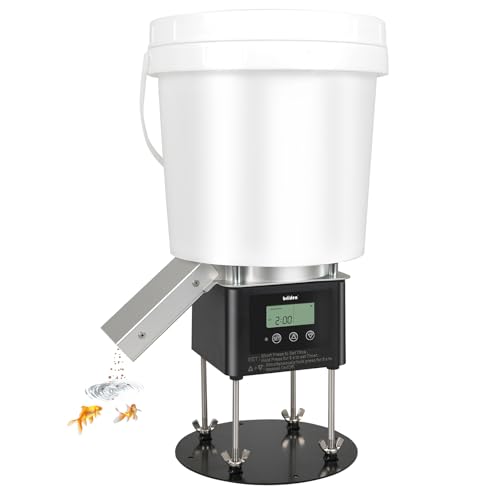
Briidea Automatic Pond Feeder with Anti-Clog System (4L)
The budget pick aimed straight at the P7000's weak spot: an anti-clog auger and a waterproof, wildlife-proof housing built to fight the rain-mush jams. The 4L hopper means more frequent refills, but for a short trip it covers the basics.


