The Best Automatic Pond Fish Feeder
By The Pond Review · Updated August 2026
Independent editorial guide. We never accept payment for coverage, though we may earn a commission if you purchase through our links.
Quick Take
An automatic pond feeder does one job, and does it well: it keeps your koi fed while you're away. That's worth buying for, because koi aren't goldfish and shouldn't be left to fend for themselves for a week. But the feature list isn't what earns a feeder its keep. Whether the hopper stays dry is. Our default is the Fish Mate P7000, the category standard, on the strict condition that you mount it where rain and spray can't reach it.
Here's the reasoning the product pages hope you skip. Every one of these feeders fails the same way. Humid air and rain get into the hopper, the pellets swell and clump, and a clumped feeder does one of two bad things: it jams, so the fish go hungry, or it dumps days of food in one drop, which is a water-quality disaster that can foul a pond faster than a few missed meals ever would. So the buy comes down to how well the hopper stays sealed and sheltered and how small it portions, not to whether it has a backlit screen. Power reliability outdoors counts too, because a feeder with a dead battery feeds nothing.
We've matched four feeders to that logic below, from the one we'd start with to a budget pick with a waterproof housing. See picks ↓

An auto-feeder solves a narrow, real problem: you want to travel, and koi shouldn't go a week unfed. Goldfish in an established pond can coast for days on what the water already offers, but koi are big fish putting on weight through the season, and a long gap sets them back. So an auto-feeder is a travel tool for koi keepers, and the question is only which one keeps working when it's sitting outside in the weather.
Our view cuts against most of what the listings sell. An auto-feeder is a moisture problem before it's anything else, and the flashy features that get top billing do nothing about the one failure that strands your fish or wrecks your water. Buy for a dry hopper and small portions first, and treat "set it and forget it for the season" as the myth it's.
Our take: an auto-feeder is a moisture problem first
We recommend buying a pond feeder the way you'd buy any outdoor electronic that has to survive months of weather: assume rain and humidity are the enemy, and pick the unit that keeps them out of the food. That's the axis that decides whether a feeder works in August, not the number of programmable feed times or the size of the display. Pellets are dry, hungry-for-water little sponges. Let damp air sit in a half-full hopper for a few days and they cake against the walls and the outlet. A metal or foil pouch of pellets stays crisp on a shelf for months; the same pellets loose in a vented hopper by the water start absorbing moisture the day you load them.
This is why our default is the Fish Mate P7000 with an asterisk we won't let you skip. It's the feeder the most experienced koi keepers keep coming back to, a plain 7-litre hopper on a timer that has fed dozens of ponds for years. Its weakness is that it isn't weatherproof, and keepers have watched it fail after sitting in the rain. Kept under a cover, an eave, or inside a small feeder house, it's the one we'd buy. Left exposed, even the best feeder on this list is a jam waiting to happen. The lesson generalizes: a feeder that stays dry beats a feeder that's clever, every time.
How every one of these feeders fails
Trace the failure all the way through and the buying criteria fall out on their own. Moisture gets in. The pellets clump. A clumped hopper jams at the outlet, and now the timer clicks on schedule but no food comes out, so your fish are quietly starving for exactly the days you're gone. That's the first failure, and it's the merciful one. The second is worse. A clump breaks loose all at once and the feeder drops days of rations into the pond in a single dump. Uneaten pellets rot, ammonia spikes, oxygen crashes, and you come home to a green, gasping pond. A pond can take a week of light hunger. It can't take a week of food rotting in the water at once.
So the two things a good feeder must do are keep water out of the hopper and meter the food in small, reliable amounts. A sealed housing, a sheltered mount, and a mechanism that resists caking, an auger or anti-clog design rather than a simple flap, are worth more than any convenience feature. This is where we part with the spec race: a big backlit LCD tells you nothing about whether the outlet caked shut overnight. A feeder that seals and portions cleanly with a plain dial beats a screen sitting on top of a hopper that clogs. Buy the sealing and the metering. The screen is a nicety.
Portion small and often, and do the arithmetic
The safe way to run any feeder is the way you'd feed by hand: small amounts, more often, only what the fish clear in a few minutes. Set several small feeds a day rather than one large one, and the failure math changes in your favor. If the mechanism ever stutters or over-drops, a small programmed portion spills a spoonful, not a week. This is the single habit that turns the dump-disaster from a pond-killer into a minor mess.
Then load the hopper light, not full. This runs against instinct, since a big hopper looks like a feature you should use. Do the division instead. A dozen koi eat a few tablespoons a day, so a full 7-litre hopper holds far more than a one-week trip needs, and every extra day of pellets sitting in damp air is one more day to clump and one more day of food that could dump at once. Fill it with a little more than the trip requires and no more. The experienced keepers say the same thing in plainer words: if you'd be gone a week, put in enough for a few feedings, so that if it all lets go at once, it isn't a catastrophe. A large hopper is a refill convenience, not a license to load a month of food over your fish.
Power it for the outdoors, batteries or solar
A feeder only feeds while it has power, so how it's powered is a reliability question, not a footnote. The battery-run feeders, the P7000 among them, are the simplest and least likely to fail in a storm, but only if you respect the battery. Leave the batteries in year-round and change them on a schedule; don't let them die, because a dead feeder both stops feeding and, on many units, forgets its entire program, so you come home to a hungry pond and a feeder to set up from scratch. A fresh set typically lasts roughly six to nine months, so swap them before a long trip rather than hoping.
Powered and solar feeders trade that simplicity for not touching batteries, and they can be the right call on a hard-to-reach mount. But each adds a way to fail outdoors: a 12V adapter means a cord and an outlet near the water and a connection to keep dry, and a solar panel means enough sun on the panel every day and a small internal battery that still ages. None of this is a reason to avoid them. It's a reason to test the feeder for a full week at home, on its real power source, before you trust it with the pond while you're a plane ride away.
A timer can't read the thermometer
Here's the limit no feeder overcomes: it feeds on a clock, and a koi's need for food is set by water temperature, not by the calendar. Koi are cold-blooded, their metabolism tracks the water, and as the pond cools their digestion slows until food sits undigested in the gut and does more harm than good. A timer knows none of this. It'll happily drop pellets into 45-degree water on the schedule you set in July.
This is a safety line, and it comes from the extension services and koi-health authorities, not from the crowd or the convenience of the machine: stop feeding your koi once the water drops below about 50 degrees Fahrenheit, regardless of what the feeder is programmed to do. Feed a warm-water pellet only while the pond is warm, taper to a low-temperature wheat-germ food as it cools through the 50s, and cut feeding off entirely below roughly 50 degrees until spring warms the water back up. The practical upshot for an auto-feeder is simple: it's a warm-season tool. When the water goes cold, you turn it off yourself. No schedule reads the thermometer for you.
Where set-and-forget goes wrong
The pitch on the box is that you fill the hopper, set the timer, and forget the pond for the season. We disagree, plainly. An auto-feeder is a way to cover a trip, a week or two while you're away, not a way to skip feeding as a chore for months. Load it for the season and you're betting a large volume of pellets against months of humidity and rain in the one part of the system most likely to clump, which is precisely the setup for the dump-disaster we keep coming back to.
There's a quieter reason too. Feeding by hand is when you look closely at your fish, and a pond left on autopilot for months is a pond whose problems, a sick koi, a failing pump, a bloom starting, go unseen until they're bad. Use a feeder to bridge the gaps when you can't be there. Don't use it to stop paying attention. The keepers who trust these units for years are the ones who load them light, shelter them, and treat them as a stand-in for a week, not a replacement for the season.
Matching a feeder to your pond
Here's how we'd choose among the four picks. For most koi keepers who can give a feeder a sheltered mount, the Fish Mate P7000 is the default: a proven 7-litre unit that feeds a dozen koi for a week on batteries you leave in, as long as you keep it dry. If you want a bigger, clearer display than the P7000's small screen and easier programming, the hygger LCD is the step across for a similar job, with the tradeoff that it runs on 12V power, so plan the outlet and shelter it the same way.
For a larger koi load or longer gaps, the Pond Guy KoiGrower is the premium pick, a much bigger hopper and a sturdier build so a heavy load eats for longer between refills, though you still load it light and mount it dry. And the Briidea is the budget way in, a smaller 4-litre unit whose waterproof housing and anti-clog system take the moisture problem seriously for the price, best on a smaller koi or goldfish pond you can refill more often. Match the feeder to the trip and the mount, keep every one of them out of the rain, and portion small.
The picks
Products we recommend for this guide.

Fish Mate P7000 Automatic Pond Fish Feeder
The category standard, and our pick as long as you keep it dry. A 7-litre hopper feeds a dozen koi for a week on batteries you leave in, but it isn't weatherproof, so mount it under a cover or eave. Kept out of the rain it runs for years.

hygger LCD Automatic Pond Fish Feeder
A 5.5-litre feeder with a large LCD you read and set at a glance, bigger and clearer than the P7000's small screen. It runs on 12V DC rather than internal batteries, so plan a nearby outlet, and shelter the hopper from rain the same as any feeder.

The Pond Guy KoiGrower Automatic Fish Feeder
The premium pick: a 5-gallon hopper that holds far more than the others, so a big koi load eats for longer between refills. You pay for the capacity and a sturdier build, and it still wants a dry, sheltered mount to keep pellets from clumping.
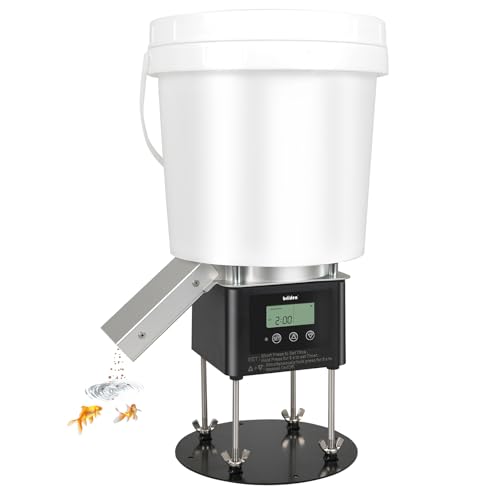
Briidea Outdoor Pond Fish Feeder, 4L
The budget way in: a 4-litre feeder whose waterproof housing and anti-clog system take the moisture problem seriously for the price. Capacity is modest, so it suits a smaller koi or goldfish pond you refill more often. Keep it out of the rain.
What owners say
Real owner reports from the threads and editorial sources we drew on for this guide.
“I have been using a "Fish Mate P7000 " for the last 3 1/2 years and it works very well. I have 12 large koi and it will feed them for a week with no problem.”
“I just got a p7000 a couple days ago, so haven't used it yet, but it's very light so it needs a "base"... and I've read it's not weatherproof and failed in the rain, so it might need to be covered”
“I would only fill it with enough food for a few feedings. That way if the entire thing dumped, it wouldnt be a disaster.”
“I tried mixing the large Blackwater pellets with the medium and the trap door would jam. So I only use the medium size pellets in my Koi Cafe.”
“For Koi though I don't believe you can do that. I have had struggles with autofeeders as they are expensive. I bought this but it broke down on me after a year and I had to buy it again.”
“I can just see the unit dumping the entire contents of food into the aquarium and then having poor water quality kill my fish before I could do anything about it”

