The Best UV Clarifier for a Pond
By The Pond Review · Updated August 2026
Independent editorial guide. We never accept payment for coverage, though we may earn a commission if you purchase through our links.
Quick Take
For a backyard koi or goldfish pond gone pea-soup green, a UV clarifier is the fix, and the unit to buy is the one whose wattage suits both your pond volume and the flow rate feeding it. Those are two different numbers, and best-of lists that rank by watts alone ignore the second one. We start most readers on the Tetra Pond GreenFree line for value, then step the wattage up as the pump gets bigger.
One correction the dealer pages bury: a clarifier kills the free-floating single-celled algae that turns water green, and it does nothing for the string algae on your waterfall or the sludge on the bottom. Those are separate jobs with separate fixes. And plan for the part nobody puts on the box, a yearly bulb swap and an occasional quartz-sleeve wipe, which is the running cost that decides what a clarifier costs you over its life.
Below we size five clarifiers to real ponds, from the value GreenFree to a 55-watt unit that doubles as a sterilizer, and show the flow math that tells you which one your pump can feed. See picks ↓

Most best UV clarifier pages rank units by wattage and stop there. Wattage is half the answer. The other half is dwell time, how long each drop of water sits under the lamp, and your flow rate sets that, not the bulb. A big lamp fed too fast can clear less green water than a small lamp fed at the right pace.
So the sizing question isn't "how many watts" on its own. It's "how many watts, at what flow, for how many gallons," and getting the order right is what separates a clarifier that clears your pond in a week from one that never quite catches up. Here's how we size one, the arithmetic the listings leave out, and where each of our five picks fits.
What a UV clarifier does, and what it can not
A UV clarifier is a lamp inside a housing that pond water flows past on its way back from the pump. As single-celled algae drift through, the ultraviolet light scrambles them, they clump together, and your mechanical filter traps the clumps downstream. That's the whole function: it clears the free-floating green algae that turns a pond into pea soup. Listings imply more than that. A clarifier does nothing to the string algae clinging to your waterfall and rocks, and nothing to the sludge on the bottom. Those are different problems, fixed with a brush and a net for the string algae, and better mechanical filtration plus lighter feeding for the sludge. When a product page suggests a UV unit will clean your whole pond, read past that line.
Clarifier and sterilizer are the same lamp
A clarifier and a sterilizer are one piece of hardware doing two jobs at two flow rates. Push water past the bulb quickly and you clear green water, which is the clarifier job most backyard keepers want. Slow that same water down and the longer exposure starts killing parasites and pathogens too, which is the sterilizer job. Nothing changes but the plumbing and the flow. This matters when you shop because a unit sold as a "clarifier/sterilizer" isn't two devices, it's one you run at different speeds, and most ponds only ever need the faster clarifier setting.
The practical read is that you should buy for the clarifier job and treat the sterilizer job as a bonus you can reach for. Green water is the problem almost every backyard pond actually has, and it's the one a clarifier fixes cleanly. Parasite and pathogen control at low flow is real, but it's a job for a keeper managing a specific health issue on a valuable koi collection, not a routine setting for a garden pond. If a listing sells you up to a bigger unit purely on the sterilizer claim, ask whether you'll ever slow the flow enough to use it. Most people never do.
Why watts alone don't size the unit
Every ranking leans on wattage because it's the number stamped on the carton. Wattage sets the ceiling on how much algae the lamp can kill per second, but the water has to spend enough time in front of it to get killed at all. That time is dwell time, and your flow rate controls it. Run a lamp at the top of its flow range and each drop gets a brief pass; throttle the flow and each drop lingers. This is why two ponds with the same wattage get different results: the one pushing water through faster is asking the lamp to do more work in less contact time, and green water is the answer it gets back.
Picture two 18-watt units. One sits on a 500-gallon pond fed by a 600 gph pump, comfortably inside the lamp's flow range, and it clears the water in a few days. The other hangs off a 3,000 gph waterfall pump on a 1,500-gallon pond, and it never gets ahead of the bloom, because the water is sprinting past the bulb at five times the pace. Same wattage, same lamp, opposite outcomes, and the only variable that changed was flow. That's the failure mode the wattage-only rankings walk you straight into, and it's why we treat flow as a first-class number rather than a footnote.
The wattage math worth doing first
Do this arithmetic before you buy. For clearing green water, plan on roughly two watts of UV per hundred gallons. By that measure a 9-watt clarifier really covers about 450 gallons, however boldly a listing rates it. It's common to see a 9-watt unit sold as good for 1,800 gallons, four times what the two-watt rule suggests, and that gap is where disappointed buyers end up. Believe the arithmetic over the badge.
Flow bends the number a second time. The same 9-watt lamp behaves like a clarifier at around 1,200 gph and like a sterilizer down near 300 gph, because cutting the flow roughly quadruples the exposure each drop gets. So size a clarifier by flow first and gallons second. Match the unit's recommended flow to the pump that'll feed it, then confirm the wattage covers your volume at the two-watt rule. Reverse that order, size by gallons and hope the flow sorts itself out, and you get the pond that stays cloudy despite a lamp that looks big enough on paper.
Matching the unit to your pump
Manufacturers publish a suggested flow range, and it's worth honoring. Run above it and the water blows past too fast to clear; run well below it and you drift into sterilizer territory, which is fine if that's what you want and slow if it isn't. A 9-watt unit typically wants somewhere near 900 gph for clarifying, so if your return pump moves far more or far less than that, you either split the flow with a valve or put the clarifier on its own smaller pump. Pond owners who size well tend to buy the unit that fits the pump they already run, not the one that matches a gallon figure in isolation.
If you're between two wattages, we'd size up. The cost difference is small, a larger lamp fed at the right flow clears faster, and you keep headroom for the day you add fish or a second waterfall. The only reason to hold back is if a bigger unit forces a flow so high it wrecks your dwell time, which is the same flow trap in reverse.
Where the clarifier sits in your plumbing changes the flow it sees, which changes the wattage you need. Put it on the full waterfall line and it has to handle your whole turnover; put it on a skimmer line or its own dedicated pump and it only sees the slice of flow you send through it, which is often the better arrangement because you can tune that slice with a ball valve. Most owners also feed the unit after the mechanical stage of their filter, so the lamp is working on already-strained water and the dead algae it produces gets caught downstream instead of settling back into the pond. Decide the placement before you decide the wattage, because a clarifier on a throttled side-line and one on the main return are being asked to do very different jobs.
The running cost nobody quotes you
The purchase price isn't the whole cost of a clarifier. A UV bulb loses output long before it goes dark, so it needs replacing on a schedule whether or not it still glows, and a tired bulb is a common reason a pond that cleared last year turns green this one. Some units use a bulb rated for a single season and some for two, and the replacement can run anywhere from a modest to a stinging annual line item, so check that price before you commit to a brand rather than after. A cheap unit with an expensive proprietary bulb isn't the bargain it looks like on the shelf.
The quartz sleeve is the other half of the upkeep. That sleeve separates the bulb from the water, and it slowly fouls with a film of biofilm and mineral scale that the UV light can't punch through. A clarifier looking through a dirty sleeve is a clarifier running at a fraction of its power, and it fails gradually enough that most owners blame the pond before they blame the glass. Pull the sleeve and wipe it clean when you rinse your filter, check the rubber seals while you have it apart, and the same lamp keeps clearing water for years. Skip that ten-minute job and even a correctly sized unit slides toward useless one invisible layer of scale at a time.
How we'd choose across the five picks
For most backyard ponds we'd start with the Tetra Pond GreenFree line: it's the value entry point, the lamps clear green water reliably, and you pick the model wattage that suits your flow rather than paying for a housing you don't need. Our full take on it lives in the Tetra Pond GreenFree review, and it's the first unit we'd put on a lightly to moderately stocked pond.
Step up from there by fish load, not by gallons. A mid-volume koi or goldfish pond that a small lamp leaves cloudy is where the 28-watt Aquascape UltraKlear 2500 earns its place, and a heavily stocked koi pond, or one where you want parasite control available at low flow, is where the 55-watt Aquascape UltraKlear 5000 makes sense despite the price. If you want high wattage without the premium tag, the Jebao CW-55 delivers the same 55 watts for far less, at the cost of plainer build, and the hygger 32W is the budget middle, a lot of clarifier for the money as long as you feed it inside its flow window. What we wouldn't do is buy the biggest number and skip the flow math, because that's the fastest way to overpay for a green pond.
Where we'd land
Buy watts for your flow first and your gallons second, and a UV clarifier is close to a solved problem: it clears suspended green algae, it holds the pond clear while it runs, and it asks only for a fresh bulb each year and a clean sleeve. Buy by the number on the box and you get the opposite, a lamp that looks big enough and never quite catches the bloom. The GreenFree line is where we'd start for value, the Aquascape units are where we'd go for a stocked pond, and the flow rate feeding whichever you pick matters more than the wattage printed on it.
The picks
Products we recommend for this guide.

Tetra Pond GreenFree UV Clarifier UVC-5
The value way into a proven clarifier line. The GreenFree lamps clear suspended green algae reliably; the trick is buying the model whose wattage matches your flow, then stepping up as your pump grows. Our first pick for most backyard ponds.
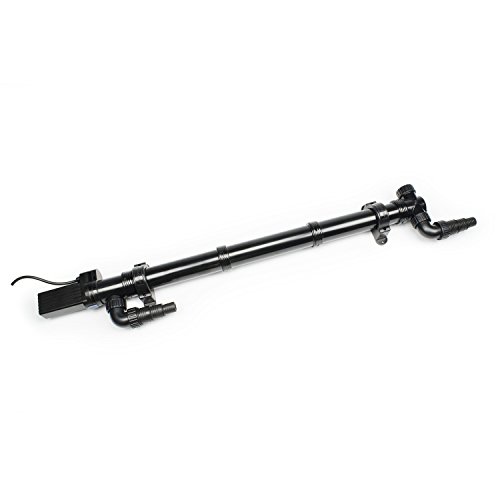
Aquascape UltraKlear 5000 UV Clarifier/Sterilizer 55W
Fifty-five watts in a build meant to double as a sterilizer at low flow. Overkill for a small water garden, but the pick if you run a heavily stocked koi pond or want parasite control on tap. You pay for the wattage and the housing here.

Aquascape UltraKlear 2500 UV Pond Clarifier 28W
The middle of the Aquascape line at 28 watts, sized for mid-volume koi and goldfish ponds. Same clarifier-or-sterilizer flexibility as the 5000 for less money, and enough lamp to clear a pond a small unit would leave cloudy and green.

hygger 32W Pond & Aquarium UV Light Water Clarifier
Thirty-two watts rated for 200 to 2,200 gallons at the lowest price here. A lot of clarifier for the money if you feed it inside that flow window; the tradeoff is a lesser-known brand and replacement bulbs you plan to source yourself each season.

Jebao CW-55 Pond and Aquarium Clarifier 55W
The cheap route to high wattage: 55 watts for a fraction of the premium Aquascape unit. Buy it when you want sterilizer-grade output on a budget and can live with plainer build and a brand that competes on price rather than polish.
What owners say
Real owner reports from the threads and editorial sources we drew on for this guide.
“flow rate can also be determined by what your using it for. higher rates for using it as a clarifier. meaning just clearing green water, lower flow for use as a sterilizer, meaning parasite and pathogen control. some units will have ratings for both.”
“UV's have ratings from their manufacture. The "suggested" flow range will kill the algae and bacterias flowing through it, but if you are trying to kill protozoas, they then suggest a slower flow, as low as 15-20% of their typical suggested flow rate.”
“I have a 9 watt UV and the manufacturer recommends 900 gph plus or minus 10 percent.”
“I have a 450+ gallon above ground pond and my 9-watt UV is rated for 1800 gallons. The only reason I went with that one as opposed to the smaller one that is rated for 660 gallons is because the smaller one wouldn't have worked well with my 1000 gph pump.”
“Ours is 38 watts and it does 1,000 gallons UK with ease it has a two year bulb life span not the one year .... Properly maintained with the cystle sleave rmoved from time to time to be cleaned on the outside .”
“If I decide to buy Tetra Pond 36 watt UV Clarifier, I'll pay the price of $47.29 annually for a crystal clear water in the pond .”