The Best Energy-Efficient Pond Pump
By The Pond Review · Updated August 2026
Independent editorial guide. We never accept payment for coverage, though we may earn a commission if you purchase through our links.
Quick Take
If your pump runs all year, buy for flow-per-watt, not the headline GPH. Our default is the Jebao DCP-4000, a DC sine-wave pump that moves about 1,050 gallons an hour on about 32 watts and lets you dial the flow down from a controller, so you aren't paying to overpump. A DC pump like this beats a comparable AC mag-drive pump by a wide margin on watts, runs cool and quiet, and pays back its price in a year or two on electricity alone.
Before you buy, do the arithmetic the listing skips: annual cost equals watts times 24 times 365, divided by 1,000, times your price per kWh. An 80W pump at 15 cents a kWh runs about 105 dollars a year; a 200W AC pump of similar output runs about 260. That 155-dollar gap is roughly the price of the efficient pump, every year, so on a pump that never shuts off the efficiency compounds. Buy for watts if you run year-round, and measure your pump's real draw with a Kill-A-Watt meter rather than trusting the box.
We have matched four efficient DC pumps to real ponds below, from the one we'd start with to the budget way in. See picks ↓

A pond pump is the one appliance in your yard that never turns off. It runs every hour of every day, all year, and that single fact makes it almost always your pond's biggest electricity cost, ahead of the UV lamp, the de-icer, and everything else combined. So the number that decides what a pump costs you isn't the gallons per hour printed on the box. It's the watts it draws to move that water, hour after hour, and how much of that flow you were ever going to use.
Our view is that on a 24/7/365 pump you buy for flow-per-watt, and a DC sine-wave pump beats an old AC mag-drive pump by a wide margin on that axis. DC pumps run cooler and quieter, and because they throttle down from a controller, you stop paying to push water you don't need. The catch is that the efficient number is the one the listing buries, so you have to do the arithmetic yourself.
Our take: on a pump that never sleeps, buy for watts
Flow-per-watt is the spec that governs a pond pump's lifetime cost, and it's the one the marketing pushes to the back. A listing leads with GPH because a big number sells, but two pumps that both claim 1,000 gallons an hour can draw 25 watts or 90 watts to do it, and over a year that spread is real money. On an appliance that runs 8,760 hours a year, a 65-watt difference decides the bill. So we start from the watts and treat the GPH as a requirement to meet at the lowest draw, not a headline to chase.
This is where a DC pump earns its keep. A modern DC sine-wave pump moves the same water on a fraction of the wattage an AC mag-drive pump needs, and it does it running cool and quiet instead of humming warm in the water. Warm is wasted electricity you're paying for and then paying again to not enjoy. The efficient pump costs a bit more at the register, and it makes that back on the electric bill inside a year or two, then keeps saving for as long as it runs.
The arithmetic the listing hopes you skip
Here's the calculation no product page will do for you, and it's short. Annual cost equals watts, times 24 hours, times 365 days, divided by 1,000, times your price per kilowatt-hour. Those are all the terms, and they turn a vague sense that pumps use power into a dollar figure you can compare across the aisle.
Run it with real numbers. An efficient 80-watt pump at 15 cents per kWh costs about 105 dollars a year to run: 80 times 24 times 365 is 700,800 watt-hours, or about 701 kWh, times 0.15 is roughly 105 dollars. A thirsty 200-watt AC pump of similar output costs about 260 dollars a year the same way. The gap between them is around 155 dollars every year, which is roughly the price of the efficient pump itself. Buy the efficient one and the electric bill buys you a second one inside twelve months. Your own rate changes the totals, so drop your price per kWh into the formula, but the direction never flips: on a pump that runs all year, the cheaper pump to run wins on total cost even when it costs more to buy.
One more piece of arithmetic keeps the watts and the flow honest, because a pump's rated GPH is measured at zero lift and drops fast as the water has to climb. A pump that claims 1,000 gallons an hour at the box may deliver 600 at the top of a four-foot waterfall, and it still draws close to its full wattage doing it. So flow-per-watt is a figure you should read at your real head height, not at the sea-level number on the listing. When you compare two pumps, compare the watts each one pulls to hit the flow you need at your lift, and the efficient pump usually widens its lead once real head enters the picture, because it holds more of its flow as the load climbs.
Why DC sine-wave beats AC mag-drive
The efficiency gap isn't marketing, it's how the two motors work. An AC mag-drive pump runs its motor straight off the 120-volt wall current at a fixed speed, and a lot of that energy leaves as heat and vibration instead of moving water. A DC pump steps the power down to low voltage and drives a controlled motor that spins only as fast as it needs to, so more of every watt ends up as flow and far less as waste heat. That's why the DC pump runs cool to the touch where the AC pump runs warm.
Low voltage carries a second benefit that matters in a wet yard. A DC pump runs on 24 volts or less through a sealed adapter, which is a gentler thing to have submerged near you and the fish than 120-volt mains. It's quieter too, since there's no mains hum, and quiet counts on a pump sitting a few feet from where you like to sit. None of this makes an AC pump useless, but on efficiency, heat, and noise the DC pump wins every comparison that matters for a pond that runs year-round.
The cooler running has a payoff past the electric bill. A motor that sheds less heat is a motor working less hard, and a DC pump's brushless design has fewer wearing parts than an old brushed or shaded-pole AC unit, so the better ones tend to last. That matters on a device you never switch off, because a pump that fails in August isn't just a replacement cost, it's a pond losing its filtration and its oxygen exchange in the heat when the fish need both most. Efficiency and longevity travel together here, and both point the same way for a pump that runs every hour of the year.
Throttling down is half the savings
The other half of the DC advantage is that you can turn it down. Most ponds are plumbed with a pump sized for the biggest job, the tall waterfall or the peak-summer flow, and then that pump runs flat out through the mild months when the pond doesn't need it. An AC pump has one speed, so it overpumps most of the year and you pay for all of it. A DC pump comes with a controller, so you set the flow the season calls for and the wattage drops with it.
That turn-down isn't a gimmick, it's money. A pump dialed to 60 percent for the shoulder seasons draws well under its rated watts for those months, and on a bill that compounds over 8,760 hours those savings add up faster than the sticker gap suggests. It's also better for the pond: gentler flow in cool weather, less stress on fish, and a quieter yard. You size the pump for the hardest job it'll ever do, then run it at the flow today needs, and only a DC pump lets you have both.
Measure your real draw before you argue about it
The wattage on the box is a rated figure, and your pump's real draw depends on how high it has to lift the water and how you have it plumbed. So before you decide whether a pump is worth swapping, measure it. A Kill-A-Watt meter plugs between the pump and the outlet and reads the actual watts it's pulling in your setup, which is the only number worth putting in the formula above. They're cheap, hardware stores carry them, and one reading settles most of the guessing.
Measuring also keeps you honest about whether the swap is worth it at all, because the answer depends on your electric rate. At a low rate a 100-watt difference is a few dollars a month and easy to shrug off. At a high rate it's real money you notice. Both of those buyers are right about their own bill, which is why the rule is to run the arithmetic on your own numbers rather than anyone else's. Measure the draw, plug in your rate, and let the figure tell you whether efficiency is worth chasing on your pond.
Matching an efficient pump to your pond
Here's how we'd choose among the four picks. For most backyard ponds that run a filter and a modest waterfall year-round, the Jebao DCP-4000 is our default: a DC sine-wave pump that moves around 1,050 gallons an hour on about 32 watts, with a controller to dial the flow down when the season allows. It's the best flow-per-watt on this list, and for a pond running all year that's the axis to optimize.
If you need more flow, the POPOSOAP 1600 and the hygger 24V step up the output while keeping the DC efficiency and low-voltage safety, with the hygger reaching to 2,650 gallons an hour for a bigger pond or a taller waterfall. For a small pond, a spitter, a solar setup, or a single fountain, the small 12-24V DC pump around 410 gallons an hour is the cheapest way into DC and sips watts doing it. Match the pump to the flow the pond needs at your actual head height, then let the DC efficiency carry the running cost down from there.
How we'd spend the money
If it were our pond, we'd buy the most efficient DC pump that covers our peak flow, run it turned down through the mild months, and put a Kill-A-Watt on it the first week to learn its real draw. That draw times our own electric rate tells us the yearly cost, and on a pump that runs 8,760 hours a year the efficient choice almost always comes out ahead on total money even after the higher purchase price.
Two habits separate the owners who save from the ones who guess. They read the watts, not the GPH, and they measure the draw instead of trusting the box. Do that and the pump quietly costs less every month it runs, which on the one appliance in your yard that never turns off is where the savings live.
The picks
Products we recommend for this guide.

Jebao DCP-4000 DC Sine Wave Pump
Our pick for flow-per-watt: a DC sine-wave return pump that moves roughly 1,050 GPH on about 32W and dials down from its controller, so you set the flow you need instead of overpumping. It runs cool and quiet on a line that never shuts off.

POPOSOAP 1600 GPH DC Pond Pump
A 24V low-voltage DC pump rated near 1,600 GPH that trades a little efficiency for more flow and a quiet, safe-voltage build. The AC/DC converter and hose adapters make it an easy drop-in where you want DC savings without a reef-pump price.

hygger 24V DC Return Pump (2650 GPH)
The high-flow DC option, rated to 2,650 GPH with a controller to throttle the draw down when you don't need the top end. It costs more up front, but on a big pond running year-round its flow-per-watt still beats an AC pump of the same output.
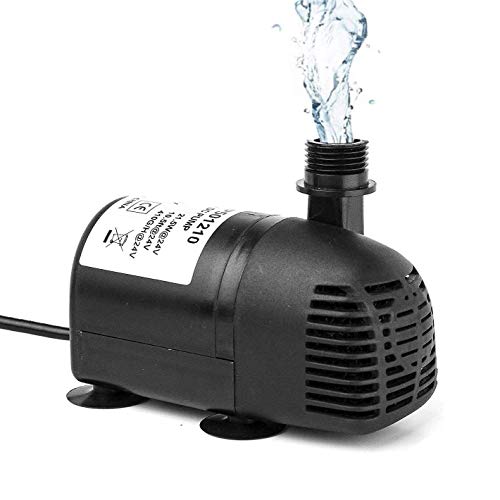
12V-24V DC Brushless Submersible Pump (410 GPH)
The budget way into DC: a small brushless 12-24V pump around 410 GPH for a fountain, spitter, or small filter feed. It sips watts on low voltage, so for a compact pond or a solar setup it's the cheapest path to a low running cost.
What owners say
Real owner reports from the threads and editorial sources we drew on for this guide.
“That sounds about right. Typical price for electricity in the US is about 11 cents/killowatt hour. So the calculations works out like this: 165 W / (1000 W/kW) *24 hr per day * 30 days/month * $0.11 per kWh and I come up with $13 a month. If the other pump is double that, it's $26 a month. You can see you quickly save the extra money spent.”
“to be honest with all the stuff from my ponds and reef tank I got drawing extra juice the increase in the monthly electric wasn’t really that bad/noticeable. But then again 10-20 bucks on a $900-1000 electric bill isn’t that big a jump.”
“You would amazed at how all the electrical appliances we use to make our lives more convenient add up to big energy usage. Take a piece of paper and list out all your electrical devices and their wattage or amperage ratings. It adds up! There's also a device called a kill-a-watt meter that you can use to measure how much energy a certain device is using.”
“Most of my pond pumps have been relatively low power consumers. (75w) 1050gph.”
“My electricity is about $0.45 KW - crazy right! I have not noticed a change in my bill running my pump and UV 24/7 and if someone should notice, it would be me! LOL! I don't think they use that much power. My pump moves 2200GPH.”
“Wattage = Amps x Volts. Your pump is very inefficient in electricity use. My 2 pumps together pull less than 8 Amps combined. I suggest that you switch to a high efficiency pump. It will pay for itself in less than a year.”