When to Put Pond Netting on for Fall
By The Pond Review · Updated September 2026
Independent editorial guide. We never accept payment for coverage, though we may earn a commission if you purchase through our links.
Quick Take
Put your pond net on as the first leaves start to turn and fall, not after the pond has already filled with them. In most climates that means late September into October, watching the trees rather than the calendar. Leave it on until the trees are bare, usually through November, then take it off before it collects a heavy snow load. The single trick that makes netting work is to hold it up off the water on stakes or a simple frame, so leaves sit on top to be swept away instead of sinking through onto the fish and rotting. Match the mesh to your trees: a quarter-inch net handles most leaves, but drop to an eighth-inch if you have pine needles or small seed pods. And keep it taut and elevated, loose netting on the water can trap birds and frogs.
The three nets we would choose from, a light value net, a fine mesh for small debris, and a heavy-duty net that doubles against herons, are below. See picks ↓

Netting is the highest-value, lowest-effort thing you can do for a pond in fall, and most people get the timing wrong in one of two directions: they wait until the pond is already full of leaves, or they lay the net flat on the water where it does half its job and creates a hazard. Do it right and a net turns the entire autumn leaf-fall from a season of scooping and a spring of sludge into a five-minute job of dragging leaves off the top. It is also the cleanest way to prevent the tea-colored, tannin-stained water that dropped leaves cause in the first place.
Get two things right and the rest is easy: put it on early, before the heavy drop rather than after, and hold it up off the water rather than letting it sag onto the surface. This guide covers exactly when to put a net on and when to take it off, how to pick the mesh size for your trees, the frame trick that separates a net that works from one that sinks, and the wildlife-safety rule that keeps the netting from doing more harm than the leaves.
When to put the net on
Watch the trees, not the date. You want the net up as the first leaves begin to turn and drop, before the heavy fall arrives, because it is far easier to keep leaves out than to get them back out once they have sunk and started to break down. In most of the country that is late September into October; in a warm-winter region it may be weeks later, and in the far north a touch earlier. The signal is the trees over and around your pond starting to color and shed, not a line on the calendar.
The reason to be early is what late leaves do. Once leaves sink and settle on the bottom, they leach tannins that stain the water tea-brown and they add to the sludge that fuels next year's algae and, as it decomposes under winter ice, draws down the oxygen your fish need. A net that goes on before the drop stops all of that at the source. If you have already missed the first fall and the pond has leaves in it, scoop out what you can, then net to stop the rest, the net still earns its place mid-season.
When to take the net off
Leave the net on until the trees over the pond are bare, which in most places means through November. Two things decide the exact timing. First, do not leave a flat, unsupported net on through a heavy snow, it will collect the snow, sag, and either tear or pull down into the water; if your net is framed up and can shed snow, some keepers leave it up all winter, but a net lying on the surface should come off once the leaves stop. Second, take it off in time for spring, before frogs, newts, and nesting birds become active around the pond and before your plants start pushing up through it.
One keeper's routine captures the framed-up approach well, they leave a PVC-supported net up from fall to spring and let the snow take care of itself: "I leave mine up from Fall to Spring. Sometimes snow will collapse it, but when the snow melts, it just pops back up!" The disposable route works too, if you live under heavy trees, roll the whole leaf-filled net up in spring and start fresh next fall rather than trying to clean it.
Get the mesh size right for your trees
Mesh size is the one spec that decides whether the net keeps debris out, and it is matched to what falls from your particular trees. A quarter-inch mesh is the sensible all-rounder: it stops oak, maple, and most broad leaves while staying light and easy to handle. Go finer, to an eighth-inch mesh, if your problem is small debris a standard net lets straight through, pine needles, seed pods, the little "helicopters" and catkins, and pollen. Avoid the loose, wide half-inch and larger weaves sold as generic garden netting; they let small leaves and needles pass and mostly just frustrate you.
Owners who have upgraded describe exactly this. As one put it after fighting debris through a coarser net: "In the past we have used standard 1/4 nylon netting (two layers) to cover the pond, but we still had quite a bit of debris fall into the pond. I would like to get a tighter weave of 1/8 netting for the pond." If you are under pines or have a lot of small seed fall, start with the finer mesh; if it is broad leaves, a quarter-inch net is plenty and easier to work with.
The trick that makes it work: hold it up off the water
This is the difference between a net that works and one that becomes its own problem. A net laid flat on the water surface does its job badly and creates hazards: leaves land on it and, with nothing holding it up, their weight pushes the net and the leaves down into the water, where they sink through to the fish and rot anyway. A wet, sagging net is also hard to clear and easy to tear. The fix is to suspend the net a foot or more above the water so leaves collect on top, dry out, and can be swept or lifted off cleanly.
You do not need anything fancy. The common backyard solution is a simple arched frame: lengths of PVC pipe bent over the pond and anchored at the ends, which keepers build for a few dollars. One describes the exact rig: "I hammer fiberglass driveway markers in the ground and slip the ends of the PVC over them. I put a zippie screw into each connection to keep it all together. When I take it down, I number each joint so I know how to put it back together next time. PVC and its fittings are cheap. I leave mine up from Fall to Spring." Even a few bamboo stakes or a large planter in the center to lift the middle is better than nothing. Another keeper's version is the whole workflow in one line: "I use a pvc frame and drape it over that. In the spring I roll it up with leaves and all and throw it away. It keeps the majority of fall trash from getting in and I can still feed and see the fish."
Keep it safe for wildlife
A net can become a wildlife trap, and this part is worth taking seriously. Loose, fine netting lying on or near the ground and water can entangle and drown birds, frogs, and the occasional snake or turtle that tries to pass through it. The rule is to keep the net taut and elevated rather than slack and pooling, so animals meet a firm surface they bounce off rather than a loose web they push into and cannot back out of. One keeper's hard-learned warning is worth repeating: "I did use deer fencing one year as anti heron, quit after finding two little dead birds that got trapped under it and drowned. I just net the leaves out." Purpose-made pond netting, held taut over a frame, is far safer than a loose sheet of garden or deer fencing, and a finer mesh is generally less of an entanglement risk than a coarse one, as another keeper noted of her eighth-inch net: "I don't think it would entrap a bird."
Netting questions, answered
When should I put netting on my pond in fall?
As the first leaves start to turn and drop, before the heavy fall, which in most climates is late September into October. Watch the trees over your pond rather than the calendar; the moment they begin coloring and shedding is your cue. Netting early is far easier than getting sunken leaves back out, and it stops the tannin staining and sludge that fallen leaves cause. If you have already missed the first drop, scoop what you can and net to stop the rest.
What mesh size pond netting is best?
A quarter-inch mesh is the best all-rounder: it stops oak, maple, and most broad leaves while staying light and easy to handle. Choose a finer eighth-inch mesh if your trees drop small debris a standard net passes, pine needles, seed pods, catkins, and helicopters. Avoid loose half-inch and wider garden netting, which lets small leaves and needles through. Match the mesh to what falls into your pond.
Should I hold pond netting off the water?
Yes, and it is the single most important thing. A net laid flat on the surface lets the weight of collected leaves push it and them down into the water, where they sink to the fish and rot, and a sagging wet net is hard to clear and easy to tear. Suspend it a foot or more above the water on a simple PVC arch, stakes, or even a central planter, so leaves sit on top to be swept off cleanly.
Can pond netting harm birds or frogs?
It can if it is loose and pooling. Slack netting on or near the water can entangle and drown birds, frogs, and other wildlife. Keep it taut and elevated over a frame so animals meet a firm surface rather than a loose web, use purpose-made pond netting rather than a floppy sheet of deer or garden fencing, and take it off in spring before frogs and nesting birds become active.
The picks
Products we recommend for this guide.
POYEE Pond Netting for Leaves
The value pick for a temporary fall cover. A light poly net that stops broad leaves, easy to stretch over stakes or a PVC arch and roll up when the trees are bare. Buy a size that overlaps your edges, and hold it up off the water so leaves sit on top.
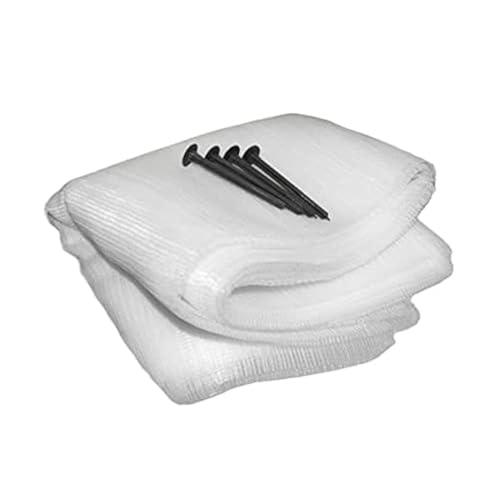
The Pond Guy Fine Mesh Pond Netting (1/8")
The fine-mesh choice for small debris. An eighth-inch mesh that catches the pine needles, seed pods, and catkins a standard net lets through, and it comes with stakes to pin the edges. Worth it under pines or heavy small-seed fall; overkill for just broad leaves.

Dewitt Deluxe Pond Protection Net
The heavy-duty net that pulls double duty: it keeps leaves out and doubles as a physical barrier against herons, so some keepers leave it framed up year-round. Costs more than a seasonal leaf net, but buy it if you want one tough net that lasts and deters predators.
What owners say
Real owner reports from the threads and editorial sources we drew on for this guide.
“I hammer fiberglass driveway markers in the ground and slip the ends of the PVC over them. I put a zippie screw into each connection to keep it all together. When I take it down, I number each joint so I know how to put it back together next time. PVC and its fittings are cheap. I leave mine up from Fall to Spring.”
“I use a pvc frame and drape it over that. In the spring I roll it up with leaves and all and throw it away. It keeps the majority of fall trash from getting in and I can still feed and see the fish.”
“In the past we have used standard 1/4 nylon netting (two layers) to cover the pond, but we still had quite a bit of debris fall into the pond. I would like to get a tighter weave of 1/8 netting for the pond”
“I did use deer fencing one year as anti heron, quit after finding two little dead birds that got trapped under it and drowned. I just net the leaves out”
“I'm using a new net this year, a 1/8 inch mesh. I don't think it would entrap a bird, but I did cut back my tall plants for winter.”


